

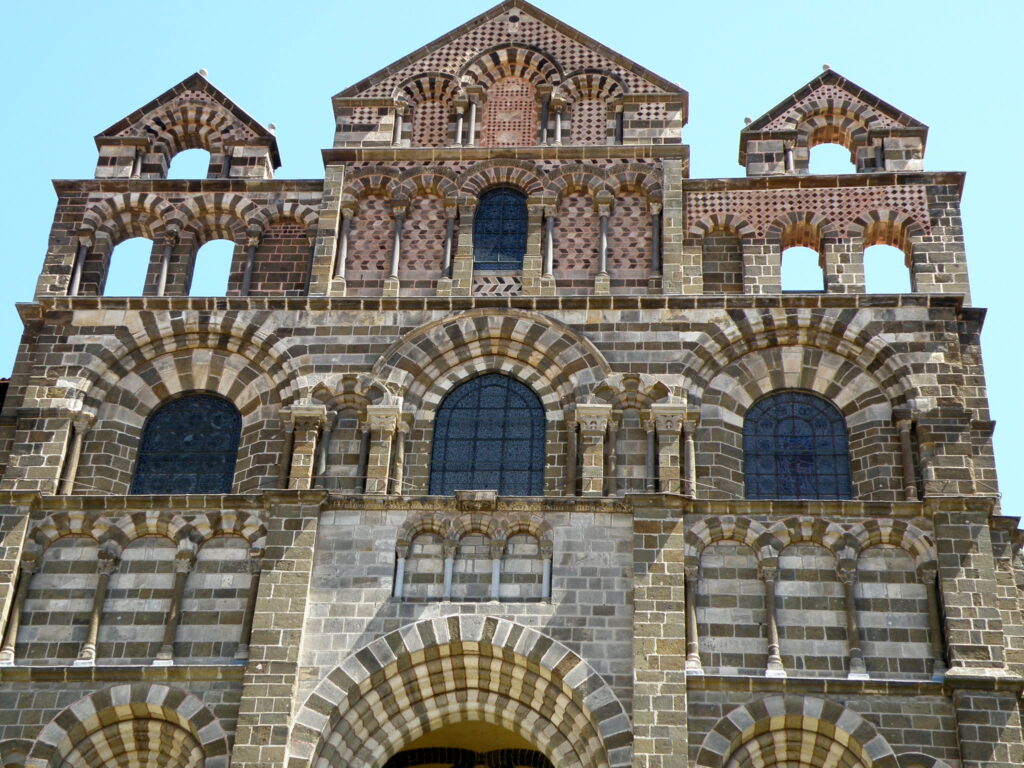
A monumental pilgrimage church rising from volcanic rock, Le Puy Cathedral has drawn devotees since before Charlemagne and stands as a layered testament to twelve centuries of Christian architecture.
At a glance
The Cathédrale Notre-Dame-de-l’Annonciation du Puy occupies the highest point of Le Puy-en-Velay, France’s Auvergne region, rising dramatically from the foot of Rocher Corneille. A national monument and UNESCO World Heritage Site, the cathedral serves as the seat of the Bishop of Le Puy and remains an active pilgrimage destination.
History
Le Puy Cathedral has functioned as a pilgrimage centre since at least the early medieval period—before Charlemagne’s reign. Over time it became a crucial stopover on the pilgrimage route to Santiago de Compostela in Spain, a role it maintains today.
In 1998, the cathedral was designated part of a multi-location UNESCO World Heritage Site honouring France’s Santiago pilgrimage routes, recognising its enduring spiritual and cultural significance.
What you see
The cathedral’s most striking feature is its theatrical siting: it rises from the base of a volcanic rock outcrop, dominating the city’s skyline. The bulk of construction dates from the first half of the 12th century, yet the building contains architectural elements spanning from the 5th to the 15th century.
This layering across centuries creates an unusual aesthetic—a palimpsest of Romanesque, Byzantine, and Gothic influences that gives the cathedral its distinctive individual character rather than unified stylistic coherence.
Cultural significance
As one of France’s oldest pilgrimage sites and a gateway to Spain’s spiritual routes, Le Puy Cathedral represents the intersection of medieval devotion and architectural ambition. Its elevation on volcanic rock transformed the building into both a spiritual landmark and an urban anchor, visible from across the city.
The cathedral embodies centuries of religious continuity and architectural evolution, making it essential to understanding medieval Christian practice and design across Western Europe.
Key facts
- Location: Le Puy-en-Velay, Auvergne, France
- Coordinates: 45.0456, 3.8847
- Status: National monument; UNESCO World Heritage Site (since 1998)
- Construction period: 5th–15th century (bulk built 12th century)
- Current function: Roman Catholic cathedral; seat of the Bishop of Le Puy
Practical information & getting there
Le Puy Cathedral is located in central Le Puy-en-Velay, atop a steep approach from the town below. As an active cathedral and major pilgrimage site, it remains open to visitors. For current visiting hours, admission details, and access information, consult local tourism resources or the cathedral’s official channels.
The cathedral’s Romanesque Black Madonna, carved in cedar, was burned by revolutionaries in 1794; another local Black Virgin was chosen to take its place above the high altar.
Sources & resources
Find it on the map
See this place and what’s around it →📷 Become a Cultural Heritage Online photographer
Share your photos of places: they stay published under your name as the author. The more they're seen, the more you get noticed — and soon a contest will reward the most appreciated photos.
Log in or sign up free to add a photoIs this page about you?
This page is read by travellers and heritage enthusiasts who find it on Google. Tell us how you are connected to this place and we will take it from there.
This entry stays online and free either way — and a free account lets you add to it yourself.