
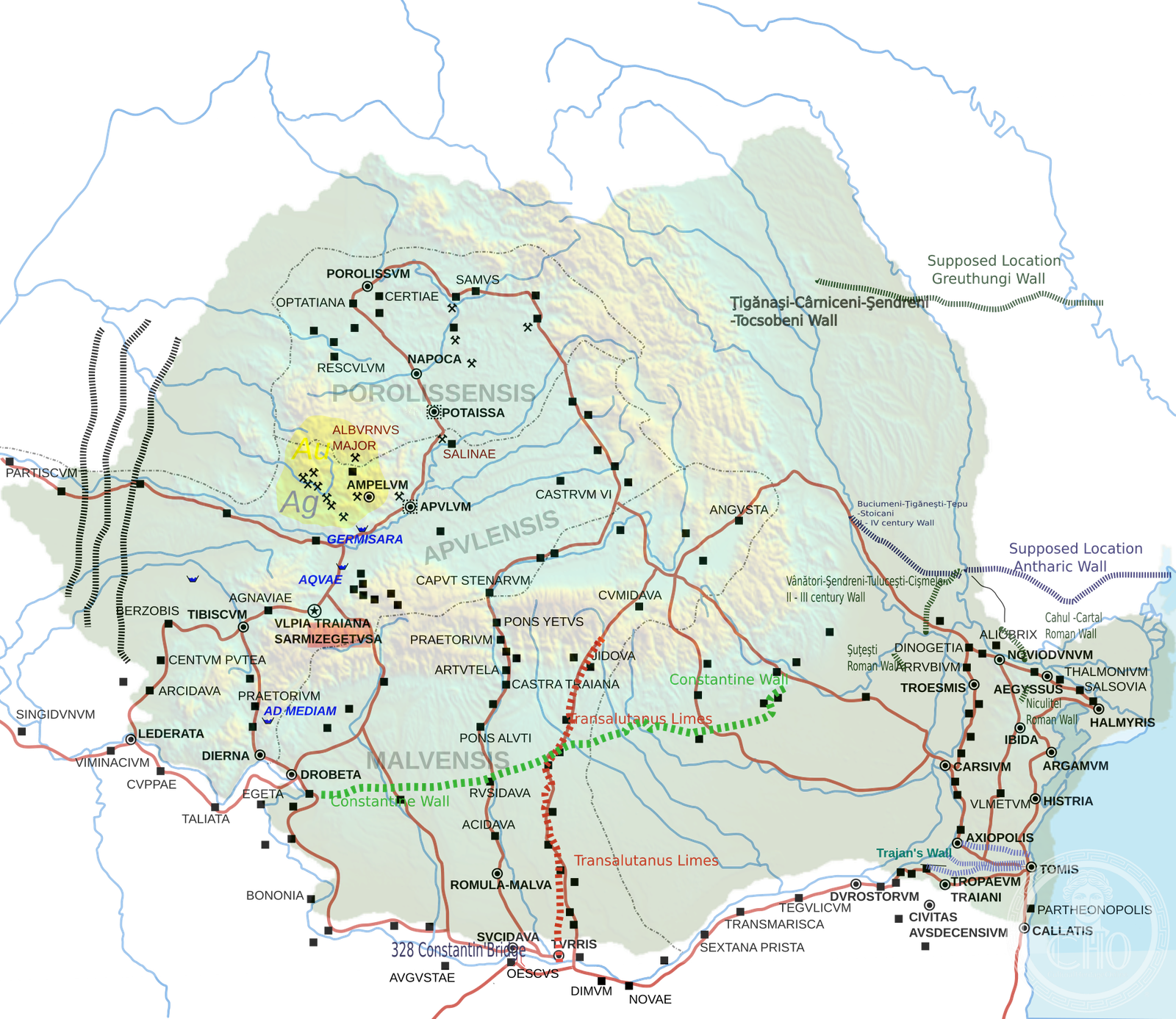
A vast network of Roman military fortifications stretching roughly 1,000 kilometers across the frontier of the province of Dacia, built from the early 2nd century to defend Rome’s northeastern territories.
At a glance
The Dacian Limes comprises ramparts and linked forts that once formed Rome’s eastern defensive line. Most structures consisted of earth ramparts approximately 3 meters high and 2 meters wide, similar in construction to the Antonine Wall in Britain. The system spanned multiple frontier lines across what is now Romania and Moldova.
History
Roman legions established these defenses in the early 2nd century AD following the conquest of Dacia. The network evolved over centuries, with some sections—notably the Constantine Wall, also known as Brazda lui Novac de Nord in Wallachia—constructed as late as around 330 AD. The frontier walls reflect Rome’s sustained military commitment to protecting its richest territorial acquisition in the Balkans.
What you see
The Dacian Limes comprises several named sections: the Limes Alutanus along the eastern Olt river; the Limes Porolissensis; and the Limes Transalutanus in Wallachia. Trajan’s Walls extend between Constanța and the Danube, including the Lower Trajan’s Wall (Athanaric’s Wall) north of the Danube delta in Moldova, and the Upper Trajan’s Wall (Greuthungi Wall) stretching between the Prut and Dniester rivers—though these may not be Roman in origin. The Constantine Wall extends approximately 300 kilometers.
Cultural significance
The Dacian Limes stands as testimony to Roman military engineering and imperial strategy. As a UNESCO World Heritage site, it represents one of the most extensive frontier systems of the Roman Empire and illustrates the scale of Rome’s defense infrastructure during its imperial zenith.
Key facts
- Country: Romania
- Period: Early 2nd–4th century AD
- Total length: Approximately 1,000 kilometers
- Construction: Primarily earth ramparts (3 m high, 2 m wide)
- UNESCO World Heritage Site: Yes
- Coordinates: 47.180789, 23.159411
Practical information & getting there
The Dacian Limes extends across multiple regions of Romania and Moldova. Visitors interested in Roman frontier archaeology should consult local tourism information for access to specific sections. The site’s dispersed nature means planning is essential for viewing multiple segments.
Sources & resources
Find it on the map
See this place and what’s around it →📷 Become a Cultural Heritage Online photographer
Share your photos of places: they stay published under your name as the author. The more they're seen, the more you get noticed — and soon a contest will reward the most appreciated photos.
Log in or sign up free to add a photo