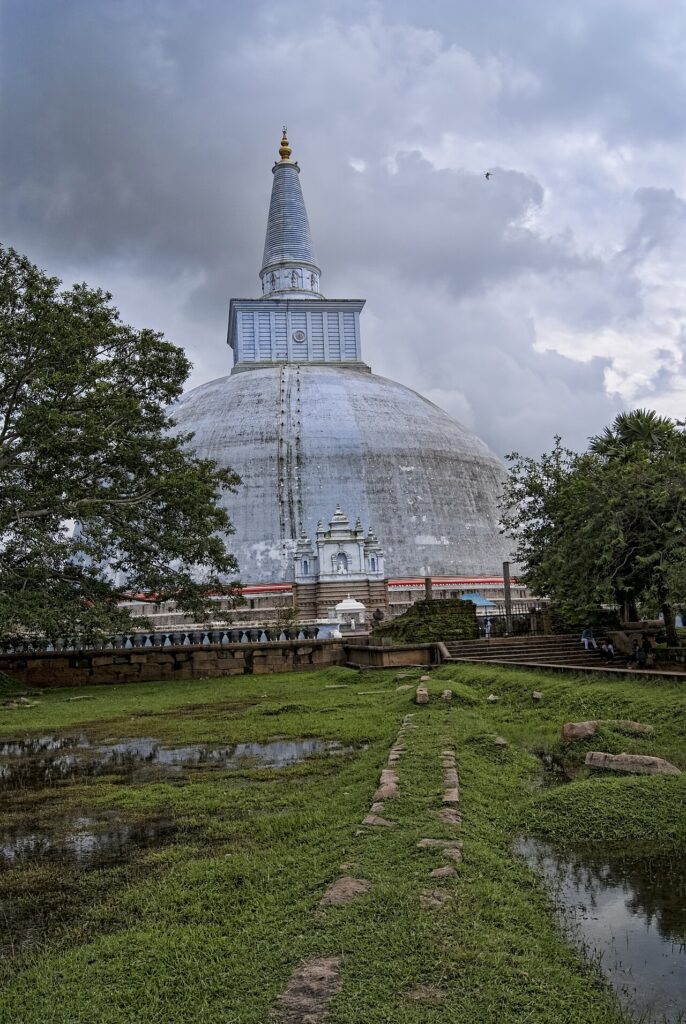
The Sacred City of Anuradhapura (ශ්රී ලංකා ශ්රී ලංකා — Sinhala: “Anuradhapura”), inscribed by UNESCO in 1982 as the first UNESCO World Heritage site in Sri Lanka, is the first and longest-lasting capital of ancient Ceylon (approximately 4th century BCE to 11th century CE — over 1,400 years of continuous occupation as the island’s primary political and religious capital) and the most sacred city in Theravada Buddhism after Bodh Gaya in India, containing within its ancient city limits (approximately 40 km²) the Bo tree (Jaya Sri Maha Bodhi — believed to be a sapling of the original Bodhi tree under which the Buddha attained enlightenment at Bodh Gaya, brought to Sri Lanka approximately 288 BCE by the nun Sanghamitta, daughter of the Emperor Ashoka, and now the oldest historically documented living tree in the world), eight major “dāgobas” (the Sinhala term for stupa — the hemispherical relic-mound type of the Sri Lankan Buddhist tradition, characterised by a white lime-plaster hemisphere on a circular drum, surmounted by a square harmika and spire) of which the four largest — the Ruwanwelisaya (103 m, built approximately 161–137 BCE by King Dutugemunu), the Jetavanaramaya (originally approximately 122 m, one of the tallest brick structures in the ancient world, built 273–301 CE by King Mahasena), the Abhayagiriya (115 m, built approximately 88–76 BCE), and the Thuparamaya (the oldest surviving dāgoba in Sri Lanka, approximately 19 m, built approximately 247 BCE by King Devanampiya Tissa, believed to contain the right clavicle of the Buddha and the first Buddhist monument built on the island after the introduction of Buddhism by Mahinda) — represent the most concentrated surviving collection of ancient Buddhist monumental architecture outside of India.
Anuradhapura’s ancient stupas and the Sri Lanka heritage corridor Ruwanwelisaya · Bo Tree · Jetavanaramaya · Polonnaruwa · Sigiriya — 0 to 100 km
The Anuradhapura UNESCO World Heritage site is a “sacred city” type — a large archaeological zone (approximately 40 km²) in which ancient monuments are distributed through a partially inhabited modern landscape, requiring the visitor to travel between major monument clusters rather than walking through a single compact monument area. The most significant monument clusters are: the Sacred Precincts (the central area around the Jaya Sri Maha Bodhi Bo tree and the adjacent Brazen Palace [Lohapasada] ruins — the Bo tree enclosure, where the original sapling planted approximately 288 BCE survives as a gnarled multi-stemmed tree protected by golden railings in a temple courtyard, and where thousands of Buddhist pilgrims pray daily, is the single most emotionally and spiritually charged Buddhist heritage site in Sri Lanka); the Mahavihara monastery complex (the principal monastery of Anuradhapura, founded approximately 4th century BCE, which became the centre of the Theravada Buddhist tradition of Sri Lanka and the source of the Theravada canonical scriptures in their current Pali form — the Tripitaka oral tradition was first committed to writing at the Aluvihare Cave near Matale approximately 29 BCE after a famine had reduced the monk population severely, creating the risk of the oral tradition being lost; the written Pali canon produced at Anuradhapura became the foundation of Theravada Buddhism in Myanmar, Thailand, Cambodia, and Laos as the tradition spread through mainland Southeast Asia); and the “Citadel” area (the secular administrative core of the ancient city, with the ruins of royal palaces and administrative buildings). The nearby Sacred Cities of Polonnaruwa (UNESCO 1982, approximately 100 km northeast — the second capital of ancient Sri Lanka, with the outstanding Gal Vihara rock-cut Buddha sculptures) and Sigiriya (UNESCO 1982, approximately 70 km east of Anuradhapura — the dramatic 5th-century royal palace on a vertical rock column) complete the triangle of ancient Sri Lanka’s most significant heritage sites.
Practical information
Anuradhapura is approximately 205 km north of Colombo (Sri Lanka’s commercial capital) by road (approximately 4.5 hours by bus or private vehicle) or by train (approximately 4.5 hours from Colombo Fort Station on the Northern Line). Anuradhapura has a small domestic airport (ADP) with occasional charter/domestic flights. The Archaeological Museum (within the sacred city area) and the Jetavanaramaya Museum (at the Jetavanaramaya stupa) provide context for the site. A combined ticket for the main archaeological monuments is available from the Sri Lanka Central Cultural Fund (SCCF) ticket offices at the main monument entry points. The site is large enough that a bicycle (hire available in town) is the recommended way to move between monuments efficiently. Pilgrimage etiquette: the Jaya Sri Maha Bodhi Bo tree area and the major stupas are active pilgrimage sites — visitors should dress modestly (shoulders and knees covered; white clothing is traditional for Sri Lankan pilgrims), remove shoes at religious sites, and avoid intrusive photography during worship. Best visiting months: January–April and August–September (dry season for the North Central Province — the monsoon October–December brings heavy rains). The Festival of Poson (Poya full moon of June, the anniversary of the introduction of Buddhism to Sri Lanka by Mahinda in 247 BCE) brings the largest annual pilgrimage to Anuradhapura, with the city lit by oil lamps overnight.
Frequently Asked Questions
What is the Bo tree of Anuradhapura and why is it considered the world’s oldest historically documented living tree?
The Jaya Sri Maha Bodhi (ජය ශ්රී මහා බෝධිය, “Victorious Sri Great Bodhi”) at Anuradhapura is a sacred fig tree (Ficus religiosa, the “pipal” tree, the species under which the historical Buddha Siddhartha Gautama attained enlightenment at Bodh Gaya in northeastern India approximately 528 BCE) that is believed to have been grown from a cutting of the original Bodhi tree at Bodh Gaya — the specific historical claim is that the nun Sanghamitta (the daughter of the Maurya Emperor Ashoka, who came to Sri Lanka in approximately 288 BCE to establish the Buddhist nuns’ order on the island) brought a southern branch of the original Bodhi tree as a living cutting to Sri Lanka, and that this cutting was planted in the Mahavihara at Anuradhapura by King Devanampiya Tissa in approximately 288 BCE where it has grown continuously since. The claim to the title “oldest historically documented living tree” rests on two components: (1) the tree is historically documented from a specific planting date (288 BCE) in continuous historical records (the Sri Lankan Buddhist chronicles, particularly the Mahavamsa and Dipavamsa — the Pali-language chronicles of Sri Lankan Buddhist history compiled approximately 4th–5th century CE — record the arrival of Sanghamitta and the planting of the Bo tree in considerable detail); (2) the documented historical continuity of care for the tree for 2,300 years (the tree has been continuously protected and tended by Buddhist monks and by successive Sri Lankan rulers — even the Portuguese colonial rulers in the 16th–17th century CE who destroyed many Buddhist monuments in Sri Lanka preserved the Jaya Sri Maha Bodhi). Other ancient trees around the world (some bristlecone pines in California are biologically older — approximately 5,000 years) are not historically documented from a specific planting event and specific date; they are known to be old through biological measurement (dendrochronology) but not through continuous historical records. The Anuradhapura Bo tree’s specific distinction is that it is documented — not merely estimated — to have been growing at its current location since 288 BCE, making it the only tree in the world whose planting in a specific year is recorded in independently verifiable historical sources. The original Bodhi tree at Bodh Gaya in India was destroyed (by the Pala Empire King Pushyamitra Shunga approximately 185 BCE, by the Brahmanical ruler Shasanka approximately 600 CE, and again by accidental fire in 1876 CE) and the current tree at Bodh Gaya is itself a descendant of the Sri Lanka cutting — making the Anuradhapura tree the senior branch of the original lineage, and the “mother tree” of the current Bodh Gaya Bodhi tree.
What happened to Anuradhapura and why was it abandoned as Sri Lanka’s capital?
The decline of Anuradhapura as the capital of Sri Lanka was a gradual process spanning approximately the 7th to 11th centuries CE, driven by two interacting factors: the repeated invasions from South India (primarily from the Chola, Pandya, and Pallava kingdoms of the Tamil-speaking South Indian region) that disrupted the hydraulic agricultural system of the North Central Province on which Anuradhapura’s rice-growing economy depended, and the internal political fragmentation of the Sinhalese kingdoms that made it increasingly difficult to maintain the elaborate tank-irrigation system (the network of approximately 2,000 man-made irrigation reservoirs — “tanks” — that had been constructed over the 1,000-year history of Anuradhapura and that stored monsoon runoff for dry-season irrigation of the paddy fields of the North Central Province) and the concentrated urban population of the capital. The final collapse of Anuradhapura’s capital function occurred approximately 1017 CE when the Chola Emperor Rajendra I conquered the entire island, sacked Anuradhapura, took the relic of the Tooth of the Buddha (the Dalada, the primary state palladium of Sinhalese kingship) as a war trophy to South India, and established the Chola administration at Polonnaruwa (approximately 100 km northeast of Anuradhapura, on a more defensible river site). The Sinhalese kingdom recovered (the Tooth of the Buddha was later returned by a subsequent dynastic arrangement) and Polonnaruwa became the new Sri Lankan capital from approximately 1017 CE to approximately 1200 CE. After the fall of Polonnaruwa (approximately 1235 CE, following another South Indian invasion and the collapse of the North Central Province’s irrigation system due to decades of political instability), the Sinhalese capitals moved progressively southward and westward (to Dambadeniya, Yapahuwa, Kurunegala, Gampola, Kotte, Kandy) away from the exposed northern plains and toward the more defensible coastal and upland regions of Sri Lanka. Anuradhapura was not permanently abandoned — it remained a pilgrimage centre for Theravada Buddhists throughout the medieval and colonial periods — but it ceased to be an inhabited city and became an overgrown archaeological site by approximately the 15th–16th century CE. The British colonial administration’s discovery of the site in the 19th century (the first systematic British description of Anuradhapura’s ruins was published by John Davy in 1821 CE) and the subsequent restoration work of H.C.P. Bell (Archaeological Commissioner of Ceylon, active 1890–1912 CE) revealed the ruins of the ancient city and began the process of heritage preservation that culminated in the 1982 UNESCO inscription.
EXCERPT: Sacred City of Anuradhapura, Sri Lanka, UNESCO-inscribed 1982, was 1,400 years (4th century BCE–11th century CE) the first capital of ancient Ceylon — the Jaya Sri Maha Bodhi Bo tree (288 BCE, oldest documented living tree), the 103-metre Ruwanwelisaya stupa, the Pali Buddhist canon committed to writing here in 29 BCE, and the original source of Theravada Buddhism for all of Southeast Asia.
META: UNESCO World Heritage Sites near Sacred City of Anuradhapura Sri Lanka: Ancient City of Polonnaruwa 100 km northeast (UNESCO 1982), Ancient City of Sigiriya 70 km east (UNESCO 1982), Sacred City of Kandy 150 km south (UNESCO 1988) — Anuradhapura Sri Lanka UNESCO 1982, Bo tree Jaya Sri Maha Bodhi oldest living tree, Ruwanwelisaya Jetavanaramaya stupa, Theravada Buddhism Mahavihara Pali canon, Sanghamitta Sangha Mahinda 288 BCE.
Sources
- S1 — UNESCO World Heritage Centre — Sacred City of Anuradhapura (Ref. 200) — https://web.archive.org/web/20230601000000/https://whc.unesco.org/en/list/200/
- S2 — UNESCO World Heritage Centre — Statement of Outstanding Universal Value (Ref. 200) — https://whc.unesco.org/en/list/200/
Spotted an error? Write to the editors and we correct it the same day.