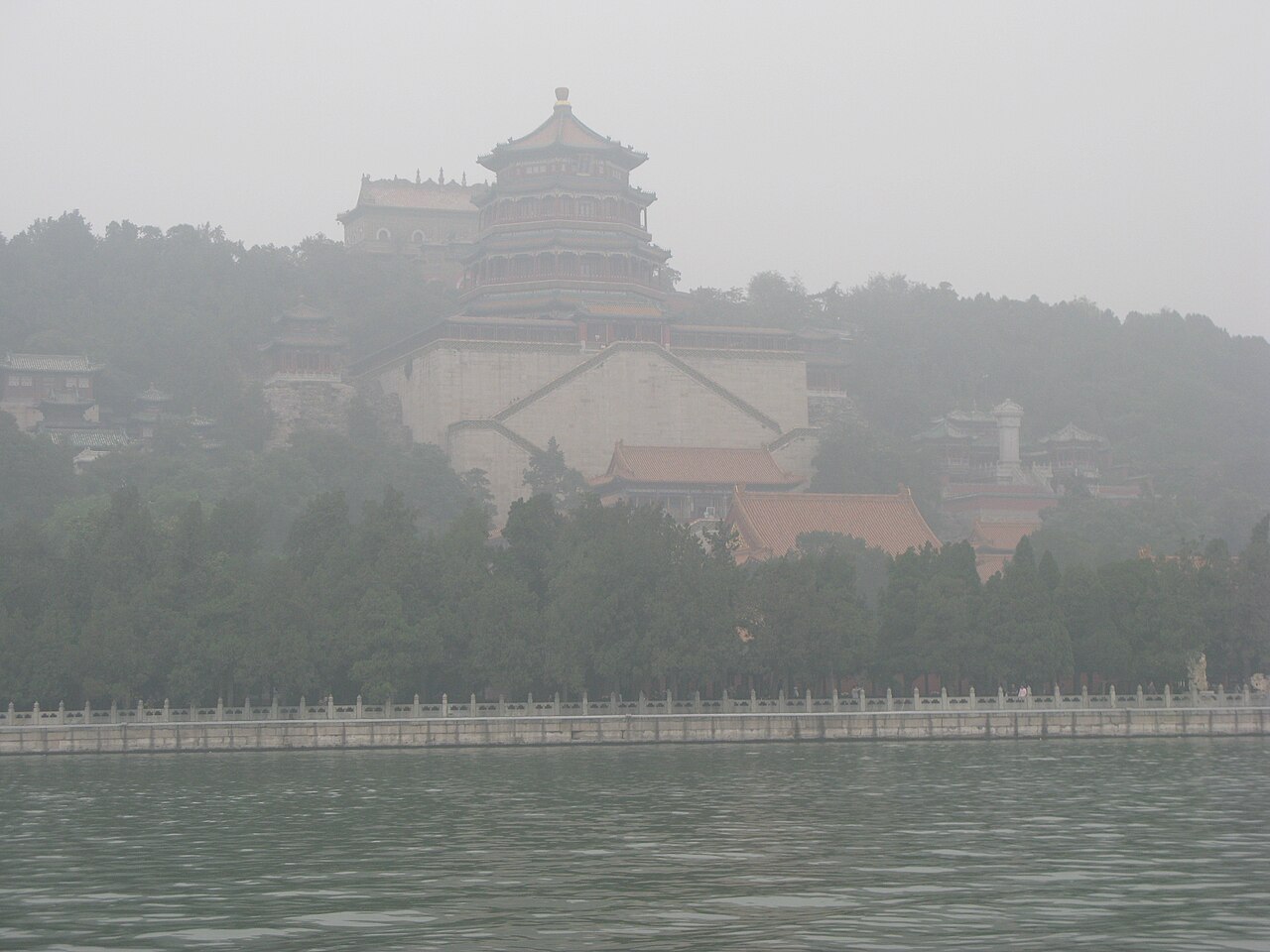
The Summer Palace (Yiheyuan), inscribed by UNESCO in 1998, is the largest and best-preserved imperial garden in China: a 2.9-square-kilometre landscape complex in Haidian District, northwest Beijing, centred on the artificial Kunming Lake (approximately 2.2 square kilometres) and Longevity Hill (58 metres above the lake), built by the Qing Emperor Qianlong (r. 1735–1796 CE) beginning in 1750 as the “Garden of Clear Ripples” (Qingyi Yuan) and rebuilt by Empress Dowager Cixi (r. 1861–1908 CE) after Anglo-French destruction in 1860 and Western Allied looting in 1900, acquiring its current name Yiheyuan (“Garden of Cultivated Harmony”) in 1888. The Summer Palace inscription recognises the site as the masterpiece of Chinese imperial garden design — integrating natural topography (the pre-existing natural lake and hill, enhanced by excavation and construction), classical Chinese architecture (the Long Corridor, 728 metres of roofed walkway with 14,000 painted scenes on its beams and ceiling; the Marble Boat pavilion; the Tower of Buddhist Incense on Longevity Hill’s south slope), and a comprehensive landscape philosophy that treats the entire 2.9-square-kilometre complex as a single aesthetic composition rather than a collection of separate elements.
Beijing’s imperial landscape circuit: gardens, palaces, and walls Forbidden City · Old Summer Palace · Ming Tombs — 10 to 65 km
Fifteen kilometres southeast of the Summer Palace by subway (approximately 40 minutes from Longevity Hill area to Tiananmen Square via Line 4 and Line 1), the Imperial Palaces of the Ming and Qing Dynasties — the Forbidden City (inscribed 1987) — are the formal administrative centre whose imperial residents escaped to the Summer Palace for the five summer months each year (May–September). The Summer Palace functioned as a genuine secondary capital during the Qing period, not merely a recreational escape: both Emperors Qianlong and Cixi conducted substantial court business from the Summer Palace during the summer months, receiving ambassadors, signing edicts, and holding audiences in the Renshou Hall and the Jade Ripple Hall (Yulantang, where the young Guangxu Emperor was imprisoned by Cixi after the 1898 Hundred Days’ Reform). The relationship between the two sites — the Forbidden City as winter-spring formality, the Summer Palace as summer-autumn informality — structured the Qing court’s annual calendar for 150 years (1750–1900). The architectural contrast between the two is deliberately maintained: the Forbidden City uses red walls, yellow glazed tiles, and axial symmetry to express imperial authority; the Summer Palace uses grey stone, painted wood, and asymmetric naturalistic composition to express imperial cultivation. From the Summer Palace (East Gate), the Forbidden City (Tiananmen Square/Meridian Gate) is reached by subway Line 4 to Xidan and Line 1 to Tiananmen East (approximately 40 minutes).
Five kilometres northwest of the Summer Palace by road (approximately 20 minutes by taxi or bus 375), the Ruins of the Old Summer Palace (Yuanming Yuan, “Garden of Perfect Brightness”) document the full ambition of the Qing imperial garden-building programme before its destruction. The Yuanming Yuan was begun by Emperor Kangxi (r. 1661–1722 CE) and expanded by Emperors Yongzheng (r. 1722–1735) and Qianlong into a 3.5-square-kilometre complex of 140 individual garden scenes, 40 scenic halls, and (in the European Section, Xiyang Lou) a suite of Baroque-style stone palace buildings designed by the Jesuit court painters and architects Giuseppe Castiglione and Michel Benoist at Qianlong’s commission (1747–1760) — the only Chinese-imperial example of Baroque architecture in China. The European Section ruins (fountains, arcade facades, throne room ruins) are the most visited part of the current site after the Anglo-French military force burned the Yuanming Yuan in October 1860 to punish the Qing court for the detention and death of a British-French diplomatic mission; the burning was ordered by Lord Elgin (James Bruce, 8th Earl of Elgin) as a deliberate destruction of personal imperial property rather than a military target. The ruins, left in their damaged state, are now maintained as a monument to the losses of the Second Opium War and are among the most emotionally charged sites in Chinese historical memory. From the Summer Palace East Gate, the Yuanming Yuan East Gate is a 20-minute walk.
Sixty-five kilometres north of the Summer Palace by road (approximately 1.5 hours from Haidian District to Changling, or 2 hours by suburban rail from Xizhimen to Changping North then bus), the Imperial Tombs of the Ming and Qing Dynasties (inscribed 2000) — specifically the Ming Tombs at Changling — are accessed from the same northwestern Beijing corridor as the Summer Palace and typically combined as a day trip. The Changling Mausoleum (construction 1409–1427, tomb of the Yongle Emperor), whose 1,200-metre Sacred Way lined with 36 stone figures (12 animal pairs, 6 human pairs) sets the template for all subsequent Ming and Qing imperial tomb approaches, is the most architecturally significant single component of the 13 Ming Tombs. The Dingling Mausoleum (tomb of the Wanli Emperor, died 1620) is the only underground chamber open to visitors; the excavation of 1956–1958 (directed by Zheng Zhenduo and Wu Han) yielded the Emperor’s crown, the gold crowns of the two Empresses, more than 3,000 burial objects, and the silk court robes — all now in the Dingling Museum. From the Summer Palace, the Ming Tombs are most efficiently reached by taxi or hired car to Changling (approximately 1 hour directly or 1.5 hours via the planned tourism circuit including Badaling Great Wall).
Fourteen kilometres northwest of the Summer Palace by road (approximately 30 minutes by bus 374 to the Fragrant Hills area), the Fragrant Hills Park (Xiangshan Park) — not UNESCO-inscribed but historically the third element of the Qing “Three Hills and Five Gardens” complex (Sanshanwuyuan) — completes the imperial landscape circuit of northwestern Beijing. The “Three Hills and Five Gardens” concept (the Summer Palace, Old Summer Palace, Jingyi Yuan at Fragrant Hills, plus two smaller complexes) describes the totality of the Qing imperial garden-building effort in the Haidian area, which transformed the entire northwestern Beijing landscape into a designed imperial parkland from 1730 to 1860. Fragrant Hills Park contains the Xiangshan Temple (founded 1186), the Biyun Temple (1331, reconstructed 1748) with its Diamond Throne Pagoda (Jingang Baozuo Ta, 1748, a Chinese version of the Indian diamond throne pagoda type), and the red maple forest that makes the park the most visited site in Beijing during October’s autumn colour season. From the Summer Palace West Gate, Fragrant Hills is accessible by bus 331 or 334 (approximately 30 minutes).
Beyond Beijing: the Great Wall corridor and the Qing heartland Badaling Great Wall · Chengde · Eastern Qing Tombs — 75 to 230 km
Seventy-five kilometres northwest of the Summer Palace by high-speed rail (approximately 20 minutes from Beijing North Station to Badaling on the Badaling HSR, opened 2019), the Great Wall of China (inscribed 1987) at Badaling is the most visited and most completely restored section of the Ming Great Wall — 3.7 kilometres of double-rampart wall on steep ridgeline terrain with eight guard towers (wanglou), fully accessible via foot, cable car, and toboggan descent. The architectural relationship between the Summer Palace and the Great Wall is the scope of the Qing imperial investment in the landscape northwest of Beijing: both the Summer Palace’s lake expansion (Qianlong excavated Kunming Lake to its current 2.2-square-kilometre size from a smaller existing water body, using the excavated earth to raise Longevity Hill to its current height of 58 metres) and the Great Wall’s major Ming restoration programme (the main construction period 1368–1644 covers the same era as the Summer Palace’s predecessor site, the Qinghua Yuan of the Ming prince Zhu Junzhang) were projects of imperial control of the same northwestern corridor that the Mongol cavalry had used to threaten Beijing in the 13th century. The Summer Palace’s Kunming Lake was originally a reservoir feeding the imperial canal system that supplied Beijing from the northwest — the lake’s military-logistical origin is the same as the Great Wall’s defensive function in the same direction. From the Summer Palace (Haidian), Badaling is reached by subway to Beijing North (Line 4) then HSR to Badaling (total approximately 55 minutes).
Two hundred thirty kilometres northeast of the Summer Palace by high-speed rail (approximately 2 hours from Beijing Station to Chengde on the Chengde HSR, opened 2021), the Mountain Resort at Chengde (inscribed 1994) is the Qing imperial summer resort that preceded the Summer Palace’s current form as the primary escape from the Beijing summer heat. The Chengde Mountain Resort (Bishu Shanzhuang, “Mountain Resort for Escaping the Summer Heat”) was established by Emperor Kangxi in 1703 and expanded under Qianlong into a 5.6-square-kilometre complex of palaces, temples, and landscaped grounds — the largest imperial garden in China by area (compared to the Summer Palace’s 2.9 square kilometres) but less intensively built, using natural forested mountain terrain where the Summer Palace used a constructed lake-and-hill landscape. The Outer Eight Temples (Waibamiao) surrounding the Chengde resort — including the Puning Temple (1755, containing the largest wooden Buddhist statue in the world, a 27.21-metre Guanyin) and the Putuo Zongcheng Temple (1767, a deliberate architectural quotation of the Potala Palace in Lhasa) — document Qianlong’s strategy of incorporating the material culture of China’s inner Asian borderlands (Tibetan Buddhism, Mongolian steppe) into the imperial landscape programme at Chengde. From the Summer Palace, Chengde is reached by high-speed rail from Beijing Station (approximately 2 hours on the recently opened Chengde HSR).
One hundred twenty kilometres east of the Summer Palace by road (approximately 1.5 hours from Beijing to Zunhua, Hebei Province), the Eastern Qing Tombs (Qing Dongling, part of the Imperial Tombs inscription, extended 2000) document the funerary architecture of five Qing emperors — Shunzhi (d. 1661), Kangxi (d. 1722), Qianlong (d. 1799), Xianfeng (d. 1861), and Tongzhi (d. 1875) — whose reigns encompass the entire construction history of the Summer Palace in its Qianlong-Cixi form (1750–1902). The largest single tomb at the Eastern Qing Tombs is Qianlong’s Yuling (completed 1800), whose underground chambers (accessible to visitors) are lined with Tibetan Buddhist scriptural texts carved into the stone walls — the same Tibetan Buddhist iconographic programme that Qianlong incorporated into the Summer Palace’s Tower of Buddhist Incense (Foxiangge, 1750, the 41-metre pavilion that anchors Longevity Hill’s south slope) and the Chengde outer temples. The geographic relationship between the Summer Palace (northwest Beijing), the Ming Tombs (north Beijing), and the Eastern Qing Tombs (east Beijing) is the imperial landscape circuit of the capital: the living palace in the centre, the summer escape to the northwest, and the funerary landscape to northeast and north. From Beijing, the Eastern Qing Tombs are best reached by private car or tourist bus (approximately 1.5 hours from central Beijing).
Practical information
The Summer Palace is in Haidian District, approximately 12 kilometres northwest of central Beijing. The primary access point is the East Gate (Dongmen), reached from Beijing’s subway network via Line 4 to Beigongmen Station (North Palace Gate) or Xiyuan Station (East Gate area), approximately 40 minutes from Tian’anmen Square. Tourist boats operate on Kunming Lake from Nanruyi Dock (south lake) to Shicheng Dock (Stone Boat area) and to the Long Corridor embarkation point — lake-crossing boats allow visitors to experience the Summer Palace’s designed waterscape from the water level (approximately ¥30–50 per ride). The Long Corridor (Changlang) runs 728 metres along the north shore of Kunming Lake from Inviting Moon Gate (Yao Yue Men) to Shizhang Pavilion; the 14,000 painted scenes on its roof beams (landscape, mythology, folk tales, daily life) are the largest extant continuous narrative painting programme in China. The Tower of Buddhist Incense (Foxiangge) on Longevity Hill is accessed by stairway or cable car; the view from the terrace looks south over Kunming Lake toward the arched Jade Belt Bridge (Yuhe Qiao) and the distant western mountains. Full coverage of the Summer Palace requires 1 full day; combining with the Ruins of the Old Summer Palace (15-minute walk) requires an additional half-day. Best visiting seasons: April (peach and cherry blossoms on Longevity Hill), June–September (lotus flowers in bloom on Kunming Lake), late October–November (autumn colour on Longevity Hill, ice-skating preparation on Kunming Lake in November). Winter skating on Kunming Lake (when frozen) is a Beijing tradition; the Summer Palace with snow on the Long Corridor’s tile roof is one of the most photographed winter scenes in Chinese heritage tourism.
Frequently Asked Questions
Who built the Summer Palace and how did it acquire its current form under Empress Dowager Cixi?
The Summer Palace’s current form is the product of two main construction campaigns separated by 110 years of destruction and reconstruction. The first campaign, under Emperor Qianlong (1750–1764), created the “Garden of Clear Ripples” (Qingyi Yuan) by expanding a natural lake into the current Kunming Lake (through excavation that created Longevity Hill from the displaced earth), constructing the Long Corridor, the Tower of Buddhist Incense, and 20 principal temple and palace complexes on and around Longevity Hill. The second destruction occurred in October 1860, when British and French troops burned the Qingyi Yuan as part of the coordinated destruction of the Yuanming Yuan Old Summer Palace — both complexes were looted and burned in two days of systematic destruction; the Summer Palace’s wooden pavilions burned more thoroughly than the Old Summer Palace’s stone European Section ruins. Emperor Tongzhi (r. 1861–1875) attempted a partial reconstruction in 1873–1874 but ran out of funds; the project was abandoned. Empress Dowager Cixi (effective ruler 1861–1908) undertook the major reconstruction in 1886–1902 using funds originally designated for modernising the Qing Navy — the Marble Boat (Qingyan Fang), a stone riverside pavilion on Longevity Hill’s shoreline, is the most cited symbol of this diversion of naval funds to garden construction. After French and allied troops looted the palace again during the Boxer Rebellion suppression (1900), Cixi’s final reconstruction (1902–1908) is essentially the Summer Palace as visitors experience it today. The palace opened to the public as a park in 1924 after the Republic of China expelled the former Qing Emperor Puyi from the Forbidden City.
What is the Long Corridor and how were its 14,000 paintings created?
The Long Corridor (Changlang, 长廊) is a 728-metre roofed walkway along the north shore of Kunming Lake — the longest painted covered corridor in the world according to the Guinness World Records — connecting the East Main Gate area to the Marble Boat pavilion at the western end of the lake shore. The corridor is constructed in the standard Qing garden walkway form: a single-ridge tiled roof supported on paired columns with interlocking carved brackets, the beams and underside of the roof covered with painted panels. The 14,000 painted scenes on the Long Corridor’s beams were executed by court painters during the Qianlong reconstruction (18th century) and restored or repainted during Cixi’s reconstruction (late 19th century); the scenes fall into five categories — landscapes of the Jiangnan region (the Yangtze Delta’s famous scenic views, particularly Suzhou and Hangzhou), mythological narratives (Journey to the West, Romance of the Three Kingdoms, Dream of the Red Chamber — the four great classical Chinese novels), bird-and-flower compositions, Daoist immortal scenes, and folk stories. The Long Corridor functions as both a practical weather protection (linking all the shore buildings without exposure to rain or summer sun) and a narrative programme: walking the full 728-metre length from east to west while reading the painted scenes amounts to a survey of classical Chinese literature, mythology, and landscape aesthetics as understood by the Qing imperial court. No two panels are identical; the 14,000 composition count is verified by the Summer Palace Museum’s catalogue. The corridor’s dimensions — 4 metres high, 2.6 metres wide — allow four abreast with the painted programme visible at head height on either side.
Why was the Summer Palace built northwest of Beijing rather than elsewhere and what is its water management significance?
The Summer Palace site was chosen in part because the Wengshan area (the pre-existing hill renamed Longevity Hill) and the Wenshan Lake (the pre-existing lake later enlarged to Kunming Lake) were already part of the natural water management system that fed Beijing’s imperial canals. The Yuan dynasty had engineered a canal system (1292 CE, under the engineer Guo Shoujing) that diverted water from the Baifu Spring in Changping, through the Wengshan area, south along what is now the Kunming Lake, and into the canal system supplying the capital — making the Wengshan/Wenshan area the upstream reservoir of the entire Beijing water supply. Qianlong’s 1749–1750 decision to expand the lake and landscape the hill was partly justified as a reservoir improvement project: by enlarging the lake, the Qianlong administration increased the effective water storage capacity for the capital’s canal system. The cover of the reservoir improvement project (public benefit) over the imperial garden project (private pleasure) was a standard Qing rhetorical strategy for justifying large construction expenditures; the actual balance between the reservoir function and the garden function was approximately 40:60 in terms of engineering investment. The northwest direction from Beijing was also militarily strategic: the Mongol threat (which had prompted the Great Wall’s construction) came from the north and northwest, and placing the imperial summer residence on the same axis as the main defensive line (the Great Wall at Badaling, due north) meant that the imperial court could monitor the northern approach routes from its summer location. The Qing emperors’ choice to make the Summer Palace their genuine administrative base for five months per year (not merely a vacation retreat) reinforced the logic of the northwest placement as a command position over both the Great Wall corridor and the canal system.
Sources
- S1 — UNESCO World Heritage Centre — Summer Palace, an Imperial Garden in Beijing (Ref. 880) — https://web.archive.org/web/20230601000000/https://whc.unesco.org/en/list/880/
- S2 — UNESCO World Heritage Centre — Statement of Outstanding Universal Value (Ref. 880) — https://whc.unesco.org/en/list/880/
Spotted an error? Write to editorial@culturalheritageonline.com and we correct it the same day.