Manas Wildlife Sanctuary in Assam is the only UNESCO World Heritage Site in India to have been placed on the In-Danger list, kept there for nineteen years, and then removed — not because the threat passed quietly but because an armed insurgency that used the forest as a base was eventually suppressed, allowing a slow ecological reconstruction to begin. Listed in 1985, inscribed as In-Danger in 1992, removed from In-Danger in 2011, Manas now holds more than 50 greater one-horned rhinoceros reintroduced from Kaziranga, along with golden langurs found nowhere else on earth, and a border with Bhutan Royal Manas National Park across the Manas River that makes it one of the largest transboundary conservation areas in South Asia.
Nineteen years on the In-Danger list: how Bodo insurgency dismantled and recovery rebuilt a UNESCO site Manas, Assam / Bodoland Territorial Region
The UNESCO In-Danger inscription came in 1992, seven years after listing. The cause was not a natural catastrophe but a political one: the Bodo Liberation Tiger Force (BLTF), an armed separatist organisation fighting for a homeland for the Bodo tribal people of Assam, established operational bases inside the Manas forest reserve in the late 1980s and early 1990s. The sanctuary’s terrain — dense riverine forest, hills at the Bhutan border, limited road access — made it suitable cover for an insurgent group that needed to avoid army operations in the Brahmaputra plains.
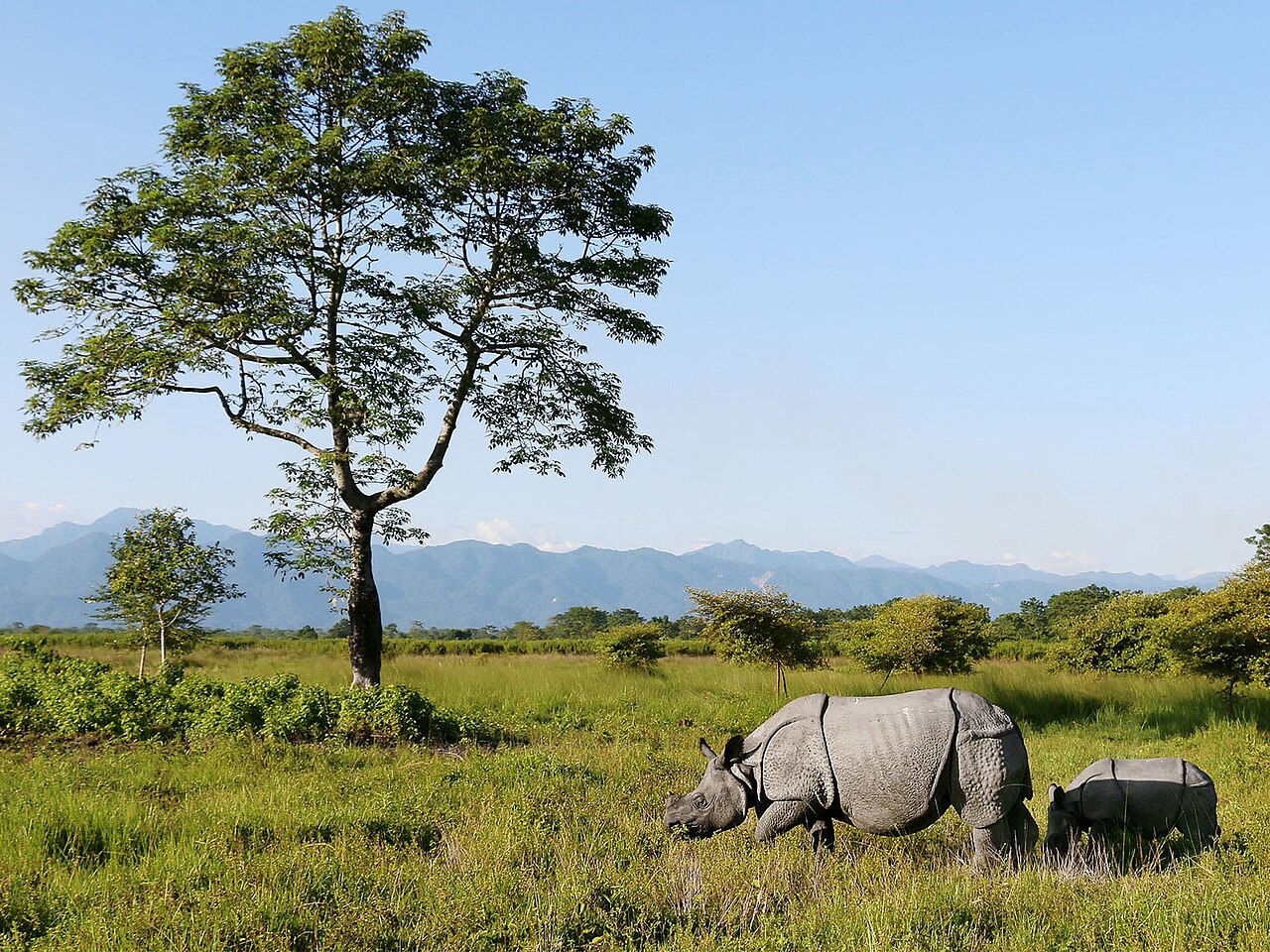
The consequences for wildlife were catastrophic. Forest Department anti-poaching staff were evacuated from the park when it became too dangerous to operate. Poachers who had previously been deterred entered without resistance. The greater one-horned rhinoceros population, which stood at approximately 70 animals in the early 1980s, was hunted to near-zero; estimates from the mid-1990s put the number at fewer than 10. Elephants were killed for ivory. Wild buffalo were taken for meat. The forest infrastructure — guard posts, patrol routes, radio equipment — was destroyed or abandoned. UNESCO placed the site on the In-Danger register citing the near-total collapse of the management system and the severe reduction in the populations of species that had justified its listing.
The insurgency wound down progressively through the 2000s following a ceasefire agreement between the Bodo factions and the Indian government. By 2003, most armed activity inside the sanctuary had ceased, and the Forest Department began cautious re-entry. The reconstruction programme that followed was unusually methodical. New guard posts were built. Community engagement programmes brought Bodo villagers adjacent to the park into employment as forest guards and naturalist guides, converting former adversaries into stakeholders in the sanctuary’s survival. The flagship recovery operation was the rhino reintroduction from Kaziranga beginning in 2008 — a multi-year programme that used veterinary immobilisation and careful translocation to bring breeding animals to Manas, where they were released into areas of the park where habitat quality had partially recovered. By 2022 the population had reached approximately 50 animals. UNESCO removed Manas from the In-Danger list in 2011, formally recognising that the management system had been restored and that wildlife populations were recovering.
The nineteen years between 1992 and 2011 represent the longest In-Danger period for any Indian UNESCO site. The recovery is not complete — rhino numbers remain far below historical levels, and some mammal populations have not recovered — but the trajectory is positive enough that the park now receives regular visitors and operates structured wildlife safaris. The story is unusual in UNESCO conservation history because the threat was human-political rather than developmental or environmental, and the solution involved a combination of political negotiation, community integration, and cross-park species transfer.
The sanctuary covers 500 sq km in India, but sits within the much larger Manas Tiger Reserve (2,837 sq km including buffer zones). It holds Project Tiger, Project Elephant, and UNESCO Biosphere Reserve designations simultaneously — a multi-designation combination that reflects the density of protected status the Indian government has applied to the landscape since the 1970s. The core UNESCO zone is the 500 sq km sanctuary, but the effective ecological unit is the entire transboundary complex including Bhutan Royal Manas National Park to the north.
The golden langur, the river border, and Kaziranga 200km east Bhutan border / Kaziranga 200km east
The golden langur (Trachypithecus geei) is found in exactly two places in the world: Manas Wildlife Sanctuary in Assam, and Bhutan Royal Manas National Park immediately across the Manas River. It occurs nowhere else. The animal was unknown to Western science until 1953, when the naturalist E.P. Gee documented it and named it after himself. Its distinctive appearance — silky golden or cream fur (darker in the wet season, paler and more intensely golden in the dry season), a black face, and a very long tail — makes it immediately distinguishable from other langur species in the region. It is classified as Endangered on the IUCN Red List, with a total wild population estimated at approximately 6,000–7,000 animals across its tiny range.
The Manas River itself forms the international border between India and Bhutan at this point. On the north bank, Bhutan Royal Manas National Park covers approximately 1,023 sq km of Himalayan foothills terrain, ranging from Terai grassland at 100m elevation to subtropical and temperate forests at 3,000m. The two parks — Indian Manas and Bhutan Royal Manas — are ecologically contiguous. Tigers, elephants, clouded leopards, fishing cats, and the golden langur move across the river; the population dynamics of several species are linked across the international boundary. Coordinated anti-poaching patrols between Indian and Bhutanese authorities have been a feature of management since the 1990s, though the operational relationship between the two services is constrained by the formal nature of the international border.
Bhutan Royal Manas is not a UNESCO World Heritage Site separately — the Indian Manas is — but the transboundary ecosystem is sometimes discussed in conservation planning documents as a candidate for a future transboundary UNESCO inscription, a designation that exists for several other cross-border protected areas globally (the Waterton-Glacier complex between the US and Canada, for instance). As of 2026 no formal proposal has been submitted.
Kaziranga National Park, 200km to the east of Manas, is the direct source of the animals now repopulating the rhino population at Manas. The logistical and biological relationship between the two parks gives Manas a position in the Assam conservation system analogous to a satellite — smaller, dependent on Kaziranga’s stock for initial recovery, but now beginning to build a self-sustaining population. For visitors travelling through Assam, the two parks are reasonably combinable: Guwahati, the regional hub, lies roughly equidistant between them (90km west of Manas, 220km west of Kaziranga), and the NH27 highway provides road access to both.
Species of note at Manas beyond rhinos and golden langur include: clouded leopard, tiger, Asian elephant, wild water buffalo, pygmy hog (one of the world’s smallest pig species, critically endangered), hispid hare, Bengal florican (critically endangered bustard), and several hundred bird species. The pygmy hog is a particular conservation target at Manas: a captive breeding programme operated by the Wildlife Trust of India has released animals here as part of a recovery effort, as Manas is one of the very few sites where suitable tall-grass habitat persists.
Practical information
Manas Wildlife Sanctuary’s main access point is Mathanguri, approximately 23km from the park entry gate at Barpeta Road. The nearest significant town is Barpeta Road, on the Assam rail network (trains from Guwahati take approximately 2.5 hours; the station is called Barpeta Road Junction). From Guwahati, road travel takes roughly 3–3.5 hours (180km). Guwahati is the nearest international-standard airport, with connections to Delhi, Mumbai, Kolkata, and Bangkok.
The park is open from October to April; the monsoon season (May to September) closes the main safari routes. Entry fees (2024): Indian nationals ₹50, foreign visitors ₹500, plus fees for jeep and elephant safaris arranged through the Forest Department or licensed lodges. Accommodation at Manas is more limited than at Kaziranga: options include the Mathanguri Forest Lodge (bookable through Assam Forest Department), and a small number of private eco-lodges near the park boundary. Advance booking is strongly recommended during December–February peak season.
Safari jeeps operate in the morning (5:30–9:30) and afternoon (14:00–17:00) slots from Mathanguri. Elephant safaris, where available, access grassland areas unsuitable for jeeps. Golden langur sightings are most reliable in the forested areas near the Bhutan border — guides know the territories of resident troops. Rhino sightings in the grassland zones near the Manas River are possible but less reliable than at Kaziranga; the population is still in recovery and the animals are more widely dispersed across a larger terrain.
Frequently Asked Questions
Why was Manas placed on the UNESCO In-Danger list, and what did it take to get off it?
Manas was inscribed as a World Heritage Site in 1985 and placed on the In-Danger list in 1992 following the collapse of the park’s management system under pressure from Bodo separatist insurgency. The Bodo Liberation Tiger Force had established bases inside the forest reserve, making it too dangerous for Forest Department staff to operate anti-poaching patrols. In their absence, commercial poachers entered and within a few years had reduced the park’s greater one-horned rhinoceros population from approximately 70 animals to fewer than 10. Elephants were killed for ivory. Guard posts and infrastructure were destroyed. UNESCO’s formal criteria for In-Danger listing include “serious deterioration” in the values that justified inscription; Manas met this criterion definitively. The recovery that ultimately led to removal from the In-Danger list in 2011 required three parallel processes: a political settlement with the Bodo factions that ended armed activity inside the sanctuary, a community integration programme that employed local Bodo people as wildlife guards and guides (converting a community that had been on the opposing side into stakeholders in the park’s survival), and a species reintroduction programme — primarily the translocation of greater one-horned rhinos from Kaziranga beginning in 2008 — that re-established populations where hunting had caused local extinction. UNESCO’s delisting in 2011 was based on a formal assessment that the management system was functional and that wildlife populations were recovering, not on targets having been fully met. The rhino count of 50+ in 2022 is still far below historical levels, but the trajectory satisfied the delisting criteria.
What is the golden langur and why is it found only here?
The golden langur (Trachypithecus geei) is a medium-sized colobine monkey with distinctive golden-cream fur that becomes paler and more vividly gold during the dry season. Its face is black with a long black tail. It was first documented for Western science by the naturalist E.P. Gee in 1953 and is named after him. Its geographic range is among the most restricted of any primate in Asia: it is found only in the forests of the lower Assam hills (Chirang Reserve Forest, Manas, and a few adjacent areas) in India, and in Bhutan Royal Manas National Park across the Manas River. The total wild population is estimated at 6,000–7,000 animals. The IUCN classifies it as Endangered. The restricted range reflects the historical distribution of a particular type of subtropical hill forest — mixed deciduous and semievergreen, with a well-developed understory — that was once more extensive but has been fragmented by agriculture and development across the lower Brahmaputra hills. The golden langur does not adapt to highly disturbed or agricultural habitats and depends on intact forest for food, movement, and predator avoidance. At Manas, the best sightings are in the northern forested zone near the Bhutan border, where troops occupy stable territories. Knowledgeable local guides can reliably locate specific troops. A Bhutan Royal Manas visit, which requires a Bhutanese park permit and entry through Bhutan’s Gelephu or Phuentsholing border crossing, also offers golden langur sightings and is the only way to see the species in Bhutan.
How does Manas compare to Kaziranga for a wildlife safari experience?
Kaziranga and Manas are the two UNESCO wildlife sites in Assam and can be visited on the same trip, but they offer substantially different experiences. Kaziranga’s 2,613 rhinos, well-developed safari infrastructure, and multiple zones mean that a visitor on their first morning has a high probability — approaching certainty in the Central Range during dry season — of seeing multiple rhinos at close range. The park is organised for high visitor throughput. Manas, with around 50 rhinos spread across 500 sq km and more limited visitor infrastructure, makes rhino sightings a possibility rather than a near-guarantee. What Manas offers that Kaziranga does not: the golden langur (unique to this area), a more remote and less-visited landscape, the visual drama of the Himalayan foothills rising immediately north of the grasslands, and the Manas River with its clear water (the Brahmaputra at Kaziranga is muddy brown). Manas also tends to have fewer visitor crowds, which makes the safari experience feel less managed. For first-time visitors to Assam wildlife parks, Kaziranga should come first — the rhino experience is unmatched and the certainty of sightings means a first-timer is unlikely to be disappointed. Manas is better suited to travellers who have already seen Kaziranga and want a complementary experience: different species emphasis, different terrain, different visitor density. The 200km road distance (approximately 4–5 hours between the parks) is manageable as part of a 5–7 day Assam circuit based from Guwahati.
Sources
- S1 — Assam Environment and Forest Department — Government of Assam — https://forest.assam.gov.in/
- S2 — Wildlife Trust of India — Manas Tiger Reserve and Species Recovery Initiatives — https://www.wti.org.in/
Spotted an error? Write to editorial@culturalheritageonline.com and we correct it the same day.