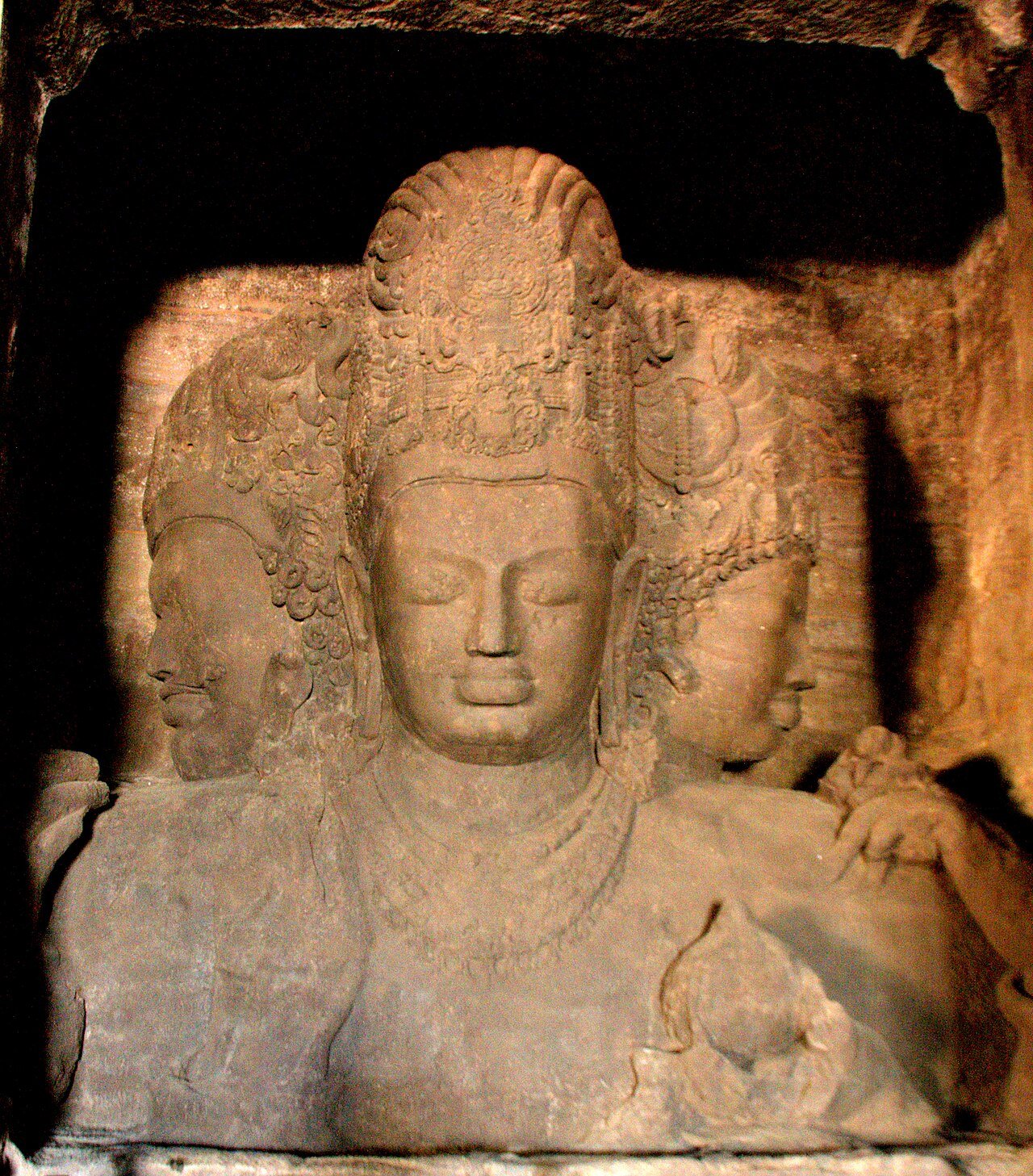
The Elephanta Caves are a complex of rock-cut cave temples on Gharapuri (Elephanta Island) in Mumbai Harbour, 11 km from the Gateway of India by ferry. The main cave, dedicated to Shiva, contains a 5.45-metre three-faced sculpture (Trimurti) carved from the living basalt of the cave wall, dating from the 5th or 6th century CE. UNESCO inscribed the site in 1987.
Gharapuri: The City of Caves Before It Was Elephant Island Mumbai Harbour, 11 km from Gateway of India
The island’s original name — Gharapuri, meaning “City of Caves” in Marathi — indicates that the cave temples were its defining characteristic long before European contact. The island covers approximately 12 km² in Mumbai Harbour and contains two groups of caves: the principal Hindu group of five caves dedicated to Shiva on the northern face of the island, dating from the 5th to 8th century CE, and two smaller Buddhist caves on the eastern face, of uncertain date and incomplete development. The Hindu caves represent the primary artistic and religious significance of the UNESCO inscription.
The main cave (Cave 1) is the largest and most elaborated. Its plan is a roughly square hall approximately 39 metres deep and 27 metres wide, with a flat ceiling supported by rows of massive columns. The columns carry cushion capitals (the broad cushion-shaped transition between column shaft and ceiling lintel) characteristic of Kalachuri-period rock-cut architecture. The cave is oriented east-west, with three major sculpted panels on the south, west, and north walls of the main hall, and a free-standing square sanctum (garbhagriha) at the centre containing a linga — the primary Shaivite form of devotion.
The attribution of the Elephanta caves to a specific dynasty has been a point of scholarly debate for over a century. Coin evidence found within the caves suggests the Kalachuri dynasty (also called Chedi or Haihayas), who controlled the Konkan coast in the 5th–6th centuries CE. Some scholars assign the main cave to the Chalukyas of Badami, who ruled the Deccan from the mid-6th to 8th century CE. The sculptural style has points of comparison with Badami cave temples, but also with earlier Gupta-period work. The question remains open: the most widely accepted dating places the main cave in the second half of the 5th century CE or the early 6th century CE.
The Portuguese arrived on the Konkan coast in 1510 when Afonso de Albuquerque captured Goa. They used Elephanta Island as a military base — a position in Mumbai Harbour with clear defensive and logistical value. Colonial accounts, including those of the Jesuit missionary Gaspar da Cruz writing in the 1560s, describe the sculptures in considerable detail and note that Portuguese soldiers had used them for target practice. The extent of the damage attributable to this specifically is difficult to assess precisely because the cave also suffered natural deterioration over the preceding millennium, but several large Shiva panels, the bull Nandi, and a number of guardian figures (dvarapalas) show damage consistent with the accounts.
The stone elephant that gave the island its Portuguese name (Ilha do Elefante — Elephant Island) stood near the landing area. It was a large and artistically significant stone sculpture in the round. The Portuguese moved it at some point; by the 19th century it was in damaged condition and was transferred to the collections that eventually became part of the Chhatrapati Shivaji Maharaj Vastu Sangrahalaya (formerly the Prince of Wales Museum) in Mumbai. A partial reconstruction of the elephant from its fragments is in the museum’s garden.
The Trimurti: Shiva in Three Faces Carved From Basalt Cave 1, Elephanta Island
The Trimurti (also called Maheshamurti — the great lord form) occupies the southern niche of Cave 1. It is the defining image of Elephanta and one of the most significant surviving examples of early medieval Indian sculpture. The panel is carved from the living basalt of the cave wall to a depth of approximately 1.5 metres; the three faces emerge from the rock as a single integrated bust reaching 5.45 metres in height, with the lower portion of the torso disappearing into the cave floor at a level calculated so that the faces are at eye level when approached from the hall.
The three faces represent three aspects (murtis) of Shiva. The central face — Tatpurusha, or “transcendent being” — is the largest and the most serene. The expression is utterly composed: eyes half-closed, lips slightly parted, the face massive and still. This is Shiva as the unchanging absolute, beyond action and beyond time. The right face — Vamadeva, or “the benevolent” — is shown as a young man with soft features, holding a lotus bud in one hand, representing Shiva as creator and sustainer. The left face — Aghora, or “the terrible” — is shown as fierce and terrifying, with a skull in the crown, a serpent in the hair, and an expression of concentrated destructive power, representing Shiva as destroyer.
The theological composition integrates the Hindu understanding of the cosmic cycle — creation, preservation, destruction — into a single sculptural unit. The three faces are not equal in the visual hierarchy: the central Tatpurusha face is physically larger and compositionally dominant, while the two lateral faces recede and are angled slightly toward the centre, indicating that the creative and destructive aspects are subordinate to the transcendent absolute. This visual theology is consistent with the Shaiva Siddhanta philosophical tradition, in which Shiva as Maheshvara — the great lord — transcends and contains all specific functions and attributes.
The other major sculptural panels in Cave 1 include the Ardhanarisvara panel on the west wall — a depiction of Shiva as half-male and half-female, the cosmic synthesis of masculine and feminine principles — and the Gangadhara panel on the north wall, depicting Shiva holding the Ganges river (represented as a small female figure) in his matted hair as it descends from heaven to earth, with his consort Parvati beside him and a cluster of celestial beings above. Both panels, approximately 5 metres high, show comparable sculptural ambition to the Trimurti and are damaged in varying degrees from the Portuguese-period military occupation.
The island was ceded by the Portuguese to the British East India Company in 1661 as part of the dowry of Catherine of Braganza upon her marriage to King Charles II of England. It passed from the Company to the British Crown in 1858, was administered as part of the Bombay Presidency, and transferred to the city of Bombay in 1947. Archaeological Survey of India conservation work has been ongoing since the late 19th century.
Practical information
Elephanta Island is reached by ferry from the Gateway of India in Colaba, South Mumbai. Government-operated launches run every 30 minutes from approximately 09:00 to 17:30, Tuesday to Sunday (closed Mondays). The journey takes approximately one hour each way. Private speedboats are available for shorter crossing times. Entry to the caves is ₹600 for foreign nationals and ₹40 for Indian nationals (as of 2024); the ferry ticket is purchased separately at the Gateway of India jetty.
From the ferry landing, a toy train or a roughly 10-minute walk through the small village leads to the base of the steps (approximately 120 steps) up to the cave entrance. Vendors sell food and handicrafts on the path and steps. The island has no overnight accommodation; it is a day trip from Mumbai. The nearest accommodation is in South Mumbai (Colaba, Marine Drive). The UNESCO inscription covers Cave 1 and the associated caves; a small museum at the site displays the stone elephant fragments.
Mumbai has no other UNESCO World Heritage Sites. The closest inscribed property is the Ajanta Caves (UNESCO since 1983), approximately 350 km northeast by road, and the Ellora Caves (UNESCO since 1983), approximately 380 km northeast — these are feasible as a two-to-three day extension from Mumbai.
Frequently Asked Questions
Who built the Elephanta Caves and when exactly were they carved?
The builders of the Elephanta Caves have not been established with certainty. There is no dedicatory inscription within the caves that names a patron or a date — a common situation with early medieval rock-cut temples in India, where inscriptional evidence was not always placed inside the cave itself. The primary evidence for dating is stylistic comparison with securely dated monuments and coin evidence. A hoard of Kalachuri copper coins found within Cave 1 suggests that the caves were in use during the Kalachuri dynasty’s control of the Konkan coast, which places them in the 5th to 6th centuries CE. The Kalachuris (not to be confused with the later Chhedi dynasty of the same name in central India) controlled the western coast from approximately the 4th to 6th centuries CE before the Chalukyas of Badami expanded northward. The sculptural style — particularly the modelling of the major figures, the treatment of jewelry and crown types, and the architectural treatment of the columns and their capitals — has been compared both to Kalachuri-period work and to Badami Chalukya caves. The most widely accepted scholarly consensus today dates the principal cave to the second half of the 5th century CE or the first decades of the 6th century CE. No single patron has been identified, and the scale and quality of the work suggest sustained royal or aristocratic patronage over a significant period rather than a single commission.
How did Elephanta Island become part of the British Crown through a royal marriage?
The transfer of Elephanta Island to British control is part of one of the more unusual episodes in the early history of what became the British Empire in India. In 1661, King Charles II of England married Catherine of Braganza, the daughter of King João IV of Portugal. The marriage was politically strategic: England and Portugal were allies against the Dutch and Spanish. The Portuguese dowry included the cities of Tangier (in present-day Morocco) and Bombay — then a small group of islands, of which Elephanta (Ilha do Elefante) was one. The Bombay islands had limited economic value to the Portuguese, who held Goa as the centre of their Estado da India and regarded the Bombay islands primarily as a harbour anchorage. King Charles II initially ceded Bombay to the British East India Company in 1668, as the Crown found the cost of maintaining a garrison there excessive. The Company held Bombay and its associated islands, including Gharapuri/Elephanta, as a trading and administrative hub. Under the Company and later the British Crown (which took direct control after 1858), Elephanta was part of the administrative territory of the Bombay Presidency. After Indian independence in 1947, the islands became part of Maharashtra and were administered by the Government of Maharashtra and, for the archaeological site, the Archaeological Survey of India.
How does Elephanta compare to the cave temples at Ajanta and Ellora?
Ajanta, Ellora, and Elephanta are the three UNESCO-inscribed rock-cut cave sites in Maharashtra, and they differ significantly in character. Ajanta (UNESCO 1983) contains 30 rock-cut Buddhist monasteries and prayer halls (chaityas) carved between approximately the 2nd century BCE and the 5th or 6th century CE; it is primarily known for its painted murals — the earliest surviving large-scale paintings in India — depicting Jataka tales and Bodhisattva figures. Ellora (UNESCO 1983) contains 34 caves spanning approximately the 6th to 11th centuries CE, including Buddhist, Hindu, and Jain caves and the extraordinary Kailasa Temple (Cave 16), a free-standing temple complex carved downward into the hillside from a single rock mass. Elephanta differs from both in its singular focus: it is a site developed around a single major cave dedicated to Shiva, with a sculptural programme of extraordinary quality but a physically more compact extent than either Ajanta or Ellora. The Trimurti at Elephanta is generally regarded by art historians as one of the finest single sculptural achievements in Indian art, comparable in ambition and execution to the best Gupta-period stone sculpture. The damage from the Portuguese military period adds an additional historical dimension absent at Ajanta and Ellora, which were abandoned and overgrown rather than actively damaged.