
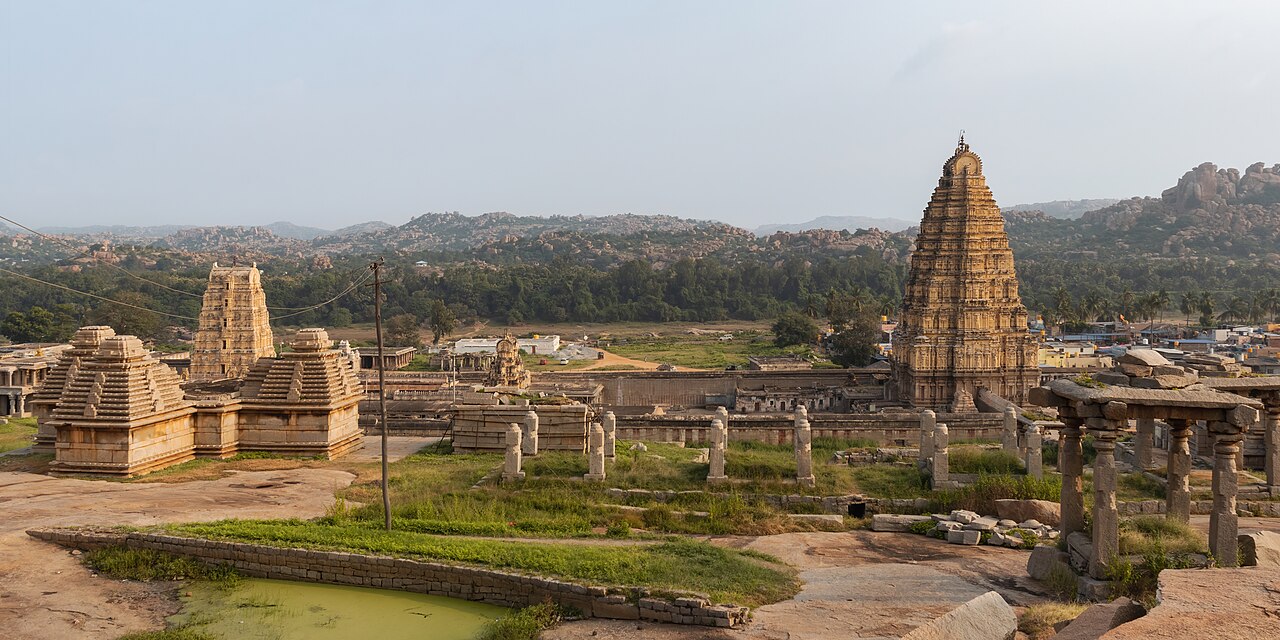
Hampi is a UNESCO World Heritage Site (inscribed 1986) comprising the ruined capital of the Vijayanagara Empire, located on the south bank of the Tungabhadra River in Ballari district, Karnataka, southern India. At its peak in the 15th and early 16th centuries, Vijayanagara held an estimated population of 500,000, making it one of the largest cities in the world — larger than Rome at the same period. The city was sacked and burned for six months following the empire’s military defeat in 1565, and its ruins, extending over 25 square kilometres, have remained unoccupied since.
The Capital of Vijayanagara: Scale, Wealth, and the Portuguese Account of 1520 Ballari district, Karnataka, India
Vijayanagara — meaning “City of Victory” — was founded in 1336 by the brothers Harihara and Bukka Raya on the banks of the Tungabhadra, at a site already considered sacred because of its association with the Ramayana epic: the monkey kingdom of Kishkindha is identified with the rocky terrain around Hampi in the Hindu tradition. The empire grew to control most of peninsular India south of the Krishna River, and the capital grew with it. By the reign of Krishnadevaraya (1509–1529), the city’s extent, population, and wealth were without peer in South Asia.
The most detailed surviving description of Vijayanagara at its height comes from two Portuguese visitors: Domingo Paes, who arrived around 1520, and Fernão Nunes, who arrived around 1535. Paes described the capital as “the best-ordered city in the world” and compared the Hampi bazaar — the colonnaded market street leading to the Virupaksha Temple — to the great markets of Lisbon and Bruges. He described jewels, silks, and precious metals traded openly along streets paved in stone, and estimated the city’s population in terms that modern historians have used to arrive at figures between 300,000 and 500,000 residents. Nunes recorded the administrative structure of the empire, its military organisation, and the conduct of court festivals, including the Mahanavami celebrations held in September and October.
The site today covers over 25 square kilometres and contains more than 1,600 surviving monuments. These include major temple complexes, royal enclosures with pavilions and stepped tanks, elephant stables large enough to house 11 animals in separate vaulted chambers, a queen’s bath with an interior moat, aqueducts that channelled water from the Tungabhadra to the city’s gardens, and the remains of a sophisticated urban infrastructure. The terrain is dramatic: rounded granite boulders, some several storeys tall, cover the landscape and were incorporated into the city’s defences and sacred topography.
The Hampi bazaar (Virupaksha bazaar) is a 700-metre colonnaded street running east from the Virupaksha Temple gopuram. Its granite pillars, still standing in rows along both sides, supported the roofs of market stalls. Paes’s description of it as the best street he had seen in the world is the source most frequently quoted in descriptions of Vijayanagara at its peak. The scale of the columns and the length of the street are still legible despite centuries of exposure.
The Vittala Temple, the Musical Pillars, and the Destruction of 1565 Northern sector, Hampi archaeological zone
The Vittala Temple complex, located in the northern sector of the Hampi archaeological zone, is considered the architectural pinnacle of the Vijayanagara style. The main shrine is dedicated to Vittala, a form of Vishnu, and the complex includes multiple mandapas (columned halls), a kalyana mandapa (marriage hall), and a rathotsava (festival) chariot in front of the main temple. The stone chariot — a miniature temple in the form of a processional vehicle, with solid stone wheels and a carved stone canopy — has become the most reproduced image of Hampi and appears on the reverse of the Indian 50-rupee note as a symbol of Karnataka’s heritage.
The main maha-mandapa (great hall) of the Vittala Temple contains the famous musical pillars. The hall is surrounded by 56 carved granite pillars, each consisting of a central shaft with multiple attached colonettes. When the colonettes are struck, they produce musical tones — the pitch varies by colonette and by the size of each shaft. Each pillar in effect functions as a set of tuned stone instruments. The mechanism relies on the resonant properties of the granite and the precise dimensions of the carved elements. Archaeological Survey of India staff now discourage visitors from striking the pillars to prevent further damage from the accumulated vibration.
The Vittala Temple was never completed. Construction proceeded through the reigns of multiple Vijayanagara kings in the 15th and early 16th centuries, reaching its most ambitious phase under Krishnadevaraya, who added the main hall. The defeat at the Battle of Talikota on 23 January 1565 interrupted construction permanently. A coalition of five Deccan Sultanates — Bijapur, Ahmadnagar, Bidar, Berar, and Golkonda — defeated the Vijayanagara army at Talikota and marched on the capital. The sack that followed lasted approximately six months; contemporary accounts from Portuguese observers and later Mughal chronicles describe burning, looting, and the systematic destruction of temples and palaces. The scorched stonework visible on many structures across the site is the physical residue of that destruction. The population dispersed; the capital was never resettled.
The Virupaksha Temple, unlike the Vittala, survived the sack in continuous use and remains an active place of worship. Dedicated to Shiva as Virupaksha — the patron deity of the Vijayanagara kings — the temple dates to the 7th century but received its most prominent additions in the 15th century. The east gopuram stands 50 metres tall and is visible from across the Tungabhadra. The temple contains a resident elephant that performs blessings for visitors who present offerings; this practice is continuous with the temple’s function as a living pilgrimage site, not merely an archaeological monument.
Practical information
Hampi is located in Ballari district, Karnataka, approximately 350 kilometres north of Bangalore (Bengaluru) and 75 kilometres from Hospet (Hosapete), the nearest major town. The nearest railway station is Hospet Junction, accessible by express trains from Bangalore (approximately 8 hours on overnight services), Hyderabad, and Goa. From Hospet, local buses, auto-rickshaws, and taxis connect to Hampi village and the main monument areas. Bicycle rental is available in Hampi village and is the most practical way to navigate the dispersed site.
The site is spread across an area too large to cover on foot in a single day; the major clusters — the Sacred Centre around the Virupaksha Temple and the Royal Enclosure — are within walking distance of each other, but the Vittala Temple complex is approximately 2 kilometres from the Virupaksha Temple and is best reached by bicycle, auto-rickshaw, or the site shuttle service. The Archaeological Survey of India monument areas charge entry fees for foreign visitors and Indian nationals at different rates. The site is open daily.
Pattadakal, the nearest UNESCO World Heritage Site, lies approximately 140 kilometres northwest of Hampi by road, near Badami. The journey takes approximately 3 hours by car and can be combined with visits to the Chalukya sites at Badami (45 km from Pattadakal) and Aihole (10 km from Pattadakal). Accommodation is available in Hampi village and in Hospet; Hospet offers more comfortable options for travellers not seeking budget guesthouses.
Frequently Asked Questions
How large was Vijayanagara at its peak, and how does it compare to other medieval cities?
The population estimates for Vijayanagara at its height — in the late 15th and early 16th centuries — range from 300,000 to 500,000 residents. These figures derive from a combination of contemporary accounts by foreign visitors, principally the Portuguese reports of Paes and Nunes, and modern archaeological survey of the city’s built extent, which covers over 25 square kilometres. For comparison, Rome in the same period had an estimated population of between 50,000 and 100,000 following its decline from late antique heights; London in 1500 had approximately 75,000 residents; Paris around 200,000. The claim that Vijayanagara was one of the largest cities in the world in the early 16th century is supportable on this evidence.
The comparison is frequently made with other pre-modern Asian capitals. Beijing during the Ming dynasty held approximately one million residents in the early 16th century; Nanjing and Hangzhou were comparable. Vijayanagara was not the largest city in Asia, but it was, by the available evidence, the largest city in India of its period and among the largest in the world outside China. The scale of the archaeological remains at Hampi — the extent of the city walls, the complexity of the hydraulic infrastructure, the number and quality of the monuments — supports the conclusion that the written accounts, however impressionistic, describe a genuinely exceptional urban centre.
After 1565, the site was never resettled at anything approaching its former scale. The ruins deteriorated slowly over the following centuries, protected in part by the inaccessibility of the terrain and the sacred status of the Virupaksha Temple, which maintained a continuous though diminished local community.
What are the musical pillars of the Vittala Temple, and how do they work?
The musical pillars in the maha-mandapa (great hall) of the Vittala Temple at Hampi are 56 carved granite columns, each constructed around a central shaft with multiple thinner colonettes attached to it. When the colonettes are struck, they emit musical tones. The tonal variation between colonettes is attributed to differences in the dimensions and mass of each carved element: a longer, thinner colonette vibrates at a different frequency from a shorter, broader one, producing a different pitch. Each pillar effectively functions as a set of resonators tuned to different notes.
The physical principle is the same as that of a struck bell or tuning fork: the granite, when impacted, vibrates at a frequency determined by its geometry and material properties. The Vijayanagara craftsmen appear to have understood, from experience with stone carving and possibly from earlier wooden or metal instrument traditions, that varying the dimensions of the attached colonettes would produce varied pitches. Whether the hall was used for musical performances or whether the tonal property was a secondary feature of an ornamental design is not established by any contemporary text.
The Archaeological Survey of India now asks visitors not to strike the pillars. Repeated impact over many decades of tourism has caused micro-fractures in some of the colonettes, and the accumulated vibration is a documented concern for the long-term structural integrity of carved elements that cannot be replaced. Early colonial-period accounts, including those of British military officers who visited the site in the 19th century, describe striking the pillars as a standard demonstration — a practice that continued well into the 20th century.
What caused the destruction of Vijayanagara in 1565, and why was it never rebuilt?
The Battle of Talikota on 23 January 1565 was the decisive military confrontation between the Vijayanagara Empire and a coalition of the five Deccan Sultanates: Bijapur, Ahmadnagar, Bidar, Berar, and Golkonda. The sultanates had cooperated before, but the 1565 alliance was their most coordinated effort. The Vijayanagara army, led by the regent Aliya Rama Raya, was defeated in the field; Rama Raya himself was captured and executed on the battlefield. The army’s cohesion collapsed and the survivors retreated toward the capital.
The sack of the city lasted approximately six months according to contemporary sources, including Portuguese accounts from Goa and later Mughal chronicles. The stone temple structures were too large to demolish completely, but roofs, wooden elements, and the interior furnishings of the palaces were burned. Portable wealth — the gold, jewels, and metalwork that the accounts of Paes and Nunes describe filling the market streets — was looted entirely. The civilian population fled; estimates of the death toll during the sack are unreliable, but the city’s social infrastructure — the merchants, craftsmen, religious communities, and court dependents who sustained it — dispersed permanently.
The capital was never rebuilt for a combination of reasons: the empire’s successor governments relocated to Penukonda, Chandragiri, and eventually Vellore, farther from the threat of the Deccan Sultanates; the economic and agricultural infrastructure around Hampi was severely damaged; and the symbolic association of the old capital with catastrophic defeat made it an unlikely site for political renewal. The Virupaksha Temple continued to function, sustained by its sacred status and local devotees, but the broader urban fabric did not recover.

_(cropped).jpg)