Harar Jugol is the walled old city of Harar, in the Harari region of eastern Ethiopia at 1,885 metres altitude, enclosed by a 4.5-kilometre wall with five gates built in the 16th century. The city holds UNESCO World Heritage status since 2006 and is considered one of the holiest sites of Islam in the Horn of Africa, containing more than 80 mosques within walls that cover roughly one square kilometre. It is also where the French poet Arthur Rimbaud spent the last decade of his life trading coffee and arms, and where wild spotted hyenas enter the city each night to be fed by hand.
A Trade Capital of Islam: The Adal Sultanate, Rimbaud, and 82 Mosques in One Square Kilometre Harar Jugol, Harari Region
Harar’s strategic position on the eastern highlands, overlooking the lowlands that descend toward the Somali plateau and the Gulf of Aden, made it a node of Islamic trade long before the Ottoman Empire began contesting the Red Sea with Portugal in the 16th century. The city served as the capital of the Adal Sultanate from approximately 1520 to 1577, the period in which the Adal ruler Ahmad ibn Ibrahim al-Ghazi — known in Ethiopian history as Ahmad Grañ (Ahmad the Left-Handed) — launched a prolonged military campaign that conquered most of highland Ethiopia before Portuguese firearms and a Portuguese expeditionary force turned the tide. The wars devastated both Christian highland Ethiopia and the Adal Sultanate; Harar survived as an independent emirate, the Emirate of Harar, from 1647 until the Egyptian occupation of 1875 and the eventual incorporation into Ethiopian imperial territory under Menelik II in 1887.
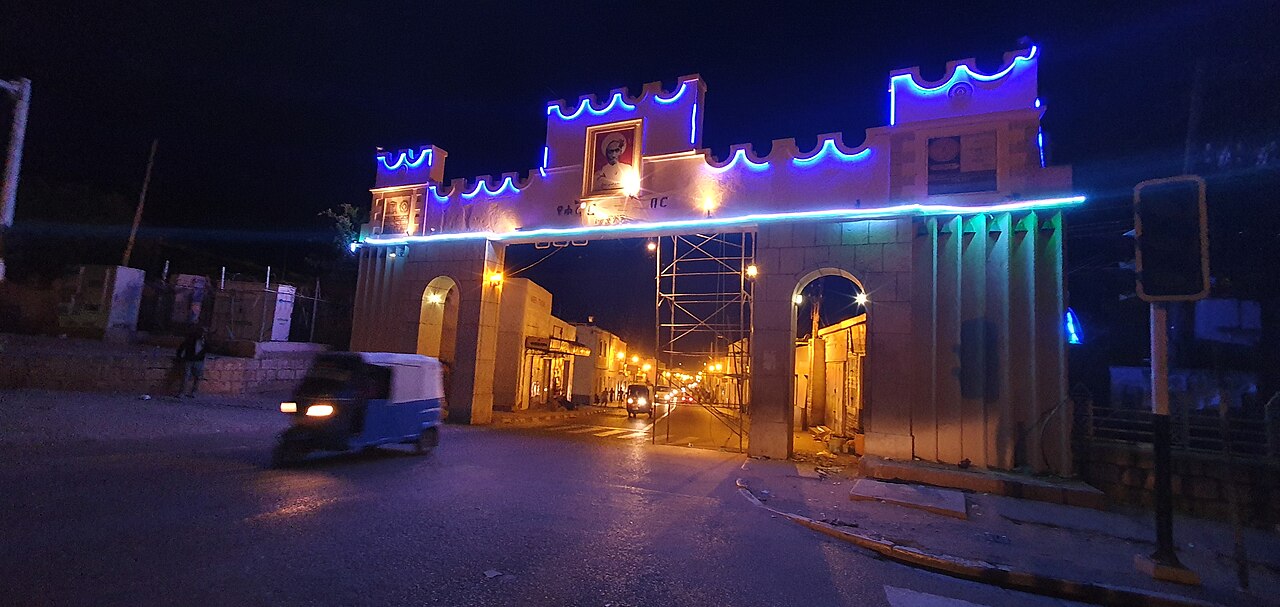
The wall that defines Harar Jugol dates to this same 16th-century period. It is approximately 4.5 kilometres in circumference, built in dressed stone to a height of between three and five metres, with five original gates: Erer Gate, Fallana Gate, Suqutat Gate, Sanga Gate, and Buda Gate. The gates are not merely functional openings but ceremonial thresholds — each has a distinct character, and each corresponds to one of the routes connecting Harar to the surrounding lowlands and trade networks. A sixth gate was added later. The wall is not uniformly intact — there are sections rebuilt in the 20th century and gaps filled with later construction — but its circuit is still legible as a continuous urban boundary.
Within the walls, the density of mosques is the most immediately striking feature of Harar’s urban fabric. The precise count varies by source — 82 is the most commonly cited figure in UNESCO documentation, while local tradition often gives 99 — but the density is verifiable by walking the lanes of the old city, where a mosque appears at every few turnings, including the Jami Mosque (the Friday mosque), whose foundation dates to the 16th century and whose minaret was added in 1754. The mosques range from large communal structures with distinctive whitewashed facades to small neighbourhood mosques that occupy narrow plots between residential buildings, identifiable mainly by their entrance doors and the small minarets rising above the roofline. Harar is among the few places outside the Arabian Peninsula where Islam developed an autonomous architectural and urban tradition of this density over multiple centuries, largely isolated from external influence by the walls and the surrounding Christian highlands.
Arthur Rimbaud arrived in Harar in 1880, having abandoned poetry at the age of 21 after writing the works that would make him famous posthumously. He spent ten years in Harar and Aden trading coffee, hides, and arms — the latter business supplying weapons to Menelik II’s campaigns, with Rimbaud’s accounts of these transactions forming a strange practical counterpoint to his earlier symbolist verse. He left Harar in 1891 with bone cancer, died in Marseille at 37, and became one of the most celebrated French poets of the 19th century in the years following his death. His house in Harar, a two-storey structure in the traditional style, is now a small museum. It is uncertain which of several buildings Rimbaud actually occupied — accounts differ — but the designated Maison Rimbaud draws visitors seeking the intersection of French literary history and East African trade.
The Hyena Men of Harar: A 400-Year Ritual at the Fallana Gate Fallana Gate, Harar
Wild spotted hyenas have lived in and around Harar for centuries, and the relationship between the city and its hyenas is one of the most documented unusual urban wildlife relationships in Africa. Spotted hyenas (Crocuta crocuta) are not domesticated in Harar — they are wild animals that move freely in the surrounding countryside and enter the city through small holes deliberately left in the base of the walls, which local tradition calls hyena gates. They come at night, after the streets have quieted, to feed on organic waste in the lanes and at certain designated spots near the walls.
The tradition of hand-feeding wild hyenas in Harar dates back at least 400 years, though its precise origin is uncertain. One account ties it to the 16th century, when hyenas were offered food to prevent them from attacking livestock during a famine; another credits a Sufi sheikh who is said to have tamed hyenas with porridge. Whatever the origin, the practice has been maintained by a small number of families — the so-called hyena men — who feed wild hyenas nightly from a stick, and in the signature gesture of the ritual, from a piece of meat held in the feeder’s mouth.
The hyenas are associated in Harari belief with protective spirits: they are said to keep evil away from the city and to consume organic waste that might otherwise breed disease. The feeding ritual near the Fallana Gate takes place after dark, typically between 20:00 and 22:00. Visitors attend with local guides; the hyenas are not tame but are habituated to the presence of the feeders and tolerate observers at a distance. The animals approach close enough for the feeder to place the stick — and eventually the meat — directly in the hyena’s jaws. Photography with flash is possible at close range without disturbing the animals; the hyenas are significantly larger than most visitors expect (adults weigh 40–80 kg), and their vocalisation — whooping and cackling — at close range is disorienting. The ritual is not performed for tourism alone: it is conducted regardless of whether visitors are present, though guides arrange for visitors to observe at the appropriate time.
The traditional Harari house — the gegar — is a distinct architectural type registered as part of the intangible and tangible heritage of Jugol. A gegar is a narrow, tall townhouse with a street facade giving little indication of the interior. The ground floor handles storage and receives guests in a formal room; the family space is on the upper floor, where the walls of the main living room are covered in a dense installation of coloured niches, woven baskets, embroideries, and lacquerware built directly into the plaster. The interior functions simultaneously as domestic space and as display of the household’s status and craft accumulation. Several gegaras are open to visitors as house museums; the Museum of the City of Harar in the old city provides the most comprehensive account of traditional Harari material culture.
Practical information
Harar is most commonly reached from Addis Ababa by road via Dire Dawa: approximately 520 km on a paved highway, six to eight hours by bus or private vehicle. Dire Dawa Airport (DIR) has flights from Addis Ababa (Ethiopian Airlines, approximately one hour), and Harar is 52 km from Dire Dawa by road (one hour). There is also a train between Dire Dawa and Addis Ababa on the Ethio-Djibouti railway, though schedules are irregular. Harar Jugol itself is a pedestrian city — the lanes inside the walls are too narrow for vehicles and must be explored on foot. A licensed local guide from the Harari Regional Tourism Bureau is strongly recommended both for navigating the old city and for arranging the hyena feeding. The hyena feeding takes place nightly near the Fallana Gate after dark; guides coordinate the timing. The Lower Valley of the Awash, the nearest UNESCO World Heritage Site (a palaeontological site containing the fossil remains of Australopithecus afarensis, including “Lucy”), is approximately 300 km to the west on the Addis Ababa highway. Accommodation ranges from guesthouses within the old city walls to mid-range hotels in the adjacent modern city of Harar.
Frequently Asked Questions
Why did Arthur Rimbaud choose Harar, and what did he actually do there?
Rimbaud arrived in Harar in 1880 at the age of 25, two years after writing A Season in Hell and the Illuminations — the works that form his entire surviving literary output. He had already been living outside France for several years, working as a labourer, dock worker, and odd-job man in Cyprus and along the Red Sea coast. His decision to settle in Harar was primarily commercial: the city was a significant trading hub connected to the Gulf of Aden and the Red Sea networks, and opportunities existed for European traders willing to work in a remote but commercially active environment. He worked initially for the French trading house Bardey and later independently, trading in coffee (which the Harar region produces in significant quantities), hides, animal skins, and eventually arms. The arms trade took him into direct dealings with Menelik II, then King of Shewa and the future Emperor of Ethiopia, for whom Rimbaud organised a shipment of weapons intended to assist the consolidation of Menelik’s power. The correspondence Rimbaud left from the Harar years is extensive — letters to his family in France describe the trade routes, the climate, the local languages (he learned Harari and Amharic to a working degree), and his frustration at the difficulty of accumulating capital in the trading environment of the period. He wrote no poetry in Harar. He never returned to France while in health; his departure in 1891 was forced by the bone cancer in his right knee that killed him within months. His literary fame was entirely posthumous, driven by Verlaine’s publication and advocacy of his work after Rimbaud had left Paris.
Are the hyenas of Harar dangerous to visitors?
Wild spotted hyenas are large, powerful carnivores — adults weigh between 40 and 80 kilograms — and are responsible for significant numbers of livestock attacks and occasional attacks on humans across sub-Saharan Africa. In Harar, however, the hyenas that enter the city and participate in the nightly feeding are habituated to human presence around the feeding sites and have not been recorded as attacking observers in recent decades, based on accounts from the Harari Regional Tourism Bureau and from guides with long experience at the Fallana Gate. The critical distinction is that the feeding ritual takes place in a specific location, at specific hours, conducted by experienced hyena men who understand the behaviour of the individual animals. Visitors attend as observers within the space managed by the feeder; they do not initiate contact with the hyenas or position themselves between the animals and their food. The risk to a visitor who follows their guide’s instructions and maintains the appropriate distance is low. The risk to a visitor who deviates from those instructions — approaching hyenas independently, feeding them unassisted, or encountering them in other parts of the city after dark away from the ritual site — is substantially higher. Harar’s hyenas do move through the old city lanes at night; walking the lanes alone after dark without a guide is not recommended, not primarily because of hyenas but because the unwalled lanes are difficult to navigate and the hyenas’ presence in the dark can be startling at close range. Observing the ritual with a licensed guide, at the designated site, at the designated time, is the safe and appropriate way to experience it.
What is the significance of Harar as an Islamic city, and how does it compare to other holy cities of Islam?
Harar’s status as a holy city of Islam rests on several foundations. The city’s connection to Islam dates to the early centuries of the faith: Arab Muslim traders had contact with the Horn of Africa from the 7th century CE, and Harar itself is traditionally dated as an Islamic settlement from around the 10th century, though its emergence as a significant urban centre dates more clearly to the 15th and 16th centuries. Its holiness in Islamic tradition derives partly from the density of its mosques — a density that has led some scholars to describe Harar as the fourth holiest city in Islam, after Mecca, Medina, and Jerusalem, a claim that appears in local tourism literature but is not formally endorsed by any central Islamic authority and is contested by other claimants such as Najaf, Karbala, and Qom. What is more solidly documented is Harar’s significance in the specifically Sufi tradition of East African Islam: the city is associated with numerous Sufi saints whose shrines are distributed throughout the old city and visited by pilgrims from across the Horn of Africa. The 82 mosques figure reflects not a single monumental tradition — there is no structure in Harar comparable in scale to the great mosques of Cairo or Istanbul — but a tradition of neighbourhood and community-scale worship in which every quarter of the city maintains its own mosque, creating a religious geography of extreme density within a small urban area. This pattern of distributed, community-embedded worship is more characteristic of the Sufi tradition than of state-sponsored mosque-building, and it reflects Harar’s development as an autonomous Islamic city-state rather than as the religious capital of a large empire.