Aksum, in the Tigray region of northern Ethiopia, was the capital of one of the ancient world’s most powerful states — a kingdom that controlled trade between the Roman Empire, Arabia, and India for nearly a millennium. The city holds UNESCO World Heritage status since 1980 and contains roughly 120 granite stelae, royal tombs, palace ruins, and what Ethiopian Orthodox tradition identifies as the resting place of the Ark of the Covenant. The centrepiece today is a 24-metre obelisk that Italy looted under Mussolini in 1937, held in Rome for 68 years, and returned to Ethiopian soil in 2005.
The Stelae: Funerary Monuments That Replicate Palaces in Granite City of Aksum, Tigray
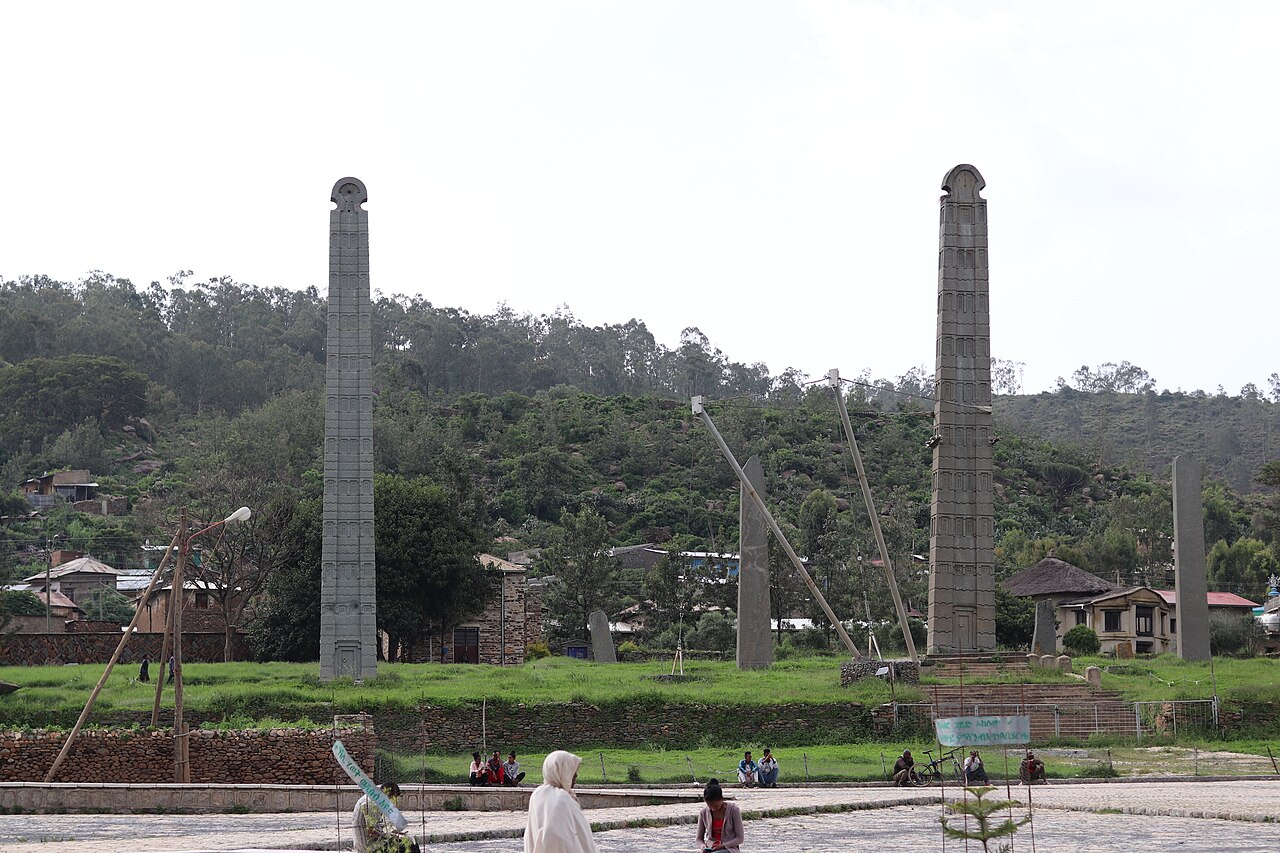
The stelae fields of Aksum are among the most singular monumental ensembles surviving from antiquity. Approximately 120 obelisks stand or lie fallen across the city, most concentrated in the Northern Stelae Park. They functioned as funerary markers above the royal tombs of the Aksumite dynasty — carved from single blocks of granite quarried in the nearby mountains of Wukro and transported to the city, in some cases over distances exceeding 100 kilometres, using means that remain debated.
What makes the stelae immediately distinctive is their surface carving. Each face is decorated with rows of false doors at the base, false windows ascending the shaft, and horizontal bands that replicate the timber beam-ends of Aksumite multi-storey architecture. The monoliths are, in effect, scale models of royal palaces rendered in stone — the building style of the living transposed into granite for the dead. Scholars believe the tallest stelae were crowned with metal eagles or solar discs, though none survive in place.
The scale of the largest examples is extraordinary. Stele 1, the Great Stele, lies fallen and broken near the park entrance. At 33 metres, had it stood upright it would have been the tallest monolithic obelisk ever quarried anywhere in the ancient world — surpassing even the largest Egyptian examples. The engineering failure that brought it down, probably during erection, left the largest known ancient obelisk horizontal and shattered, a permanent monument to overreach.
Stele 2, the Obelisk of Aksum at 24 metres, is the most visited. It stood for centuries until Italian forces dismantled it in 1937, during Mussolini’s occupation of Ethiopia, and transported it in three sections to Rome, where it was re-erected near the Circus Maximus. It remained there for 67 years despite post-war agreements requiring its return. After sustained Ethiopian diplomatic pressure and two decades of negotiations, Italy finally shipped the stele home in 2005. Structural damage sustained in Rome and during transport meant re-erection required a 15-month engineering operation; the obelisk was raised again in its original position in 2008. The tomb complex beneath the stelae field includes the Tomb of the False Door and the Tomb of Brick Arches — both accessible by descending underground, with corbelled brick vaulting that demonstrates the Aksumite command of structural arch engineering centuries before it appeared widely elsewhere in sub-Saharan Africa.
Christianity, the Ark, and the Cathedral of Our Lady of Zion Central Aksum
Aksum holds a singular place in Christian history. Around 330 CE — approximately contemporaneous with Constantine’s Edict of Milan — King Ezana of Aksum converted to Christianity, making the Aksumite Kingdom the first sub-Saharan African state to adopt the faith as official state religion. The conversion was carried out under the influence of Frumentius, a Syrian Christian who had been captured as a child, educated at the Aksumite court, and eventually appointed the first bishop of Aksum by Athanasius of Alexandria. This placed the Aksumite church firmly within the Oriental Orthodox tradition, theologically aligned with the Coptic Church of Egypt and distinct from Roman Catholicism and Eastern Orthodoxy.
The institutional descendant of Ezana’s church is the Ethiopian Orthodox Tewahedo Church, one of the oldest continuously functioning Christian denominations in the world. Its most sacred site is the Cathedral of Our Lady of Zion in Aksum, reconstructed in the 1960s under Emperor Haile Selassie but occupying a site that has held a church since at least the fourth century. Adjacent to the cathedral stands a smaller, older chapel: the Chapel of the Tablet.
Ethiopian Orthodox tradition holds that this chapel houses the original Ark of the Covenant — the gilded acacia chest described in Exodus as containing the stone tablets of the Ten Commandments. The tradition states that Menelik I, son of King Solomon of Israel and the Queen of Sheba, brought the Ark to Aksum after visiting his father in Jerusalem; it has been held in Aksum ever since. A single monk, the Guardian of the Ark, is permanently assigned to its protection and is forbidden to leave the chapel grounds. No outside person — not even the Patriarch of the Ethiopian Orthodox Church — is permitted to view the Ark. The claim is unverifiable by external scholarship, but the tradition shapes the spiritual geography of the entire city and draws tens of thousands of Ethiopian Orthodox pilgrims annually.
The Palace of Queen Sheba (Dungur) lies on the western outskirts of the city. The ruins are of a large Aksumite palace, excavated in the 1970s and dated by archaeology to approximately the sixth century CE — well after the Queen of Sheba’s era — but the popular association with her endures. The stone base of the palace, with its distinctive Aksumite stepped-podium construction, conveys the scale of elite residential architecture at the height of Aksumite power.
Practical information
Aksum is served by Aksum Zara Yaqob Airport (AXU), with direct flights from Addis Ababa (Ethiopian Airlines, approximately 90 minutes). Travel to Aksum from other parts of Ethiopia has been restricted at periods due to conflict in the Tigray region; verify the current security situation and entry requirements with official sources before planning. The Northern Stelae Park, Tomb of the False Door, and Tomb of Brick Arches are managed as a single ticketed site; a separate ticket is required for the archaeological museum. The Cathedral of Our Lady of Zion and Chapel of the Tablet are open to visitors; entry to the chapel itself is restricted, but the compound is accessible. Guided licensed local guides are strongly recommended for the tomb systems and palace sites. The nearest UNESCO site, Simien Mountains National Park, is approximately 130 km to the west via a mountain road; Lalibela is approximately 200 km to the south. Accommodation ranges from basic guesthouses to mid-range hotels in the city centre.
Frequently Asked Questions
Was the Obelisk of Aksum actually looted, or was it purchased legally?
The obelisk was removed by Italian forces in 1937 during the occupation of Ethiopia following the Second Italo-Ethiopian War (1935–36), in which Mussolini’s military used chemical weapons and airpower against Ethiopian troops and civilians. The removal was an act of wartime spoliation, not a legal transaction. The stele was dismantled in three sections, transported to the port of Massawa, and shipped to Italy, where it was erected in Rome as a trophy of empire near the Palazzo della FAO. The 1947 Peace Treaty between Italy and the Allied powers explicitly required Italy to return the obelisk to Ethiopia, but successive Italian governments treated the obligation as symbolic rather than binding for five decades — citing technical difficulties, cost, and the objections of the Rome neighbourhood where the stele stood. Ethiopia’s persistent diplomatic pressure, eventually backed by UNESCO, resulted in Italy formally agreeing to return it in 2002 and completing the physical transfer in 2005. The re-erection in Aksum was completed in 2008 after structural repair of damage sustained during its decades in Rome and during transport. The episode is now taught in Ethiopian schools as a case study of colonial-era cultural property theft and its eventual partial remedy.
Is the Ark of the Covenant claim taken seriously by scholars?
The Ethiopian Orthodox claim that the Ark of the Covenant rests in the Chapel of the Tablet in Aksum is taken seriously by scholars as a significant religious tradition and cultural reality, but it cannot be verified by external investigation because access to the chapel is permanently forbidden to all persons other than the appointed guardian monk. Academic opinion divides roughly into three positions. Some scholars, notably Graham Hancock in his 1992 book The Sign and the Seal, argue that a genuine ancient object may lie in the chapel — possibly a Solomonic-era artefact transported from Jerusalem to Egypt and eventually to Aksum via the island monastery of Tana Qirqos. Other scholars suggest the chapel holds a tabot — a consecrated altar tablet representing the Ark, of which every Ethiopian Orthodox church holds one — and that the Aksum tabot is simply the most venerated. A third view holds that the tradition developed as a theological claim during the Zagwe dynasty (12th–13th century) to reinforce Ethiopian Christian identity as the true Israel, without a specific artefact. What is certain is that the tradition is ancient, that it is central to Ethiopian Orthodox identity, and that the Ethiopian government has never permitted any form of independent verification.
What is the best way to combine Aksum with Lalibela and the Simien Mountains in one trip?
The three sites form a coherent northern Ethiopia heritage circuit. The most practical routing is to fly into Aksum from Addis Ababa, spend two to three days exploring the stelae, tombs, and cathedral, then take the road south-east to Lalibela — approximately 200 km, usually a full driving day on paved and unpaved roads, or a short domestic flight. From Lalibela, the Simien Mountains are approximately 250 km to the north-west, most conveniently reached by returning through Gondar, where the Fasil Ghebbi royal compound (itself a UNESCO site) merits a half-day stop. The Simien Mountains require a minimum of two nights at Debark or the park lodges to access the main viewpoints and trek the escarpment. Total for the full circuit: eight to ten days from Addis Ababa. The dry season (October to March) offers the clearest skies and most reliable road conditions; the Timkat festival (Ethiopian Epiphany, around January 19) brings enormous crowds to both Aksum and Lalibela and requires accommodation booked months in advance. Ethiopian Airlines connects Aksum, Lalibela, and Gondar with Addis Ababa daily in the dry season; flying between sites saves road time but reduces flexibility.