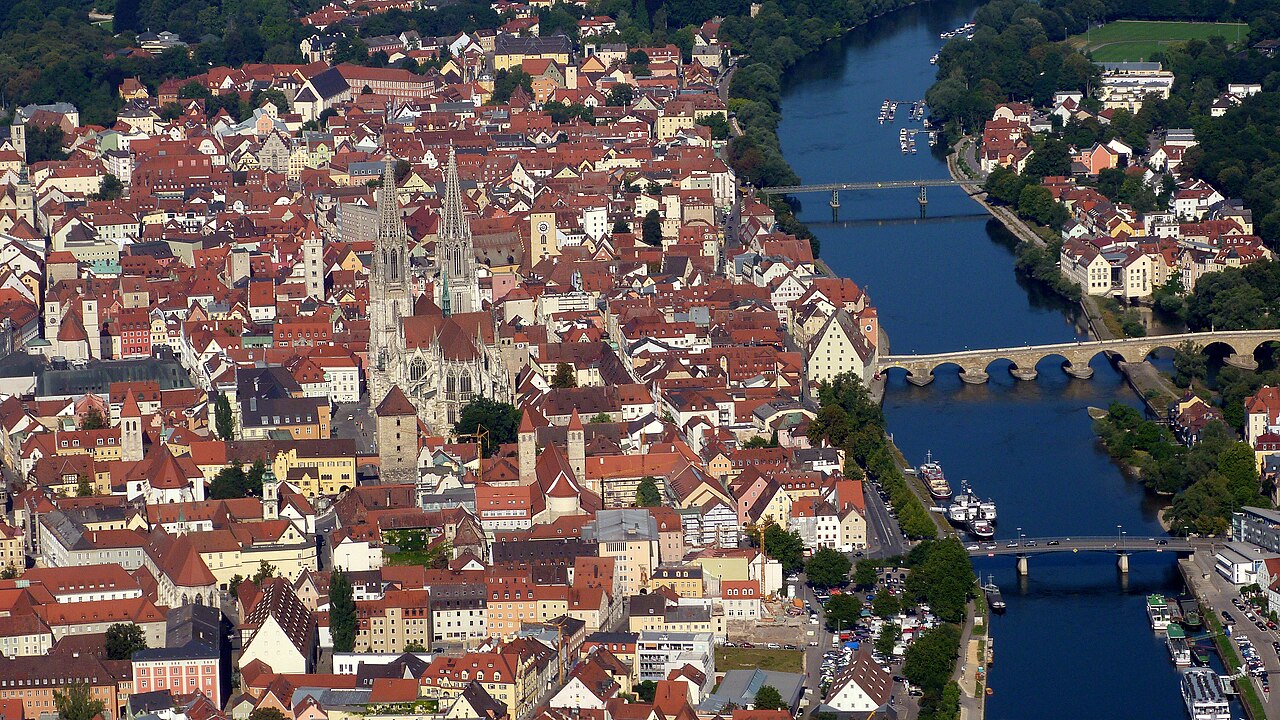
Regensburg is a city of around 150,000 in Bavaria, Germany, at the northernmost bend of the Danube, inscribed as a UNESCO World Heritage Site in 2006 under the title “Old Town of Regensburg with Stadtamhof.” The old town contains approximately 1,500 listed buildings within a 1.7 square kilometre area, making it the largest intact medieval city centre in Germany. Among its landmarks are a Roman gate from 179 CE, a 12th-century stone bridge that stood as the only Danube crossing between Ulm and Vienna for 800 years, and a boys’ choir founded in 975 CE that is still performing.
The Steinerne Brücke and the Roman Foundation Old Town centre, walkable from main railway station (15 min)
The Steinerne Brücke (Stone Bridge) was built between 1135 and 1146 and held its crossing over the Danube for approximately 800 years as the only bridge between Ulm upstream and Vienna downstream. This monopoly on Danube crossing gave Regensburg an economic advantage that accounts for much of its medieval prosperity: all goods moving between the Italian cities and the Baltic had to pass through this city, and the tolls collected at the bridge funded the merchant towers, the cathedral, and the patrician palaces that still define the skyline.
The bridge is 336 metres long with sixteen arches. It was built using cofferdam construction techniques — temporary watertight enclosures pumped dry to allow foundation work in the riverbed — a method that required sophisticated engineering organisation for the 12th century. Legend attached itself to the construction almost immediately: according to the popular story, the bridge builder made a pact with the devil, promising the soul of the first living being to cross the bridge when it was finished. When the bridge was complete, the builder tricked the devil by sending a rooster across first. The tale reflects the genuine popular astonishment that a stone bridge of this scale could have been built so quickly and completely.
The Porta Praetoria, a Roman gate dating from 179 CE, stands in the old city partially integrated into the wall of a hotel near the cathedral. Regensburg was founded as the Roman legionary camp Castra Regina under Emperor Marcus Aurelius; the camp covered the area between what is now the cathedral and the Danube bank. The Porta Praetoria is one of the best-preserved Roman structures in Germany — its lower section is original Roman masonry, and it remains visible as an archway in a busy street between modern buildings, an encounter with Rome that requires no museum context to understand.
The astronomer Johannes Kepler died in Regensburg in 1630, while attempting to collect a debt from the imperial treasury at the Diet of Regensburg. His death house in the Kepler-Gedächtnishaus (Keplerstrasse 5) is a museum documenting his life and work. Kepler had spent much of his career in Prague and Linz, but his presence at Regensburg at the moment of his death and the survival of the house make the museum a significant stop for visitors interested in the history of science.
The Cathedral, the Domspatzen and the Sausage Kitchen Cathedral quarter and Danube riverbank, within 10 min walk
The Cathedral of St Peter was begun in 1250 and took two and a half centuries to complete, reaching its present form around 1520. It is one of the finest Gothic cathedrals in Bavaria, distinguished by the delicacy of its nave stonework, its extensive program of medieval stained glass (much of it original 14th and 15th century), and the two slender towers of the west facade that have become the city’s visual landmark. The interior is large enough that the acoustic properties — significant, since the cathedral’s choir is one of the most historically important in the German-speaking world — are best appreciated during a service or concert rather than a silent visit.
The Domspatzen (literally “Cathedral Sparrows”) is the boys’ choir of the Cathedral of St Peter, founded in 975 CE and still performing. It is documented as the oldest boys’ choir in continuous operation in the world. The choir has maintained its identity and continuity across more than a thousand years of political change, Reformation, wars, and social transformation; the fact that it is still a functioning performing ensemble — not a heritage reconstruction — gives it a different quality from many historical music institutions. In 2010, investigations revealed that 547 former choir members had reported physical and psychological abuse by choirmasters and choir staff over a period of decades, primarily between the 1950s and 1990s. The scandal prompted an independent investigation, public apologies from the Diocese of Regensburg, and a compensation programme. The choir’s director from 1964 to 1994 was Georg Ratzinger, brother of Pope Benedict XVI; his role in the period of abuse was investigated and assessed in the inquiry’s published report.
The Wurstkuchl (Sausage Kitchen) is a small riverside restaurant on the Danube bank next to the Stone Bridge that has operated in some form since the 12th century, when it served construction workers and later dockhands working at the bridge and the adjacent salt warehouse. It is reliably described as one of the oldest public restaurants in the world in continuous operation. The menu has remained substantially unchanged for centuries: grilled Regensburg bratwurst, sauerkraut, sweet mustard, and bread. The restaurant’s size — it seats around 40 people inside and has outdoor benches on the Danube bank — means queues are common in summer, and the combination of the view across the river to Stadtamhof (the north bank settlement included in the UNESCO listing) with a plate of sausages is a set piece of the Regensburg visitor experience.
The wider old town contains merchant towers built from the 12th century onward by wealthy Regensburg trading families who competed in height as a display of prestige — a pattern similar to the tower cities of San Gimignano in Tuscany. Around twenty of these towers survive to significant height, giving parts of the old town a profile unlike anywhere else in Bavaria.
Practical information
Regensburg railway station is served by direct trains from Munich (approximately 1 hour 15 minutes), Nuremberg (1 hour), and Passau (1 hour). The old town and Stone Bridge are 15 minutes on foot from the station. There is no UNESCO World Heritage Site immediately adjacent in eastern Bavaria; the nearest is Bamberg, approximately 90 kilometres northwest (around 1 hour by regional train), which is well worth a day trip.
The Cathedral of St Peter is open daily and free to enter; guided tours in English are available at set times and cover the stained glass, the treasury, and the Domspatzen history. The Porta Praetoria Roman gate is visible from the street without charge. The Kepler Memorial Museum is open on standard museum hours with modest admission. The Historisches Museum Regensburg covers the full arc of the city’s history from Roman foundation to the 20th century and is useful for visitors who want context before exploring the streets.
The Wurstkuchl operates daily from early morning; arrive before noon to avoid the longest queues. The Danube riverbank walk between the Stone Bridge and the Stadtamhof district to the north provides the best view of the bridge’s full length and the cathedral towers. Regensburg has good hotel accommodation across price ranges; the old town is small enough that almost any hotel provides walking-distance access to the main sites.
Frequently Asked Questions
Why is the Old Town of Regensburg a UNESCO World Heritage Site?
Regensburg was inscribed as a UNESCO World Heritage Site in 2006 under the title “Old Town of Regensburg with Stadtamhof.” The designation recognised the old town as the largest and best-preserved intact medieval urban centre in Germany, with approximately 1,500 listed buildings within a 1.7 square kilometre area. The city’s significance spans multiple historical periods: it was a major Roman legionary camp (Castra Regina) from 179 CE, whose street plan and surviving gate (the Porta Praetoria) remain visible in the modern city; it became the wealthiest trading city in Bavaria and one of the most important in the Holy Roman Empire during the medieval period, when the Steinerne Brücke (1135–1146) made it the unique Danube crossing between Ulm and Vienna; and it continued as a seat of the Imperial Diet (the German equivalent of parliament) from the 17th century until the dissolution of the Holy Roman Empire in 1806. The merchant towers built by competing patrician families in the 12th to 14th centuries are exceptional survivals of an urban tower-building tradition shared with a handful of Italian cities. The cathedral’s Domspatzen boys’ choir, documented since 975 CE and still active, adds a living heritage dimension that few UNESCO inscriptions can match.
What is the history of the Steinerne Brücke?
The Steinerne Brücke (Stone Bridge) was built between 1135 and 1146, making it the oldest bridge over the Danube still in regular use. At 336 metres long with sixteen semicircular stone arches, it was an engineering achievement of the first order for the 12th century. The construction used cofferdam techniques — temporary watertight enclosures driven into the riverbed and pumped dry — to allow foundation work in the active river. The bridge was built during the reign of King Conrad III and served as the only stone bridge over the Danube between the cities of Ulm upstream and Vienna downstream for approximately 800 years. This monopoly gave Regensburg decisive control over Alpine and trans-European trade routes and was a primary source of the city’s medieval wealth. The bridge was closed to motor traffic in 1986 and is now a pedestrian crossing. Two of its original sixteen arches were destroyed by a flood in 1784 and rebuilt; the remaining arches are substantially the original 12th-century masonry. The adjacent Wurstkuchl (Sausage Kitchen) has operated in the shadow of the bridge since the construction period, initially serving bridge workers and dockhands, and is now one of the oldest restaurants in the world in continuous operation.
What is the Domspatzen and what happened in the abuse scandal?
The Domspatzen (Cathedral Sparrows) is the boys’ choir of the Cathedral of St Peter in Regensburg, documented in records from 975 CE and regarded as the oldest boys’ choir in continuous operation in the world. The choir has performed through more than a millennium of European history and remains a functioning ensemble today, giving around 70 concerts annually. In 2010, following the broader wave of abuse disclosures in the Catholic Church in Germany, former choir members began speaking publicly about physical and psychological abuse they had experienced at the choir’s preparatory school and at the choir itself. An independent investigation commissioned by the Diocese of Regensburg and led by the lawyer Ulrich Weber, published in 2017, found that 547 former choir members had been physically or psychologically abused between the 1940s and 1990s. The investigation identified systemic use of corporal punishment, often severe, over several decades. Georg Ratzinger, brother of Pope Benedict XVI and director of the choir from 1964 to 1994, acknowledged knowledge of some physical punishment during his tenure while stating he was not aware of the full extent. The Diocese established a compensation fund for affected former choir members. The Domspatzen continues to perform; its history is now understood in its entirety, including this chapter.