
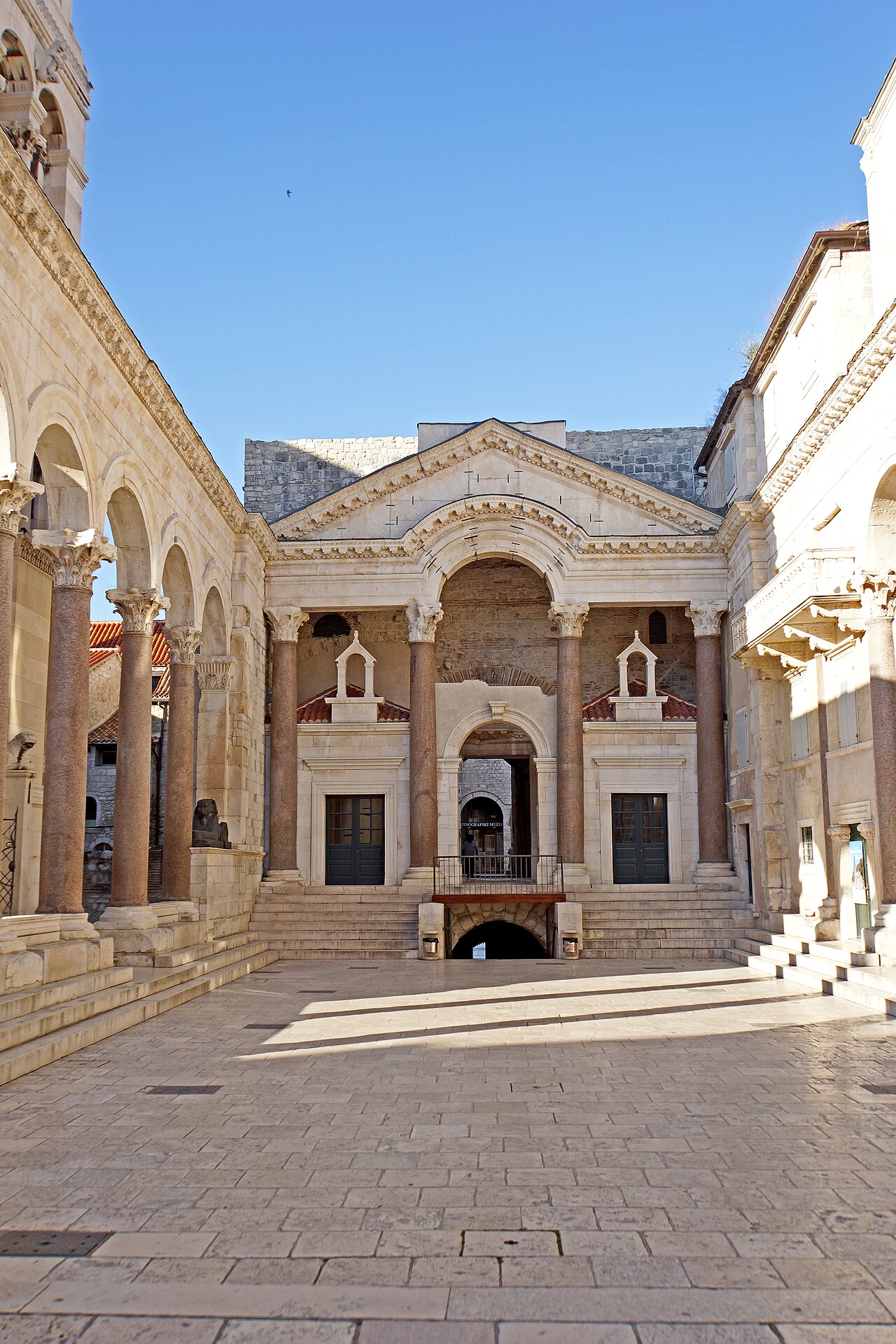
Diocletian’s Palace in Split is not a palace in any conventional sense — it is a living city, with approximately 3,000 people residing inside the walls of a 4th-century Roman imperial residence. Built between 295 and 305 CE as the retirement estate of the Emperor Diocletian, it covers roughly 30,000 square metres on the Dalmatian coast and is one of the best-preserved Roman complexes in the world. UNESCO inscribed the Historic Complex of Split with Diocletian’s Palace in 1979.
The Emperor Who Abdicated, the Palace He Built for Himself, and the City That Grew Inside It Split, central Dalmatia — ferry hub for the Adriatic islands
Diocletian was born around 244 CE in the Roman province of Dalmatia — probably at Salona (now Solin), a few kilometres from where his palace now stands — and rose through the ranks of the Roman military to become emperor in 284 CE. His reign reshaped the late Roman state: he introduced the Tetrarchy, dividing authority among four co-emperors to stabilise a vast empire that had been fractured by a half-century of military usurpations, and he launched the Great Persecution of Christians in 303–311 CE, the last and most severe Roman persecution of the new religion. In 305 CE, Diocletian did something no Roman emperor before him had done voluntarily: he abdicated, ceding power to his co-emperor Maximian, and retired to the palace he had spent a decade building on the Dalmatian coast.
Construction of the palace began around 295 CE and was substantially complete when Diocletian arrived in 305 CE. It occupies a rectangular footprint of approximately 215 by 180 metres, with walls 2 metres thick and up to 28 metres high reinforced by 16 towers. The layout combined the plan of a Roman military fortress — four gates, two main streets crossing at right angles — with the amenities of an imperial villa. The southern half, facing the sea, contained Diocletian’s private apartments, the mausoleum, and two temples; the northern half, structured around the military layout, housed the garrison and administrative functions. The palace was built from local Brač limestone — the same pale, fine-grained stone used centuries later in the construction of the White House in Washington DC — and from granite and marble imported from Egypt.
When the Western Roman Empire collapsed in 476 CE and the nearby city of Salona was sacked and abandoned by Avars and Slavs in the early 7th century, the surviving population moved inside the palace walls. They built houses between the columns, installed hearths in the temples, subdivided the great vaulted halls of the basement, and gradually converted the imperial complex into a medieval town. The Peristyle — the open ceremonial courtyard at the heart of the southern half — became the main square. Diocletian’s mausoleum became the Cathedral of Saint Domnius, one of the oldest-functioning cathedrals in the world, still used for regular liturgical services today. The palace did not fall into ruin and get excavated; it was continuously inhabited and transformed over 1,700 years into the city that exists within its walls.
Today approximately 3,000 people live inside the palace walls — in medieval apartments above Roman arches, in houses built into the galleries of the Peristyle, in flats that occupy what were once imperial sleeping chambers. The old town within the walls contains cafés, restaurants, hotels, a cathedral, several churches, the Split City Museum, and the Archaeological Museum (now relocated outside the palace, though its collections span both sites). The boundary between a Roman archaeological site and a living 21st-century city is simply absent: both occupy the same walls simultaneously.
The Mausoleum That Became a Cathedral, the Egyptian Sphinxes, and the Game of Thrones Cellars Old town — entire palace interior walkable; Meštrović Gallery 2 km west
The Mausoleum of Diocletian stands in the southeast corner of the palace complex, directly adjacent to the Peristyle. Diocletian designed it as his burial chamber — a domed octagonal structure of exceptional architectural refinement, with a coffered ceiling above and a colonnade of Corinthian columns surrounding the exterior drum. Diocletian was buried here following his death around 311 CE; his remains and sarcophagus were later removed or lost during the Christian period. In the early 7th century, the citizens who had moved into the palace converted the mausoleum into a church dedicated to the Virgin Mary and later to Saint Domnius — a Christian bishop martyred during Diocletian’s own persecution. The conversion was complete by the 7th century, making the Cathedral of Saint Domnius one of the oldest continuously functioning churches in the world, operating in a building originally designed by and for the man who had ordered the killing of its patron saint. The original bronze doors and the 13th-century Romanesque bell tower — built against the exterior of the Roman mausoleum drum — complete one of the most layered architectural juxtapositions in Europe.
On the Peristyle itself, four granite sphinxes from Egypt stand on their original 3,500-year-old bases — brought from Egypt by Diocletian to flank the entrance to his mausoleum. One is relatively intact; the others are fragmentary. They are among the oldest objects in Split, predating the palace by more than 2,000 years. The Peristyle also features a pedimented entrance portico with Corinthian columns that defines the southern approach to the mausoleum; this colonnaded space is still used for public events, concerts, and film screenings, a continuation of its function as a ceremonial gathering place that has lasted nearly 1,700 years.
The basement halls of the palace — the Podrum, or cellars — are an intact labyrinth of vaulted Roman rooms and corridors that precisely mirror the floor plan of the imperial apartments above. Diocletian’s living quarters were built on a raised platform over these service spaces; the cellars provided storage, drainage, and structural support for the residence above. Since the basement was not inhabited after the medieval period, it preserves the Roman structure with minimal alteration — an underground map of the palace plan that the floors above, built over and rebuilt repeatedly through the centuries, no longer provide. The cellars became internationally recognisable when HBO’s Game of Thrones used them as the filming location for the Dragon Queen Daenerys’s throne room in Meereen during seasons four and five. Visitor numbers to the Podrum increased substantially after the series aired.
Outside the palace walls, Split’s wider heritage extends to the Meštrović Gallery — the former studio and home of the Croatian sculptor Ivan Meštrović (1883–1962), 2 km west along the Riva promenade — and to Solin (ancient Salona), 5 km inland, where the ruins of the Roman city Diocletian was born near include an amphitheatre, early Christian basilicas, and extensive necropolis areas.
Practical information
Split is the main ferry hub of the Croatian Dalmatian coast. Jadrolinija and other ferry operators run services from Split to the islands of Hvar (car ferry to Stari Grad: 2 hours; passenger catamaran to Hvar town: 1 hour), Brač (car ferry to Supetar: 50 minutes), Vis, Šolta, and onward to Ancona in Italy (overnight ferry). Split Airport (SPU) is 20 km west of the city and handles year-round international connections.
Plitvice Lakes National Park is 180 km north by road (approximately 2.5 hours). Dubrovnik is 230 km south (3 to 3.5 hours by car, depending on the Neum corridor crossing into and out of Bosnia and Herzegovina). Trogir, a smaller UNESCO-inscribed medieval town, is 27 km west (30 minutes) and easily combined as a half-day addition.
Entry to the palace grounds is free — the old town is a living city, not a ticketed archaeological site. The Cathedral of Saint Domnius charges a fee for entry to the treasury and bell tower (approximately €5–8). The Podrum (basement halls) charges a separate entry fee of approximately €10. The Meštrović Gallery, operated by the Foundation Ivan Meštrović, charges approximately €10 for adults. The best time to visit the palace interior is early morning (before 9:00) or in the evening (after 18:00) when day-trip crowds from cruise ships have departed. The Peristyle, in particular, is significantly more atmospheric with fewer people.
Frequently Asked Questions
Why did Diocletian choose this specific location on the Dalmatian coast for his retirement palace?
Several factors converged on the site now occupied by Split. Diocletian was almost certainly born in or near Salona, the provincial capital of Dalmatia a few kilometres inland — returning to his birthplace region was a deliberate homecoming. The coast at the foot of the Mosor and Kozjak mountains offered a protected position: a small peninsula with deep water suitable for supply ships on the south, and mountain terrain that limited overland approaches. The area was close enough to Salona for communications and supplies but separate enough to constitute a private domain. The stone available locally — Brač limestone from the nearby island — was of sufficient quality for the precision-cut ashlar construction Diocletian’s architects required. The climate was also relevant: the sheltered position of the bay, protected from the worst bora winds by the mountain wall behind, produces a mild coastal microclimate notably different from the exposed open coast. Diocletian’s choice of Dalmatia was not unprecedented; the emperor Maximian, his co-ruler, built a comparable retirement residence at Aquileia in northern Italy, also in a region connected to his origins. The pattern reflects a late Roman tendency for emperors to associate their legitimacy with specific provincial identities rather than with Rome itself — a significant shift from earlier imperial ideology that had placed the city of Rome at the ideological centre of power. Diocletian never returned to Rome after his abdication and apparently resisted pressure from his former co-emperors to do so, reportedly responding with a reference to the excellence of his cabbages.
How was Diocletian’s Mausoleum converted into a Christian cathedral, and why is this historically significant?
The conversion of Diocletian’s Mausoleum into the Cathedral of Saint Domnius is one of the more striking ironies of European religious history. Diocletian was the author of the Great Persecution of 303–311 CE — the most systematic Roman attempt to suppress Christianity, involving the destruction of churches, the burning of scriptures, and the execution of clergy and lay Christians who refused to sacrifice to the Roman gods. Saint Domnius was a bishop of Salona who was martyred during this persecution, almost certainly on Diocletian’s orders or under the legal framework his edicts created. Yet within a century of Diocletian’s death, Christianity had become the official religion of the Roman Empire (under Theodosius I, 380 CE), and within three centuries, the citizens sheltering in Diocletian’s palace had converted his intended tomb into a church dedicated to one of his victims. The mausoleum’s octagonal form — unusual for a Roman tomb, chosen by Diocletian for reasons that remain debated — was well suited to Christian liturgical use. The high drum with its colonnade, the domed interior, and the processional approach through the Peristyle all translated into ecclesiastical architecture without major structural modification. The original porphyry sarcophagus of Diocletian was removed from the building, probably during the early medieval period; its current location is unknown. The cathedral has been in continuous liturgical use since the 7th century, making it one of the oldest functioning churches in the world operating in a pre-Christian structure — and the only one that was originally built as the personal mausoleum of a Roman emperor who persecuted Christians.
What other UNESCO World Heritage Sites can be visited on a trip to Split, and how are they connected?
Split functions as the most convenient hub for Croatia’s Dalmatian UNESCO cluster. Trogir, 27 km west (30 minutes by road or 1 hour by local ferry), is a small island city with an intact medieval core inscribed by UNESCO in 1997 for its exceptional concentration of Romanesque, Gothic, and Renaissance architecture — including the Cathedral of Saint Lawrence with its famous Radovan Portal (1240 CE), considered one of the finest Romanesque sculptural works in the Adriatic. The Stari Grad Plain on Hvar island, 65 km by ferry from Split’s car ferry terminal, is a UNESCO-inscribed ancient Greek agricultural landscape dating to the 4th century BCE. The geometric chora field divisions — stone-walled plots laid out by Greek colonists from Paros — are still used for the cultivation of lavender, grapes, and olives, making them among the oldest continuously cultivated agricultural plots in Europe. Dubrovnik is 230 km south, a 3-hour drive or a scenic overnight coastal bus. Plitvice Lakes National Park is 180 km north, a 2.5-hour drive via the A1 motorway. A ten-day Croatia UNESCO circuit beginning in Split and working outward covers Trogir, Hvar (Stari Grad Plain), Dubrovnik, Plitvice, and optionally Poreč (Euphrasius Basilica) in the north — five separate UNESCO inscriptions connected by ferry, motorway, and coastal road in a logical geographic arc. The ferry network between Split and the islands also provides access to Vis, associated with a significant Greek colonial site at Issa, and Korčula, the medieval walled town where Marco Polo is traditionally said to have been born.

.jpg)