
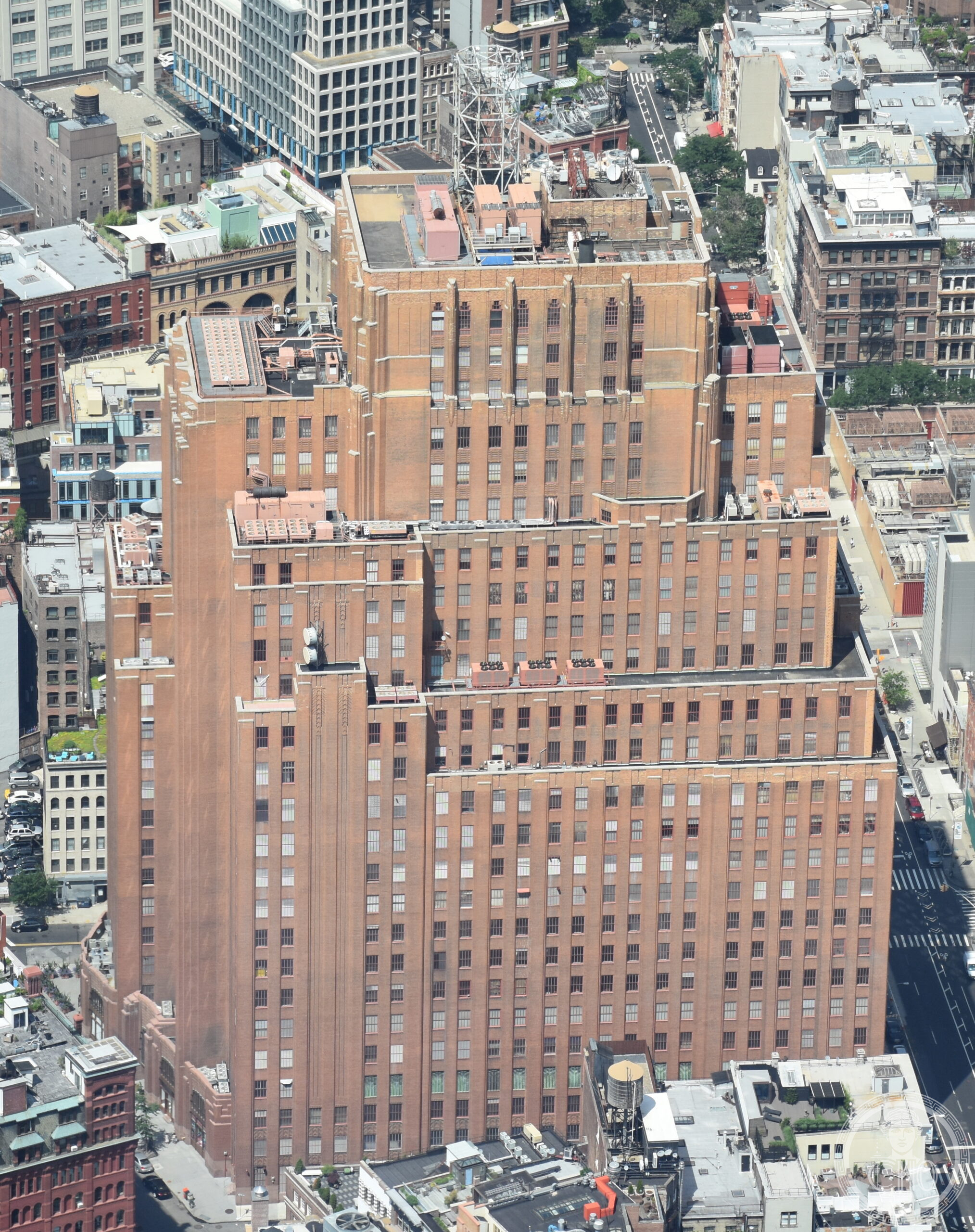
Ralph Walker’s 1930 polychrome brick tower in TriBeCa was built for the Western Union Telegraph Company and has since become one of the world’s most important internet exchange points, a building whose function evolved with communications technology across a century.
At a glance
The Western Union Building at 60 Hudson Street was completed in 1930 to designs by Ralph Walker of the firm Voorhees, Gmelin & Walker, and is notable both as one of the finest Art Deco towers in Lower Manhattan and as a building whose functional life has spanned two eras of communications technology. Built for the Western Union Telegraph Company as its New York headquarters, the 24-story tower occupies a full city block in TriBeCa and is clad in nineteen different shades of brick — an extraordinary chromatic surface unique in New York architecture. The building currently serves as a major internet exchange point, hosting telecommunications infrastructure for dozens of companies.
Key facts
- Location: 60 Hudson Street, TriBeCa, New York City
- Architect: Ralph Walker (firm: Voorhees, Gmelin & Walker)
- Completed: 1930
- Floors: 24 stories
- Style: Art Deco; polychrome brick in nineteen shades
- Status: New York City Individual Landmark; National Register of Historic Places
- Current use: Internet exchange facility (telecommunications)
History
Western Union was at the height of its power as the dominant telegraph company in North America when it commissioned the building in the late 1920s. The Hudson Street location, then in the industrial wholesale district that would later be rebranded TriBeCa, gave the company a large block where it could consolidate New York operations. Ralph Walker had established his reputation with the Barclay-Vesey Building (1927) three blocks south, and his selection for the Western Union commission reflected his standing as the leading architect for large-scale communications infrastructure buildings in New York.
Walker’s principal innovation at 60 Hudson was the polychrome brick exterior. Nineteen different shades of brick, ranging from ivory-white at the lower courses to deep red-brown at the setback crown, were laid in a pattern that gives the surface a shimmering, textile-like quality when seen in raking light. The brick colours correspond to gradations in tone that Walker calculated to complement the building’s massive footprint and to modulate the relationship between the tower and its lower base at street level.
The building’s role as a communications hub persisted through the decline of telegraph communication. When the internet era arrived in the 1990s, 60 Hudson Street’s existing telecommunications infrastructure — its conduit systems, power supplies, and secure access — made it a natural location for internet exchange points, and it became one of the most important nodes in the internet’s physical infrastructure in the northeastern United States.
What you see
The building occupies a substantial footprint, a mass that gives it more the character of a large civic structure than a typical skyscraper. The polychrome brick surface is best seen in morning light from Hudson Street, where the gradations from light to dark across the facade become visible. The setbacks at the upper floors are less dramatic than those of the Barclay-Vesey Building but follow the same organic principle, with the brick ornament concentrating at the transition lines rather than applied uniformly. The entrance portals on Hudson Street retain original Art Deco metalwork and carved stone surrounds.
Because the building operates as a secure internet exchange, public access is restricted to the exterior and entrance areas. The building’s physical presence — occupying an entire lower Manhattan block — is best appreciated by walking around its perimeter, which reveals the variations in brick tone and the subtle changes in the ornamental programme on different elevations.
Practical information
- Access: Telecommunications facility; exterior viewing only.
- Best viewing: The polychrome brick is most visible in morning or late-afternoon raking light from Hudson Street.
- Time needed: 15 minutes for exterior circuit; combine with the Barclay-Vesey Building and the TriBeCa historic district.
- Transit: Franklin Street station (1/2) is two blocks north; Canal Street (A/C/E) is four blocks south.
Getting there
The Western Union Building is at 60 Hudson Street in TriBeCa, between Thomas and Worth Streets. The nearest subway stations are Franklin Street (1/2 trains, two blocks north) and Chambers Street (1/2/3, four blocks south). The building is a ten-minute walk north from the Barclay-Vesey Building and a ten-minute walk south from Canal Street.
Nearby
- Barclay-Vesey Building (1927) — Ralph Walker’s earlier telephone exchange tower, four blocks south at 140 West Street, showing the Barclay-Vesey idiom that Walker refined in the Western Union building.
- TriBeCa Historic District — The surrounding cast-iron warehouse district from the 1860s-1880s, one of the largest collections of mid-nineteenth-century commercial architecture in the United States.
- New York City Police Museum (former) — In the former Police Headquarters (1909), one block east, a Baroque-influenced civic building.
- Washington Market Park — The small park on Chambers and Greenwich Streets, two blocks south, on the site of the former Washington Market wholesale district.
Sources
- New York City Landmarks Preservation Commission, Individual Landmark Designation Report: 60 Hudson Street (Western Union Building).
- National Register of Historic Places nomination, Western Union Building.
- Stern, Robert A. M., Gregory Gilmartin, and Thomas Mellins. New York 1930. Rizzoli, 1987.
- Maddox, Robert James. The Western Union Telegraph Company: A History. Archon Books, 1979.
- Wikipedia, “60 Hudson Street,” https://en.wikipedia.org/wiki/60_Hudson_Street.
Find it on the map
See this place and what’s around it →📷 Become a Cultural Heritage Online photographer
Share your photos of places: they stay published under your name as the author. The more they're seen, the more you get noticed — and soon a contest will reward the most appreciated photos.
Log in or sign up free to add a photoIs this page about you?
This page is read by travellers and heritage enthusiasts who find it on Google. Tell us how you are connected to this place and we will take it from there.