
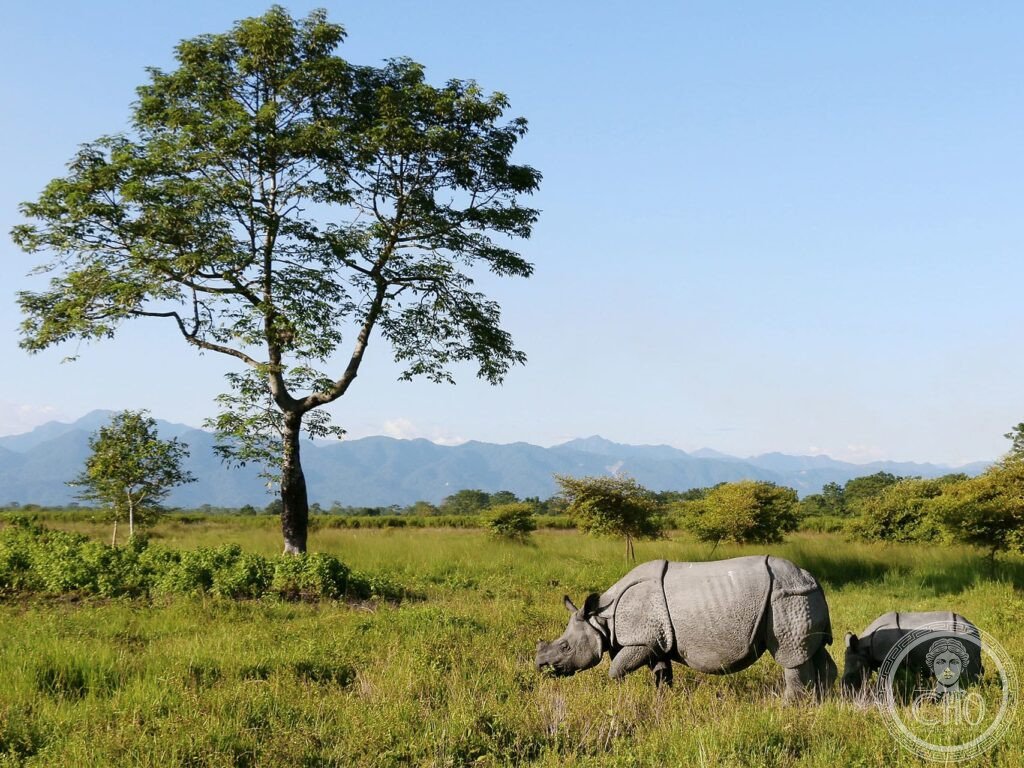
Where the plains of Assam meet the first mountains of the Himalaya, along the border with Bhutan, lies Manas: a tiger reserve of grassland and forest, refuge of such very rare species as the pygmy hog and the golden langur. A wild landscape crossed by the river that gives it its name.
At a glance
Manas National Park, on the Himalayan foothills of Assam along the border with Bhutan, is a tiger reserve of grasslands, forests and the braided Manas river. Its varied habitats shelter an exceptional range of wildlife, including several species found almost nowhere else — the pygmy hog, the golden langur, the hispid hare and the Bengal florican — alongside tigers, elephants and rhinos. This wild and biodiverse landscape was inscribed by UNESCO in 1985.
Key facts
- UNESCO: World Heritage since 1985 (Manas Wildlife Sanctuary)
- Tiger reserve: a core habitat for the Bengal tiger
- Rare endemics: pygmy hog, golden langur, hispid hare, Bengal florican
- Big game: elephants, rhinos and wild buffalo
- Trans-border: continues into Bhutan as the Royal Manas park
- River landscape: the braided Manas river crosses the reserve
History
Long a hunting reserve of the rulers of Cooch Behar and Gauripur, the Manas country was protected as a sanctuary and later a national park and tiger reserve, prized for its rich and unusual wildlife at the meeting of plain and mountain. It was inscribed by UNESCO in 1985.
In the following decades political unrest in the region damaged the park and its animals, and it was placed on the List of World Heritage in Danger. Sustained conservation and the involvement of local communities brought a recovery, and Manas was removed from the danger list in 2011, its rhinos and other species reintroduced and protected.
What you see
Jeep tracks and river trips lead through tall grassland and forest beneath the blue line of the Bhutan hills, where one may see elephants, rhinos, wild buffalo and deer, and — for the fortunate — a tiger or the golden langur in the trees. The Manas river runs clear over shingle through the reserve.
The sense of wilderness, framed by the Himalayan foothills, sets Manas apart.
Practical information
- Park: jeep safaris and river rafting from the Bansbari/Mathanguri ranges
- Best time: November–April
- Time needed: one to two days
- Note: quieter than Kaziranga; arrange permits and guides locally
Getting there
Manas is in western Assam, north-eastern India, on the Bhutan border about 150 km north-west of Guwahati, which has the nearest airport. The park is reached by road. GPS: 26.72° N, 91.00° E.
Nearby
- Bhutan — the Royal Manas National Park across the border
- Guwahati — the largest city of Assam, to the south-east
- Bodoland — the region and its Bodo culture
Sources
- UNESCO World Heritage Centre — “Manas Wildlife Sanctuary” (ref. 338)
- Assam Forest Department / Bodoland — official body
- Encyclopaedia Britannica — Manas Wildlife Sanctuary
Find it on the map
See this place and what’s around it →📷 Become a Cultural Heritage Online photographer
Share your photos of places: they stay published under your name as the author. The more they're seen, the more you get noticed — and soon a contest will reward the most appreciated photos.
Log in or sign up free to add a photo