
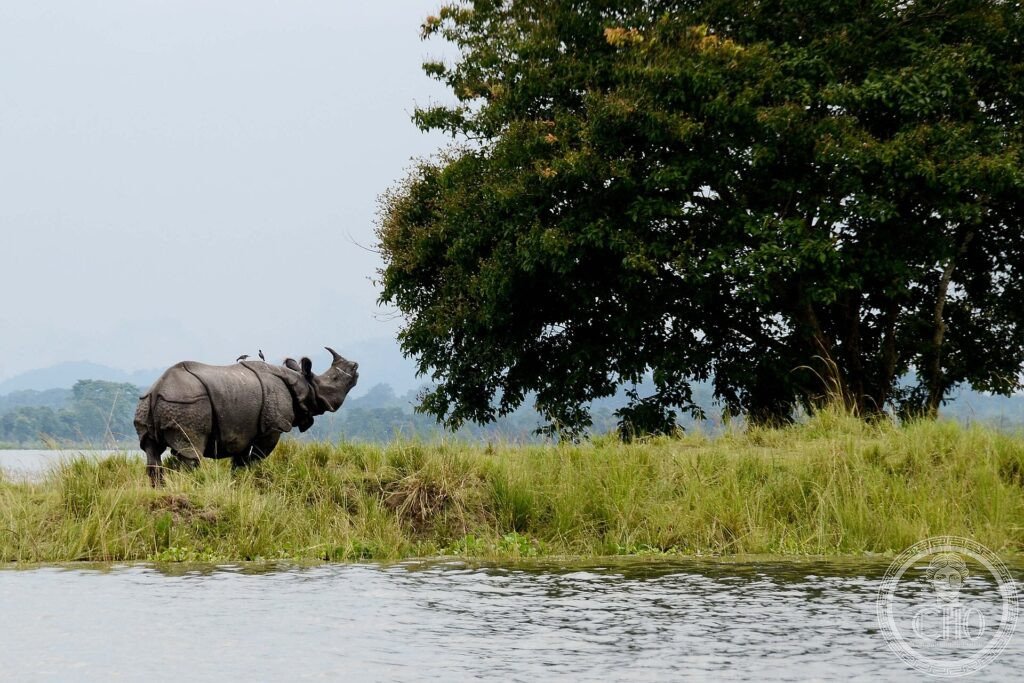
On the floodplain of the Brahmaputra, among tall grasses and marshes, lives the largest population in the world of the one-horned Indian rhinoceros. Kaziranga, in Assam, holds two thirds of the world total, along with tigers, elephants and swamp deer: one of the great conservation successes of Asia.
At a glance
Kaziranga National Park, on the floodplain of the Brahmaputra river in Assam, holds the largest population in the world of the greater one-horned (Indian) rhinoceros — about two-thirds of the global total. Its tall elephant grass, swamps and forests, flooded each year by the river, also shelter tigers, wild elephants, swamp deer and water buffalo, and vast numbers of birds. One of Asia’s great conservation successes, it was inscribed by UNESCO in 1985.
Key facts
- UNESCO: World Heritage since 1985 (Kaziranga National Park)
- One-horned rhino: the largest population in the world, about two-thirds of the total
- Big game: tigers, wild elephants, swamp deer and water buffalo
- Brahmaputra floodplain: grassland and swamp flooded each year
- Birdlife: a wetland of international importance for birds
- Conservation icon: a model of recovery from near-extinction
History
At the start of the 20th century the Indian rhinoceros had been hunted almost to extinction in Assam. A reserve was created at Kaziranga in 1905 — by tradition after the wife of the viceroy, Lord Curzon, came to see the rhinos and found none — and strict protection slowly brought the species back. From a handful of animals the population has grown to over two thousand.
The annual flooding of the Brahmaputra renews the grasslands but also drives animals to higher ground and exposes them to danger; anti-poaching patrols and habitat management remain vital. Kaziranga’s success in saving the rhino, alongside its tigers and elephants, led to its inscription by UNESCO in 1985.
What you see
Visitors tour the park by jeep or, traditionally, on elephant-back at dawn, crossing grasslands where rhinos graze singly or in groups, often near pools and rivers, with herds of swamp deer and wild buffalo and, with luck, a glimpse of an elephant or tiger. Watchtowers overlook the wetlands and their birds.
The sea of tall grass under the Assam sky, with the great river beyond, is the setting of Kaziranga.
Practical information
- Park: jeep and (seasonal) elephant safaris from several ranges
- Best time: November–April; the park closes in the monsoon floods
- Time needed: one to two days
- Note: book safaris in advance; stay near the Kohora gate
Getting there
Kaziranga is in central Assam, north-eastern India, on the highway between Guwahati (about 200 km west) and Jorhat. The nearest airports are Jorhat and Guwahati. GPS: 26.58° N, 93.17° E.
Nearby
- Brahmaputra river — the great river along the park’s edge
- Jorhat — the tea-country town to the east
- Majuli — the large river island with its monasteries
Sources
- UNESCO World Heritage Centre — “Kaziranga National Park” (ref. 337)
- Assam Forest Department — official body
- Encyclopaedia Britannica — Kaziranga National Park
Find it on the map
See this place and what’s around it →📷 Become a Cultural Heritage Online photographer
Share your photos of places: they stay published under your name as the author. The more they're seen, the more you get noticed — and soon a contest will reward the most appreciated photos.
Log in or sign up free to add a photo