
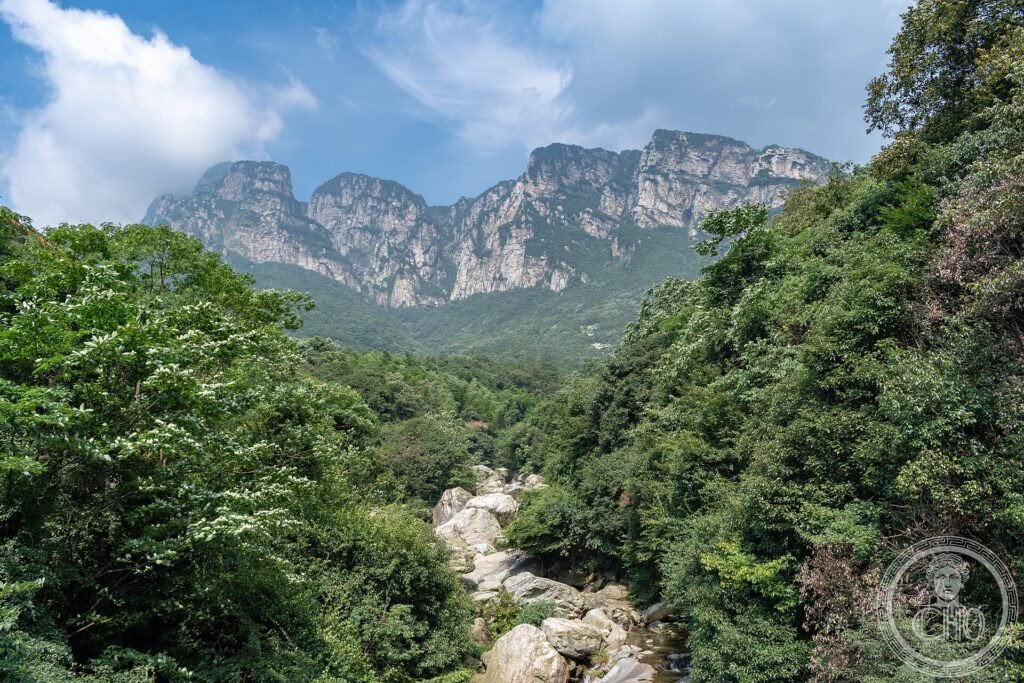
Wrapped in mist above the Yangtze, Mount Lu has been a forge of Chinese culture for two thousand years: its landscapes have inspired poets and painters, its temples have received Buddhists and Daoists, and its academy was a beacon of Neo-Confucianism. A mountain where nature and the Chinese spirit merge.
At a glance
Mount Lu (Lushan), in Jiangxi province near the Yangtze, is one of the great cultural landscapes of China. For two thousand years its misty peaks, waterfalls and gorges have inspired Chinese poets and painters, while its slopes gathered Buddhist and Daoist temples and, above all, the White Deer Grotto Academy, a centre of Neo-Confucian learning under the philosopher Zhu Xi. The interweaving of spectacular scenery with spiritual and intellectual life led to its inscription by UNESCO in 1996 as a cultural landscape.
Key facts
- UNESCO: World Heritage since 1996 (Lushan National Park), a cultural landscape
- Inspiration: celebrated by Chinese poets and landscape painters
- Temples: Buddhist and Daoist monasteries on the slopes
- White Deer Grotto Academy: a great Neo-Confucian school
- Scenery: peaks, waterfalls and gorges often wrapped in cloud
- By the Yangtze: overlooking the river and Poyang Lake
History
Mount Lu rose to fame early: poets of the Tang such as Li Bai wrote of its waterfalls, and generations of painters made it a subject of the landscape tradition. Buddhist monks founded temples here — the Donglin monastery was a cradle of Pure Land Buddhism — and Daoists too retreated to its heights.
In the Song dynasty the philosopher Zhu Xi revived the White Deer Grotto Academy on the mountain, making it a leading centre of Neo-Confucian thought. In modern times Lushan also became a summer hill station with European-style villas. This long layering of nature, religion, learning and history is why it is listed as a cultural landscape.
What you see
Roads and paths wind among forested peaks and ridges, past waterfalls, gorges and viewpoints over the clouds and the distant Yangtze and Poyang Lake. Temples, the White Deer Grotto Academy, pavilions and inscriptions recall the mountain’s spiritual and literary past, while the hill town of Guling preserves old villas.
The shifting mist that gives Lushan its poetic reputation is part of every visit.
Practical information
- Park: entry ticket; roads and trails reach the scenic spots
- Time needed: one to two days
- Note: cool in summer; the mist is part of the experience
- Setting: near Jiujiang on the Yangtze, Jiangxi
Getting there
Mount Lu is in northern Jiangxi province, China, near the city of Jiujiang on the Yangtze. Jiujiang has rail links; the mountain is reached by road. GPS: 29.55° N, 115.98° E.
Nearby
- Poyang Lake — China’s largest freshwater lake, nearby
- Jiujiang — the Yangtze river city at the foot
- Jingdezhen — the historic porcelain city to the east
Sources
- UNESCO World Heritage Centre — “Lushan National Park” (ref. 778)
- Lushan administration — official body
- Encyclopaedia Britannica — Mount Lu; Zhu Xi
Find it on the map
See this place and what’s around it →📷 Become a Cultural Heritage Online photographer
Share your photos of places: they stay published under your name as the author. The more they're seen, the more you get noticed — and soon a contest will reward the most appreciated photos.
Log in or sign up free to add a photo