
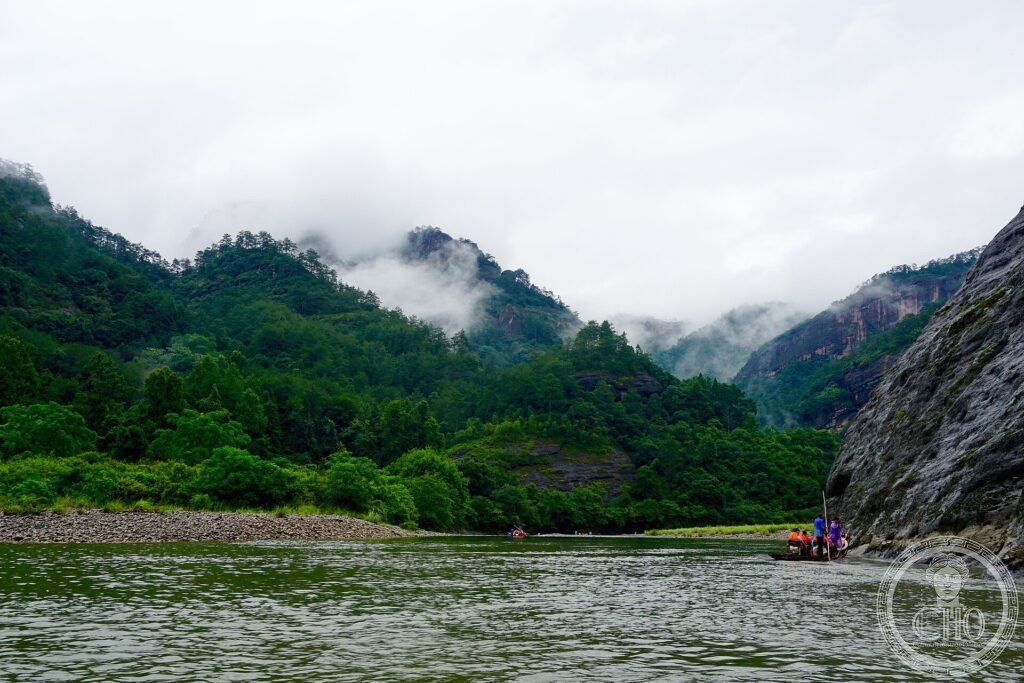
Between reddish cliffs and the winding Nine-Bend River, Mount Wuyi joins spectacular scenery to a history of thought: here, in the twelfth century, the philosopher Zhu Xi worked out the Neo-Confucianism that would shape China and East Asia. And here grow some of the most celebrated teas in the world.
At a glance
Mount Wuyi, in the Fujian province of south-eastern China, is a landscape of dramatic red sandstone cliffs and gorges through which the Nine-Bend River (Jiuqu) winds, famous for its scenery, its biodiversity and its place in the history of Chinese thought. In the 11th and 12th centuries it became a centre of learning where the philosopher Zhu Xi developed Neo-Confucianism, the doctrine that shaped China and East Asia for centuries. It is also the home of celebrated Wuyi teas. This mixed cultural and natural site was inscribed by UNESCO in 1999.
Key facts
- UNESCO: World Heritage since 1999 (Mount Wuyi), a mixed cultural and natural site
- Nine-Bend River: the Jiuqu winding among the cliffs, toured by bamboo raft
- Neo-Confucianism: developed here by the philosopher Zhu Xi in the 12th century
- Academies: Zhu Xi’s academy and many temples among the peaks
- Cliff burials: ancient boat-coffins set in the cliffs
- Wuyi tea: the home of famous rock oolong teas (Da Hong Pao)
History
The Wuyi mountains were long a retreat for Daoists and Buddhists, but their greatest fame came in the Song dynasty, when the scholar Zhu Xi founded an academy here and, in the 12th century, synthesised the strands of Confucian thought into Neo-Confucianism. This philosophy became the orthodoxy of imperial China and spread across Korea, Japan and Vietnam, making Wuyi one of the intellectual cradles of East Asia.
The landscape also preserves far older traces — the mysterious boat-shaped coffins lodged high in the cliffs by a Bronze Age people — and a rich subtropical forest. On its slopes grow the rock teas for which Wuyi is renowned, completing a site where culture and nature are inseparable.
What you see
The classic experience is a bamboo-raft drift down the Nine-Bend River, the clear water curving between sheer red cliffs crowned with green, past peaks, caves and the boat-coffins lodged high in the rock. On the heights stand temples, the ruins of Zhu Xi’s academy and pavilions among the tea terraces.
Walking trails climb to viewpoints over the maze of gorges and the subtropical forest.
Practical information
- River: the bamboo-raft trip on the Nine-Bend River is the highlight
- Time needed: one to two days for river, peaks and tea
- Note: taste the famous Wuyi rock teas
- Setting: in northern Fujian, south-eastern China
Getting there
Mount Wuyi is in the north of Fujian province, south-eastern China. Wuyishan city has an airport and high-speed rail links; the scenic area adjoins the town. GPS: 27.717° N, 117.675° E.
Nearby
- Wuyishan town — the gateway to the scenic area
- Tea villages — the slopes where Wuyi rock teas grow
- Fujian tulou — the UNESCO earthen roundhouses, elsewhere in the province
Sources
- UNESCO World Heritage Centre — “Mount Wuyi” (ref. 911)
- State Administration of Cultural Heritage of China — official body
- Encyclopaedia Britannica — Zhu Xi; Neo-Confucianism
Find it on the map
See this place and what’s around it →📷 Become a Cultural Heritage Online photographer
Share your photos of places: they stay published under your name as the author. The more they're seen, the more you get noticed — and soon a contest will reward the most appreciated photos.
Log in or sign up free to add a photo