

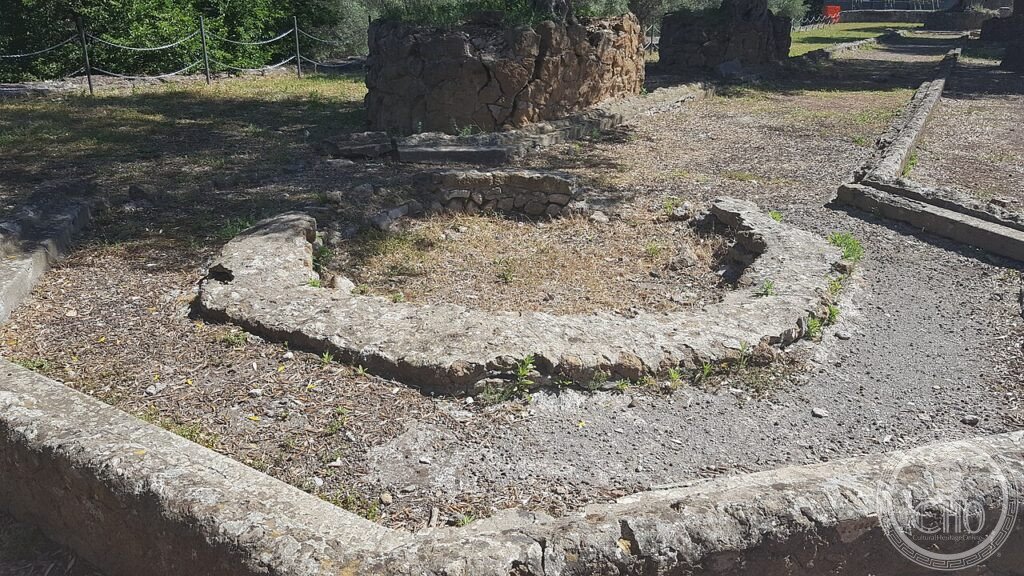
Hadrian designed this vast estate below Tivoli as both an imperial retreat and a three-dimensional museum of the wonders he had seen on his travels across the empire. Covering some 120 hectares, it holds more than thirty structures, from the canal-sanctuary of the Canopo to the private island retreat known as the Teatro Marittimo.
At a glance
Villa Adriana lies on the plain below Tivoli, the ancient Tibur, some way from Rome. It was built between 118 and 134 CE as the personal residence of the emperor Hadrian, who is said to have designed much of it himself. The complex spreads across roughly 120 hectares and originally comprised more than thirty individual buildings, making it the largest imperial villa ever built in the Roman world.
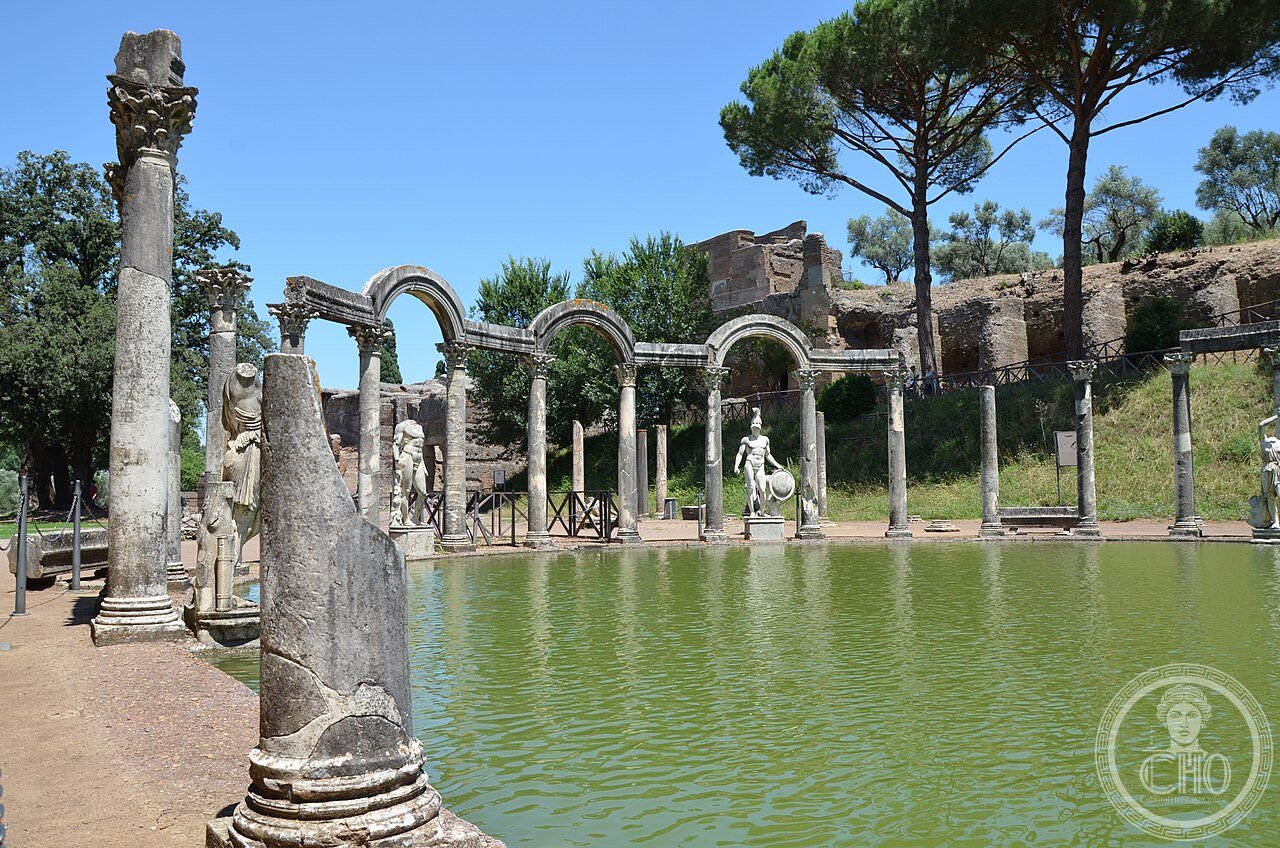
Hadrian conceived the villa as a kind of built anthology of the places he had visited during his tours of the empire. The Canopo recalls the canal-sanctuary of Serapis near Alexandria, the Pecile echoes the Painted Stoa of Athens, and the Accademia refers to the Athenian suburb where Plato taught. The Teatro Marittimo, despite its name, was not a theatre at all but a self-contained island retreat.
Key facts
- Location: on the plain below Tivoli, Lazio, at around 270 m altitude.
- Built: 118–134 CE, under the emperor Hadrian (76–138 CE).
- Extent: about 120 hectares, with more than thirty surviving structures.
- Status: inscribed on the UNESCO World Heritage List in 1999, reference 907.
- Teatro Marittimo: a circular island 43 m across, set in a canal 7 m wide and reached by retractable bridges.
- Canopo and Serapeo: a 119 m canal lined with copies of Greek sculpture, ending in a domed nymphaeum.
History
Hadrian ruled from 117 to 138 CE, consolidating the empire after Trajan’s expansion; Hadrian’s Wall in Britain, begun in 122 CE, is the best-known monument of that policy. He spent a large part of his reign travelling the provinces, and the villa at Tivoli became the place where he gathered architectural memories of what he had seen. The Roman historian Dio Cassius records that Hadrian took a direct hand in design, and that he clashed with Trajan’s architect Apollodorus of Damascus over technical questions.
Construction proceeded in phases: the Pecile, the Teatro Marittimo and the main baths came first, followed by the Canopo, the Serapeo, the Accademia and the Palazzo Imperiale, with smaller baths and the vestibule added towards the end of the reign. After Hadrian’s death the villa continued in use under later emperors, including Marcus Aurelius, Septimius Severus and Diocletian, but was never enlarged, and it was abandoned after the late third century.
Through the Middle Ages the site was quarried for marble and brick used in building Tivoli and Rome. It was rediscovered in the mid-sixteenth century by Cardinal Ippolito II d’Este, who excavated it and removed many of its sculptures for his new Villa d’Este nearby, where some can still be seen in the garden fountains. Villa Adriana was inscribed on the UNESCO World Heritage List in 1999, separately from Villa d’Este, which followed in 2001.
What you see
The site is large enough that a full visit involves several hours of walking over uneven stone and grass, and a site map is worth having to make sense of the scattered ruins. The Pecile is a long rectangular portico with a double inner wall, built to keep a constant temperature for Hadrian’s morning walks. Nearby, the Teatro Marittimo shows its circular island still ringed by its canal, once crossed only by small swing bridges that could be withdrawn to leave the emperor completely isolated; traces of its miniature villa, with an atrium, dining room, baths and sleeping quarters, are still legible.
The bath complexes preserve the raised brick floors of their hypocaust heating systems, which carried hot air beneath the caldarium, tepidarium and frigidarium. At the far end of the site, the Canopo canal is bordered by copies of classical Greek sculpture, including figures modelled on the Caryatids, and leads to the Serapeo, a curved nymphaeum roofed with an early example of a large concrete shell vault.
Practical information
- Time needed: a full circuit of the grounds takes several hours; comfortable footwear is advisable given the uneven terrain.
- Orientation: the site map available at the entrance is useful, as the buildings are spread widely across the grounds.
- Current opening arrangements and admission: check the official channels of the site before visiting, as these can change.
Getting there
Villa Adriana is reached from Rome by regional train to Tivoli, followed by a short local bus or taxi ride to the site entrance on Via di Villa Adriana. Current timetables and fares should be checked directly with the transport operators.
Nearby
- Villa d’Este — a few kilometres away in Tivoli itself; inscribed on the UNESCO World Heritage List in 2001, its gardens include the Fontana dell’Organo and the Cento Fontane, and its fountains incorporate ancient sculpture brought from Villa Adriana.
- Ostia Antica — the ancient port of Rome, covering some 40 hectares and known for its black-and-white mosaics, reachable by train from the capital.
Sources
- Wikipedia, Hadrian’s Villa
- Wikipedia, Hadrian
- Wikipedia, Teatro Marittimo
- UNESCO, Villa Adriana (Tivoli), World Heritage Site reference 907
- MacDonald, William L.; Pinto, John A., Hadrian’s Villa and Its Legacy, Yale University Press, 1995
Gallery
Find it on the map
See this place and what’s around it →📷 Become a Cultural Heritage Online photographer
Share your photos of places: they stay published under your name as the author. The more they're seen, the more you get noticed — and soon a contest will reward the most appreciated photos.
Log in or sign up free to add a photo