

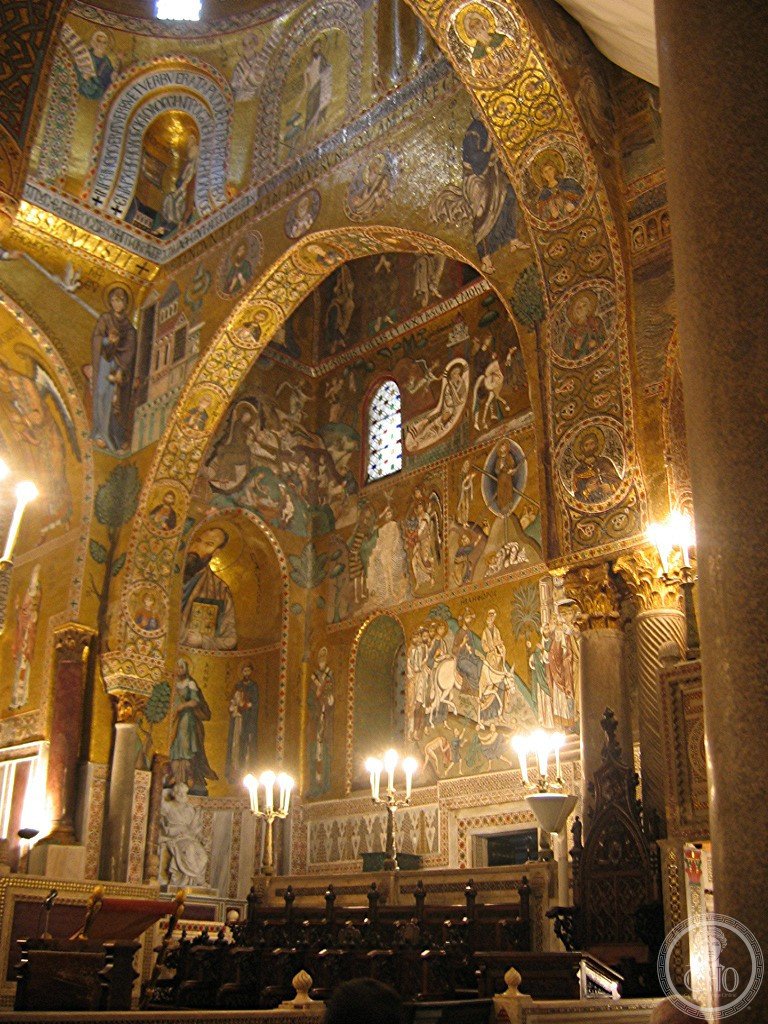
Inside the Palazzo dei Normanni, the Cappella Palatina brings together Byzantine gold mosaics, a painted wooden ceiling carved by Fatimid craftsmen and Latin architecture in a single interior, built for Roger II as the founding monument of Sicily’s Arab-Norman culture.
At a glance
The Cappella Palatina is the royal chapel of the Norman kings of Sicily, built within the Palazzo dei Normanni in Palermo between 1130 and 1143. It forms part of a serial UNESCO World Heritage Site, inscribed in 2015 under the name Palermo Arabo-Normanna, which groups nine components across the city and its surroundings: the Palazzo dei Normanni and its chapel, the churches of San Giovanni degli Eremiti, Santa Maria dell’Ammiraglio and San Cataldo, the Palazzo della Zisa and the Palazzo della Cuba, and the cathedrals of Palermo, Cefalù and Monreale.
The chapel stands as physical evidence of the Norman Kingdom of Sicily founded by Roger II in 1130, a state that united Sicily and southern Italy under Catholic rulers who deliberately kept Byzantine Greek and Arab Islamic craftsmen and traditions at the heart of court life alongside the Latin church.
Key facts
- Location: Palazzo dei Normanni, Piazza del Parlamento, Palermo, Sicilia
- Built: 1130–1143 CE, commissioned by Roger II of Sicily
- Mosaics: around 6,340 square metres of gold tesserae, including the Christ Pantocrator in the central dome and apostolic cycles along the naves
- Ceiling: painted wooden muqarnas ceiling, 1132–1140 CE, carved by Fatimid craftsmen from Cairo
- Plan: Latin cross basilica with three naves divided by two rows of six columns in granite and cipollino marble reused from Roman buildings
- Recognition: part of the Palermo Arabo-Normanna UNESCO World Heritage Site, inscribed in 2015 under reference 1487
History
Arab forces from the Aghlabid dynasty of Tunisia began the conquest of Sicily in 827 and took Palermo in 831, making it their capital under the name Bal’harm. The two and a half centuries of Arab rule that followed left the city with irrigation systems bringing water from the mountains, citrus groves that would come to cover the Conca d’Oro plain, and an architectural vocabulary that included the muqarnas, the horseshoe arch and the pointed arch.
Norman forces under Robert Guiscard and Roger I took Palermo from Arab rule in 1072. Roger I kept much of the existing Arab administration in place, and his son Roger II, crowned king in Palermo Cathedral on Christmas Day 1130, founded the Kingdom of Sicily and began building the Cappella Palatina as the first major monument of the Arab-Norman synthesis, employing Byzantine mosaicists, Fatimid woodcarvers and Latin architects side by side.
The chapel and the wider group of Arab-Norman monuments in Palermo, Cefalù and Monreale were inscribed on the UNESCO World Heritage List in 2015, under reference 1487.
What you see
The chapel’s interior is dominated by gold-ground mosaics covering the walls and the central dome, where a Christ Pantocrator presides above cycles depicting the apostles along the naves. Above, the painted wooden muqarnas ceiling, carved between 1132 and 1140, is arranged in eight compartments carrying medallions of zodiac signs and planetary figures, twenty-eight in total, corresponding to the lunar mansions of Arabic astronomical tradition; Arabic inscriptions among the decoration include praise for Roger II phrased in the language usually reserved for a caliph. The columns supporting the three naves are granite and cipollino marble reused from earlier Roman buildings on the island.
Nearby, the domes of San Giovanni degli Eremiti and the mosaics of the Martorana, including a portrait of Roger II being crowned by Christ, extend the same visual language across the city, while the cathedral at Cefalù preserves apse mosaics from 1148 regarded as among the best-preserved Byzantine work in Sicily.
Practical information
- Booking: entry to the Cappella Palatina requires advance booking through the official channel, federicosecondo.org, with timed entry slots; advance booking is recommended, especially in summer
- Best time to visit: early morning light through the high windows is said to bring out the mosaics most clearly, with late afternoon light favouring the west-facing walls
- Combined ticket: entry usually covers both the chapel and the Palazzo dei Normanni; check current prices and hours on the official site
- City pass: a Palermo Card covering public transport and municipal museums, with a discount on the Cappella Palatina, is available; check current terms officially
Getting there
Palermo is reached by air from major Italian cities, with the airport connected to the centre by bus or train. From Catania, the journey can be made by train, changing at Messina, or by long-distance coach. The Cappella Palatina itself is in the Palazzo dei Normanni on Piazza del Parlamento, in the historic centre of Palermo.
Nearby
- San Giovanni degli Eremiti — a short walk away, known for its five red domes and the remains of an Arab-style paradise garden
- Martorana (Santa Maria dell’Ammiraglio) — in Piazza Bellini, with Byzantine mosaics of 1143 including the only contemporary portrait of Roger II
- Mercato del Capo — a historic city market, a stop for local street food such as sfincioneddi and panelle
- Cattedrale di Cefalù — about 60 km from Palermo, reachable by train, with apse mosaics of 1148 including a large Christ Pantocrator
Sources
- UNESCO
Gallery
Find it on the map
See this place and what’s around it →📷 Become a Cultural Heritage Online photographer
Share your photos of places: they stay published under your name as the author. The more they're seen, the more you get noticed — and soon a contest will reward the most appreciated photos.
Log in or sign up free to add a photoIs this page about you?
This page is read by travellers and heritage enthusiasts who find it on Google. Tell us how you are connected to this place and we will take it from there.