

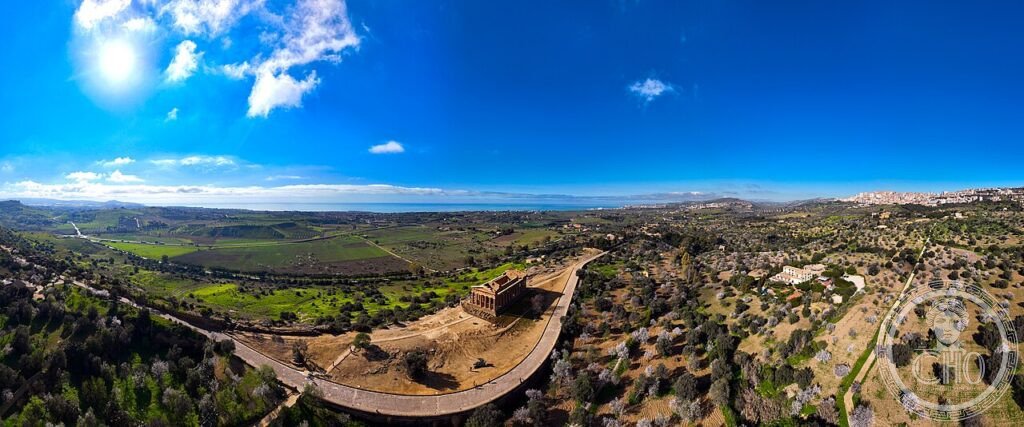
Below the temples of ancient Akragas lies a citrus garden planted inside what was once the largest artificial reservoir of the Greek world, dug by Carthaginian prisoners of war and later farmed, drained and forgotten before the FAI brought it back to life in 1999.
At a glance
The Giardino della Kolymbethra occupies a narrow valley beneath the Temple of Castor and Pollux, within the Valle dei Templi archaeological landscape at Agrigento. What is now a citrus and almond garden of some five hectares began as an enormous artificial lake, built in 480 BCE and later drained and farmed until it fell into decades of neglect. Since 1999 it has been managed by FAI, the Fondo Ambiente Italiano, which restored the orchards and reopened the site to visitors.
Key facts
- Name: Kolymbethra, from the Greek κολυμβήθρα, meaning swimming pool or basin.
- Original structure: an artificial lake built in 480 BCE under Theron, tyrant of Akragas, using Carthaginian prisoners captured after the Battle of Himera.
- Later uses: fish pond and bird-trapping ground in the Roman period, before silting up and draining during the medieval period.
- Present form: a garden of citrus, almond and other Mediterranean plants covering around five hectares.
- Management: restored and run by FAI since 1999, following around fifty years of abandonment.
History
The Kolymbethra basin was created in 480 BCE on the orders of Theron, tyrant of Akragas, using the forced labour of Carthaginian prisoners taken after the Battle of Himera, a victory won jointly with Gelo of Syracuse. The same workforce is said to have built the city’s water supply and the Temple of Olympian Zeus. The basin served the city as a reservoir, a fish pond stocked with eels and mullet, and a hunting ground for migratory birds drawn to its waters; the Roman writer Diodorus Siculus records its use as a fish pond.
The lake began to silt up under Roman rule and had drained completely by the medieval period, coinciding with the Arab occupation of Sicily. It was during this period that citrus fruits, among them orange, lemon and bergamot, were introduced to the island for the first time, transforming the valley into agricultural land. Cultivation continued under Norman rule and into private ownership, with the garden eventually farmed as a citrus grove until it was abandoned in 1949.
FAI began negotiations to take over the site in 1994 and assumed management in 1999, launching a restoration programme that replanted historic varieties including mulberry, fig, carob, almond and several types of citrus. Archaeological work carried out since has uncovered the rock-cut water channels that once fed the ancient basin, now visible along the garden’s paths.
What you see
The garden descends into the valley below the level of the ridge road, and the drop brings a noticeably cooler, sheltered microclimate. A path of several hundred metres runs through the citrus grove, lined with labelled trees including bergamot, chinotto, citron and other varieties, some of them now rare in commercial cultivation. In spring the lemon blossom gives the valley an intense fragrance.
Alongside the orchards, the rock-cut tunnels that once carried water into the ancient Kolymbethra basin are visible from the walking path, along with the ruins of a Roman-period nymphaeum partway along the route. FAI organises seasonal activities tied to the growing calendar, including citrus harvest workshops in autumn and grafting demonstrations in spring, with talks given by a resident archaeologist.
Practical information
- Tickets and hours: the garden has its own FAI entrance ticket, separate from the Valle dei Templi archaeological park ticket; opening times vary by season, so check the official FAI website before visiting.
- Guided tours: Italian-language walk-through commentary is offered by FAI guides; English-language tours need to be booked in advance through FAI’s official channels.
- Best time to visit: citrus blossom peaks between February and April, with harvest workshops running in autumn; the valley can feel hot and airless around midday in high summer.
- Access note: the descent from the ridge road into the garden is steep, so appropriate footwear is advisable.
Getting there
The garden lies on the south side of the ridge road in the Valle dei Templi, close to the Temple of Castor and Pollux. It can be reached from Agrigento by taxi or by local bus services running to the Valle dei Templi, with the final approach on foot down a steep path into the valley.
Nearby
- Valle dei Templi — adjacent; a UNESCO World Heritage Site since 1997, containing one of the most intact collections of Doric temples outside Greece.
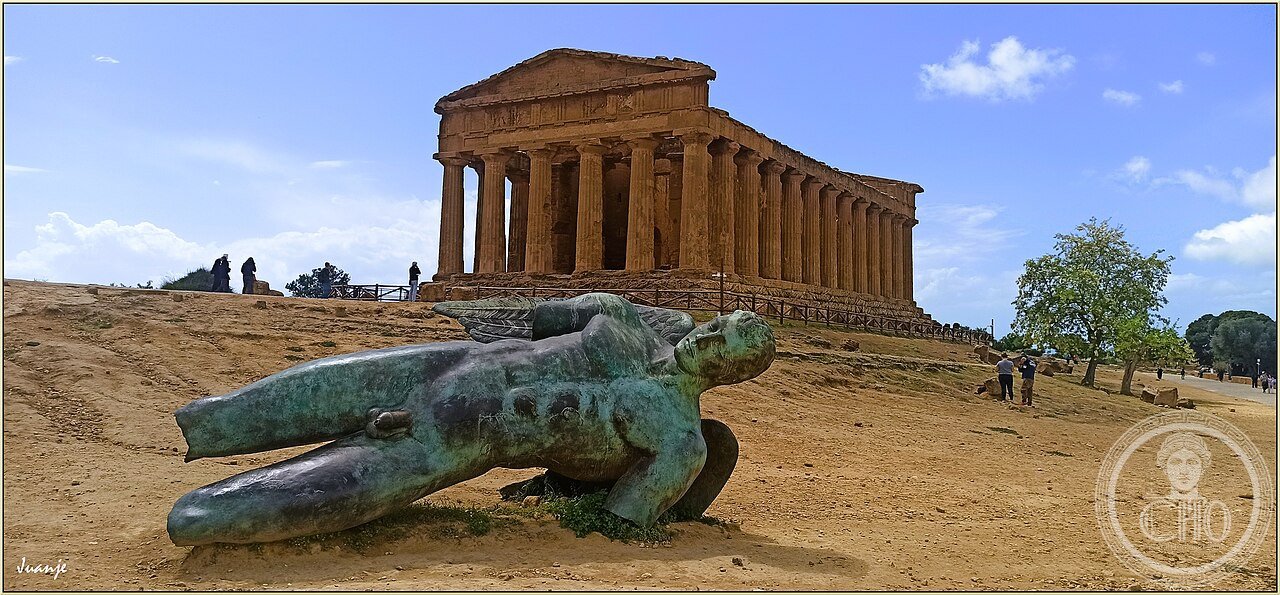
- Temple of Concordia — within the same park; dating from around 430 BCE, it survives with all its original columns and owes its preservation to its later conversion into a Christian church.
- Temple of Hera Lacinia — within the same park; built around 450 BCE, its stones still show fire scarring from the Carthaginian sack of Akragas in 406 BCE.
- Temple of Zeus (Olympieion) — within the same park; begun in 480 BCE as the largest Doric temple ever attempted, it was never finished and now survives in ruins.
Sources
- FAI — Fondo Ambiente Italiano
- Diodorus Siculus
Gallery
Find it on the map
See this place and what’s around it →📷 Become a Cultural Heritage Online photographer
Share your photos of places: they stay published under your name as the author. The more they're seen, the more you get noticed — and soon a contest will reward the most appreciated photos.
Log in or sign up free to add a photo