
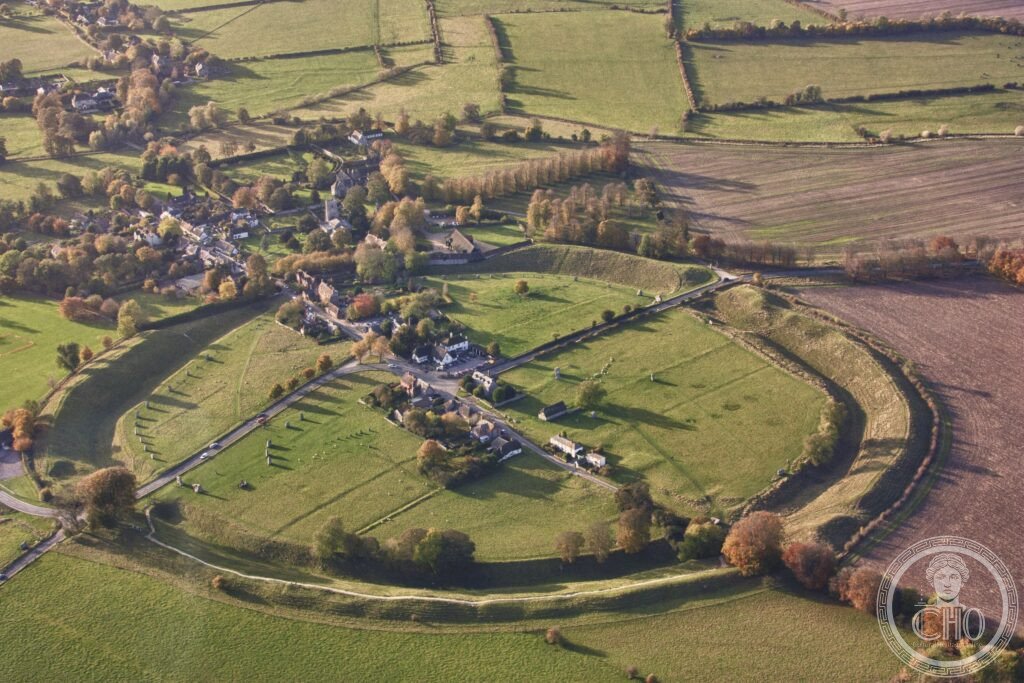
Britain’s largest stone circle has a village inside it. You can walk among the sarsens at any hour, past the pub and the parish church, because Avebury was never fenced off from ordinary life — and the same medieval villagers who lived there also buried the stones, which is how several of them survived.
At a glance
Avebury is a henge monument in the chalk downland of north Wiltshire: a circular bank and internal ditch some 425 metres across, enclosing the largest stone circle in Britain and, within that, two smaller circles. It was built and repeatedly altered during the Neolithic, roughly between 2850 and 2200 BC, and it does not stand alone — it is the centre of the most extensive prehistoric ritual landscape in Europe, tied by stone avenues to Silbury Hill, the West Kennet Long Barrow, Windmill Hill and the Sanctuary. The henge and circles are managed by the National Trust on behalf of English Heritage, and the whole complex is inscribed by UNESCO together with Stonehenge.
Key facts
- Scale: the bank and ditch enclose a circle about 425 metres in diameter; the outer stone circle inside it measures roughly 331 metres. Stonehenge, 30 km south, would fit inside it several times over.
- The stones: the outer circle originally held about a hundred sarsens — hard sandstone blocks dragged from the Marlborough Downs, some weighing tens of tonnes. They were left rough, unlike the shaped and jointed stones of Stonehenge. Only a fraction still stand.
- The inner circles: two, set side by side within the outer ring. The southern held around twenty-nine stones and a central monolith known as the Obelisk, long since gone; the northern held fewer, with the three-stone setting called the Cove at its centre.
- The village: a medieval settlement grew up inside the earthwork and is still there, with a Norman parish church and a pub among the stones. From the fourteenth century villagers toppled and buried stones, some for building material and some, it is usually argued, out of hostility to a pagan monument. Burial preserved them: several were dug up and re-erected in the twentieth century.
- The landscape: Silbury Hill, the largest artificial mound in prehistoric Europe, lies about 2.4 km south; the West Kennet Avenue, a double line of standing stones, runs some 2.5 km from the henge towards the Sanctuary; Windmill Hill, a causewayed enclosure to the north-west, is older than the circle by several centuries.
- Heritage: part of the UNESCO World Heritage Site Stonehenge, Avebury and Associated Sites, inscribed 1986.
- GPS: 51.4286° N, 1.8544° W
History
The monuments were not built to a single plan. Windmill Hill came first, several centuries before the henge; the bank, ditch and stone settings at Avebury took shape over some six hundred years of building, rearranging and adding, and Silbury Hill rose nearby within the same span. What the complex was for is not recorded and cannot be: it belongs to a society without writing. What is clear from the scale of the earth moved and the stone hauled is that it mattered to a great many people over many generations.
Interest revived in the seventeenth century, when the antiquary John Aubrey came upon the stones and reported that Avebury “does as much exceed in greatness the so renowned Stonehenge as a Cathedral does a parish Church”. Charles II visited on his recommendation. Destruction continued regardless: stones were broken up for building well into the eighteenth century, and the antiquary William Stukeley recorded the losses as they happened. The site owes its present legibility to Alexander Keiller, heir to a marmalade fortune, who bought land here in the 1930s, excavated, re-erected fallen stones and marked the missing ones with concrete posts. The museum in the village carries his name and holds the finds.
What you see
The earthwork reads best from the bank: a ditch dug on the inside rather than the outside, which is why Avebury was never a defensive work — whatever happened inside was meant to be separated from the world, not protected from it. Four causeways cross the circuit at the cardinal points, and the modern road still uses two of them.
Among the stones, the difference from Stonehenge is immediate. These are natural boulders, unworked, irregular, and their placing follows no obvious geometry; some are tall and narrow, others squat and broad, a contrast archaeologists have long read as deliberate. Inside the circle stand the Cove, the two surviving stones of the northern setting, and, running south-east from the henge, the surviving stretch of the West Kennet Avenue. Silbury Hill is visible from the road, and the West Kennet Long Barrow — whose chambers can be entered — sits on the ridge beyond it.
Practical information
- Access: the henge and stone circles are open at all times and free to walk. The village lives inside the monument, so the stones are simply there, in fields grazed by sheep — boots are more use than a ticket.
- Paid: the Alexander Keiller Museum, Avebury Manor and the car park charge admission, free to National Trust members; check current arrangements with the Trust before travelling.
- Doing it properly: allow half a day for the circle, the avenue and Silbury Hill together, more if you walk out to the West Kennet Long Barrow. Early morning and late afternoon are quietest, and the low light shows the earthwork far better than midday.
Getting there
Avebury is about 10 km west of Marlborough in Wiltshire, off the A4. By train the nearest useful station is Swindon, with a bus onward to the village; services are sparse at weekends and in winter, so check before relying on them. Many visitors combine Avebury with Stonehenge, 30 km to the south. GPS: 51.4286, -1.8544.
Nearby
- Silbury Hill — 2.4 km south; the largest man-made mound in prehistoric Europe, viewed from the roadside as climbing it is not permitted.
- West Kennet Long Barrow — 3 km south; a Neolithic chambered tomb on the ridge, open to walk into.
- Stonehenge — 30 km south; the other half of the World Heritage Site, and a wholly different kind of monument.
Sources
- English Heritage — Avebury Henge and Stone Circles: description, history and the Avebury World Heritage Site
- National Trust — Avebury: the stone circles and henge, which the Trust manages on English Heritage’s behalf
- Historic England — scheduled monument entry for Avebury henge and stone circles (list entry 1015546)
- UNESCO World Heritage Centre, Stonehenge, Avebury and Associated Sites, inscribed 1986
- Encyclopaedia Britannica, Avebury
Find it on the map
See this place and what’s around it →📷 Become a Cultural Heritage Online photographer
Share your photos of places: they stay published under your name as the author. The more they're seen, the more you get noticed — and soon a contest will reward the most appreciated photos.
Log in or sign up free to add a photoDo you manage this place?
This page is read by travellers and heritage enthusiasts who find it on Google. Keep it accurate — and make it work for you. Free for non-profit heritage institutions.