
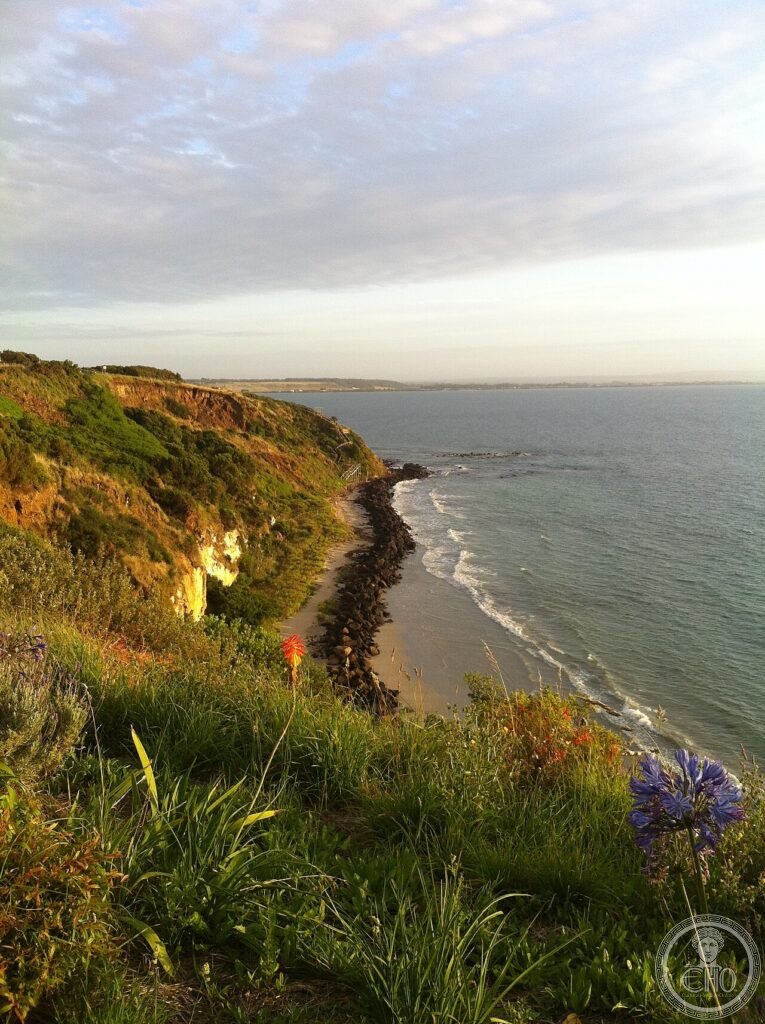
In western Victoria, the Gunditjmara people built stone channels and weirs to trap migrating eels some 6,600 years ago, and lived in permanent stone-walled villages around them. Budj Bim stands as physical proof that Aboriginal Australians farmed and settled long before European colonisation.
At a glance
Budj Bim Cultural Landscape centres on Tae Rak, also known as Lake Condah, in the volcanic country of the Gunditjmara people in western Victoria. Its basalt stone channels and weirs were built to direct the seasonal migration of the shortfin eel, allowing the eels to be trapped in woven baskets called koyang as they crossed over stacked-boulder dams. The system includes overflow channels to keep the wetland healthy, holding ponds where eels were kept alive, and smoking chambers for preserving the catch.
Around the channels stand the foundations of more than 800 stone huts, circular structures with basalt walls still standing to a modest height. Their distribution follows family fishing rights over particular stretches of channel, and together they form some of the clearest physical evidence in Australia of permanent Aboriginal settlement, challenging the assumption that all Aboriginal communities were nomadic.
Key facts
- Location: Heywood area, western Victoria, Australia, around Tae Rak (Lake Condah)
- Built by: the Gunditjmara people, including the Worn Gundidj and Kirrae Whurrong clans
- Age: aquaculture channels dated by carbon analysis of organic material to roughly 6,600 years old
- Purpose: managing migrating shortfin eel populations for a reliable, year-round food supply
- Native title: granted to the Gunditjmara by the Victorian government in 2004 over significant portions of their traditional country
- Management: the Gunditjmara People Aboriginal Corporation, working with Parks Victoria
History
The Gunditjmara constructed the Budj Bim channels and weirs millennia before British colonisation, using them alongside permanent stone settlements built on the strength of the reliable eel harvest. Between roughly 1839 and 1844, after British pastoral settlers moved into western Victoria, the Gunditjmara fought an effective guerrilla resistance known as the Eumerella War, attacking sheep runs in defence of their country. The British authorities responded with punitive expeditions counted among the most violent episodes of the Victorian Frontier Wars, and the Gunditjmara were ultimately confined to the Framlingham and Lake Condah reserves. Despite this, they retained their connection to Budj Bim, and never signed any treaty ceding sovereignty over their land.
The Gunditjmara people never formally ceded sovereignty or accepted colonisation through any legal act. Recognition of their native title rights over the Budj Bim landscape came in 2004, and the site was inscribed by UNESCO in 2019 as the first Aboriginal Australian entry on the World Heritage List. The inscription followed a notably fast nomination process, driven in part by the threat of bushfire; a major fire swept through the region in 2019 and burned a large share of the inscribed area, though the stone channels themselves survived.
What you see
The main visitor facility is the Tae Rak Aquaculture Centre near Lake Condah, run jointly by Parks Victoria and the Gunditjmara Aboriginal Corporation. Guided tours led by Gunditjmara rangers are the most rewarding way to understand the site: rangers demonstrate the koyang trapping technique at the weir, explain the ecological and astronomical knowledge built into the channel design, and discuss both the disruption of the tradition under colonisation and its ongoing revival. Booking ahead is recommended.
Budj Bim National Park, around Mount Eccles and its volcanic crater lake, gives the wider geological context, including lava tube caves and a walking track to the crater rim. The basalt formed by this volcanic activity is the same stone the Gunditjmara shaped into their channels and weirs.
Practical information
- Booking: tours at the Tae Rak Aquaculture Centre should be arranged in advance through the Gunditjmara website
- Access: a 4WD vehicle is recommended in wet conditions, particularly on the road to the centre via Condah
- Best time to visit: spring to autumn, roughly September to April; Victorian winters are cold and wet, and eel migration is most active in September–November and March–April
- Bushfire risk: summer months carry the highest risk of closure due to fire danger
Getting there
Budj Bim lies in western Victoria, with Melbourne the nearest major city and Hamilton the closest regional centre. No public transport serves the site, so a hire car is necessary, whether from Melbourne or from Hamilton.
Nearby
- Port Fairy — a National Trust-classified 19th-century coastal town, site of the 1859 wreck of the Admella and host to the annual Port Fairy Folk Festival
- Tower Hill Wildlife Reserve — a volcanic crater reserve near Warrnambool with emu, kangaroo and koala populations inside the caldera; its eruption, some 30,000 years ago, is recorded in Gunditjmara oral memory
Sources
- Wikipedia
- UNESCO
Find it on the map
See this place and what’s around it →📷 Become a Cultural Heritage Online photographer
Share your photos of places: they stay published under your name as the author. The more they're seen, the more you get noticed — and soon a contest will reward the most appreciated photos.
Log in or sign up free to add a photo