
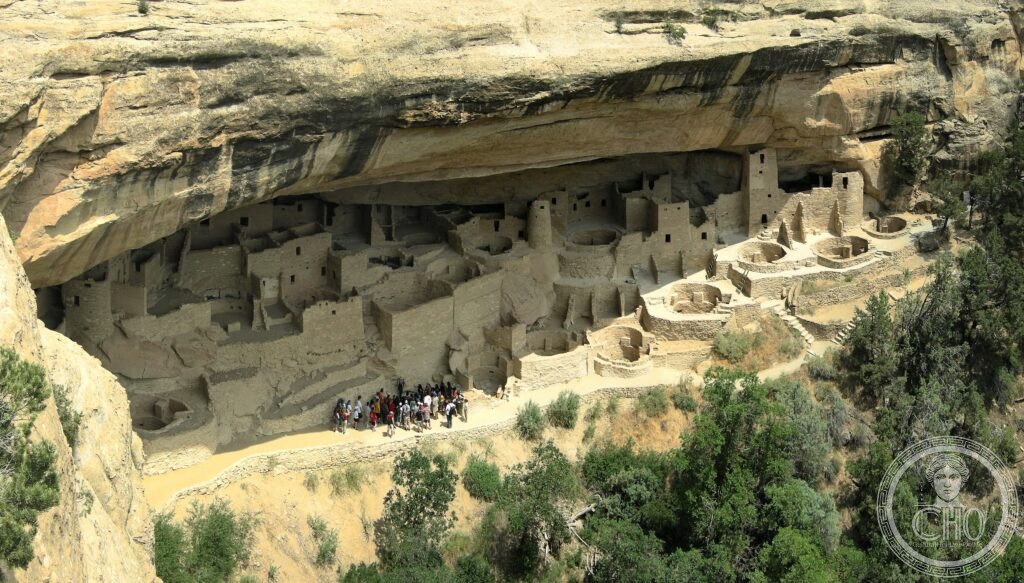
Mesa Verde preserves the largest concentration of cliff dwellings in North America, built into sandstone alcoves by the Ancestral Pueblo people over seven centuries and abandoned around 1300 CE, leaving villages such as Cliff Palace remarkably intact until their rediscovery in 1888.
At a glance
Mesa Verde, meaning Green Table in Spanish, is a flat-topped sandstone mesa in Colorado covered in piñon and juniper trees. Deep canyons cut into its sides created natural overhangs, or alcoves, in which the Ancestral Pueblo people built entire villages. The park contains over 600 cliff dwellings and more than 5,000 archaeological sites in total.
The people who built Mesa Verde are known today as the Ancestral Pueblo people. The older term Anasazi, a Navajo word meaning ancient enemies, is no longer preferred by their descendants.
Key facts
- Cliff Palace: the largest cliff dwelling in North America, with 150 rooms, 23 kivas, and evidence of over 100 inhabitants at its peak.
- Kivas: circular underground ceremonial chambers used for religious rituals; those at Cliff Palace are among the finest preserved in North America.
- Access: Cliff Palace includes four-storey towers and is reached by a ranger-led guided tour involving ladders and narrow passages, unsuitable for those with severe claustrophobia.
- Abandonment: the Ancestral Pueblo people left Mesa Verde around 1300 CE after more than 700 years, with a prolonged drought between 1276 and 1299 CE thought to be a contributing factor.
- Descendants: the Mesa Verde Ancestral Puebloans migrated south to the Rio Grande pueblos of New Mexico and Arizona; their descendants include the modern Hopi, Zuni and Acoma peoples.
- Discovery: ranchers Richard Wetherill and Charles Mason found Cliff Palace buried in snow on 18 December 1888 while searching for cattle.
History
The earliest Ancestral Pueblo inhabitants at Mesa Verde, known as Basketmakers, settled the mesa top around 600 CE, living in pit houses dug into the ground. Cliff dwelling construction began around 1150 CE and reached its peak between 1190 and 1260 CE, though the reasons for the move into the alcoves remain debated, whether for defence, spiritual significance or practicality.
The Ancestral Pueblo people also kept domestic turkeys, using their feathers to make warm blankets, a single blanket requiring feathers from many birds. Around 1300 CE, after more than 700 years of continuous occupation, the community abandoned Mesa Verde, likely driven in part by the severe Great Drought of the late thirteenth century.
The site lay largely forgotten until Richard Wetherill and Charles Mason stumbled upon Cliff Palace in a snowstorm in December 1888. Subsequent excavation and sale of artefacts to museums provoked national debate over the protection of Native American heritage, contributing to the passage of the Antiquities Act of 1906. Mesa Verde National Park was inscribed as a UNESCO World Heritage Site in 1978.
What you see
The dwellings are built into natural sandstone alcoves that sheltered them from rain, snow and enemies, with south-facing alcoves capturing winter sun for passive heating. Walls of local sandstone blocks were mortared with adobe, a mixture of sand and clay, and traditionally built by Ancestral Pueblo women. Many rooms still carry geometric murals painted with mineral pigments, red from iron oxide, white from gypsum and black from charcoal.
Practical information
- Visiting Cliff Palace: access is only possible on a ranger-led, timed tour, sold at the Mesa Verde Visitor and Research Center, running from April to November. Check the park’s official channels for current availability.
- Best light: Cliff Palace faces southeast and is well lit in the early morning; the first available tour of the day is recommended.
- Terrain: the tour involves ladders and narrow passages and is not suitable for those with severe claustrophobia.
Getting there
The nearest airport is Durango-La Plata County Airport in Colorado. From there it is a drive of around 55 kilometres to the park entrance, which lies off US Highway 160 east of Cortez, Colorado.
Nearby
- Canyon de Chelly — around 200 km southwest, sacred to the Navajo Nation, home to the White House Ruins and the sandstone spire known as Spider Rock.
- Chaco Culture National Historical Park — around 200 km southeast on a partially unpaved road, a UNESCO World Heritage Site since 1987 and the centre of the Ancestral Pueblo world between 850 and 1150 CE, including the multi-storey complex of Pueblo Bonito.
- Grand Canyon — around 300 km southwest, a UNESCO World Heritage Site since 1979.
Sources
- Wikipedia
- UNESCO
Find it on the map
See this place and what’s around it →📷 Become a Cultural Heritage Online photographer
Share your photos of places: they stay published under your name as the author. The more they're seen, the more you get noticed — and soon a contest will reward the most appreciated photos.
Log in or sign up free to add a photo