
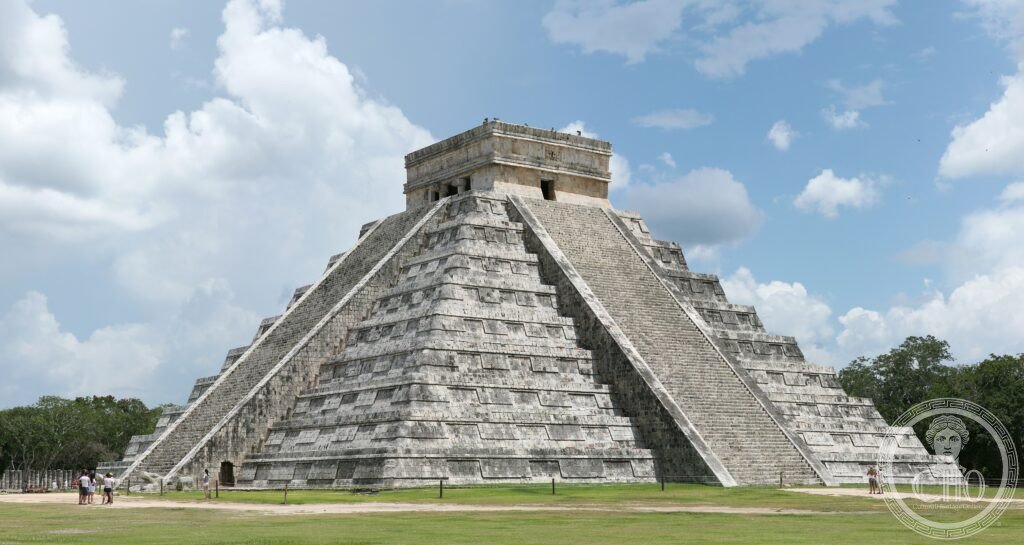
At the heart of this Maya city in the Yucatán stands El Castillo, a stepped pyramid whose staircases add up to the days of the solar year and whose balustrades cast a serpent-shaped shadow at the equinoxes. Around it lie the largest ball court in Mesoamerica and the Sacred Cenote, where excavation recovered thousands of ritual offerings.
At a glance
Chichen Itza was one of the principal cities of the northern Maya lowlands, occupied through the Terminal Classic and Early Post-Classic periods. The site is laid out in two zones, one showing Toltec-influenced architecture and the other in the older Puuc Maya style, and scholars still debate whether this mixture reflects a Toltec conquest or an independent parallel development by the Itzá. More than thirty significant structures survive across the complex.
Key facts
- El Castillo: a 30-metre step pyramid, also called the Temple of Kukulcan, with four staircases of 91 steps each; together with the top platform they total 365 steps, matching the days of the solar year.
- Equinox effect: around the spring equinox (20–21 March) and the autumn equinox (22–23 September), the late-afternoon light casts the shadow of the balustrades onto the north staircase, giving the illusion of a serpent descending toward the carved serpent head at its base.
- Great Ball Court: the largest known Maya ball court, measuring 168 by 70 metres, with stone scoring rings set 8 metres up the walls; the court’s parallel walls give it unusually clear long-distance acoustics.
- Sacred Cenote: a natural sinkhole around 60 metres across and some 27 metres deep, with roughly 13.5 metres of water; excavation by Edward Herbert Thompson between 1904 and 1911 recovered a large number of objects, including gold, jade, copal incense and human remains, evidence of ritual sacrifice.
- Heritage status: inscribed by UNESCO as the Pre-Hispanic City of Chichen-Itza in 1988, and named one of the New Seven Wonders of the World in 2007.
History
Chichen Itza rose to prominence in the northern Maya lowlands from around 600 CE, flourishing through the Terminal Classic period and into the Early Post-Classic, until roughly 1200 CE. Colonial-era Maya chronicles describe the Itzá, associated with the city’s later phase, as outsiders arriving from the south-west, though their exact origin remains disputed. The most intensive building phase, between about 800 and 900 CE, produced El Castillo, the Great Ball Court, the causeway to the Sacred Cenote and the Temple of the Warriors.
The city’s role as a major political centre ended sometime between about 1100 and 1250 CE; historians continue to debate whether drought, internal conflict or a shift in trade routes was responsible. Long after its decline, the Spanish colonist Francisco de Montejo attempted to found a capital at the site in 1532, but the settlement was abandoned by 1534. Chichen Itza was inscribed as a UNESCO World Heritage Site in 1988.
What you see
The site divides into a northern area, showing Toltec-influenced building styles, and a southern area in the older Puuc Maya tradition. El Castillo dominates the northern zone and can be viewed from its base; an earlier pyramid buried within it, containing a jaguar throne and a Chac Mool figure, was open to visitors by way of an internal tunnel until access was closed in 2006 for conservation reasons.
Nearby stands the Temple of the Warriors, fronted by some two hundred carved columns depicting Toltec warriors, with a Chac Mool figure at its summit. A short walk north leads to the Sacred Cenote, and close to El Castillo lies the Great Ball Court, notable for the way sound carries across its full length. On equinox evenings large numbers of visitors gather to watch the serpent-shadow effect on El Castillo.
Practical information
- Visiting: the site is actively managed and some interior spaces, including the tunnel inside El Castillo, are closed to protect the monuments; current access arrangements, hours and admission should be checked with the site’s official channels.
- Best time to see the serpent shadow: the effect is visible around the spring and autumn equinoxes, when the site draws particularly large crowds.
- Base: Mérida, around 120 kilometres to the west, is commonly used as an overnight base for visiting Chichen Itza.
Getting there
Chichen Itza lies in Tinum Municipality in the Yucatán, roughly 120 kilometres east of Mérida. ADO buses run from Mérida’s CAME terminal toward the site; travellers should confirm current timetables and connections with the bus operator or the site’s official visitor information before setting out.
Nearby
- Mérida — about 120 kilometres west; the usual overnight base for visiting Chichen Itza, with bus connections to the site.
Sources
- UNESCO
- New Seven Wonders of the World
- Peabody Museum at Harvard
- Museo Nacional de Antropología, Mexico City
Find it on the map
See this place and what’s around it →📷 Become a Cultural Heritage Online photographer
Share your photos of places: they stay published under your name as the author. The more they're seen, the more you get noticed — and soon a contest will reward the most appreciated photos.
Log in or sign up free to add a photo