
The largest living medieval city in the world and the most intact example of an Islamic urban civilization that has been continuously inhabited for twelve centuries. Fès el-Bali, the old city of Fès, is a labyrinth of approximately 9,400 streets and alleys without a single road wide enough for a car, organized around the world’s oldest university and the most important mosque in North Africa, and still functioning as a complete medieval city in the 21st century.
At a glance
Fès el-Bali (Arabic: فاس البالي; “Old Fès”; the historic walled medina; UNESCO WHS 1981; covering approximately 280 hectares (larger than many European city centres); population approximately 100,000–150,000 people living within the walls (the largest concentration of people in any medina in the world)) was founded in 789 AD by Idris I, the founder of the Idrisid dynasty and the first Islamic kingdom in Morocco. The city grew rapidly in the 9th century when 8,000 families of Andalusian refugees (expelled from Córdoba after a rebellion in 818 AD) settled on the west bank of the Oued Fès, creating the Andalusian quarter. And 2,000 Arab families from the Qarawiyyin quarter of Kairouan (in modern Tunisia) settled on the east bank, creating the Qarawiyyin quarter. The two quarters were separated by the river (and sometimes at war with each other) until they were unified by the Almoravid dynasty in 1069–1070. The Merinid dynasty (13th–15th centuries) was the golden age of Fès (the construction of the great madrasas — Quranic schools — including the Bou Inania and Attarine madrasas, which are the most ornate Moroccan-Andalusian architectural interiors in existence). Fès was the capital of Morocco until 1912.
Key facts
- The Université al-Qarawiyyin: the oldest university in continuous operation in the world. The al-Qarawiyyin University (Arabic: جامعة القرويين) was founded in 859 AD by Fatima al-Fihri, a woman of Tunisian origin who inherited her father’s wealth and gave all of it to build the mosque and the school. UNESCO and the Guinness Book of World Records recognise it as the world’s oldest university in continuous operation: it has been teaching for over 1,160 years. From the beginning it taught the Quran, Islamic law, grammar, rhetoric and logic, and later added mathematics, astronomy and history. Its alumni include Pope Sylvester II, Gerbert d’Aurillac, the only French pope, who studied here in the 10th century and is believed to have introduced Arabic numerals to Europe; Ibn Khaldun, the greatest historian of the pre-modern world, who spent time in Fès in the 14th century and wrote the Muqaddimah, the first work of philosophy of history; and Maimonides, the greatest Jewish philosopher of the medieval period, born in Córdoba and a student in Fès in the 12th century. The mosque and library (Morocco’s oldest library; recently restored; open to academic researchers) are in the heart of the medina. The mosque is not accessible to non-Muslims, but the exterior (the entrance portal, the courtyard seen through the door) is visible.
- The Chouara Tannery: the most visually extraordinary craftsmen’s quarter in North Africa. The Chouara Tannery is the largest of the three still working in the medina, in the quarter near Bab Guissa in the north-east. Approximately 100 stone vats of different sizes hold the colours of the trade: white from pigeon droppings, used as a softening agent, yellow from saffron, red from poppy, brown from pomegranate bark, blue from indigo, each vat given to one stage of tanning and dyeing. The hides — mainly cattle, goat, sheep and camel — are worked entirely by hand, with no machines, by techniques unchanged since the medieval period, and the workers stand barefoot in the vats treading them in a solution of pigeon dung and water, whose ammonia softens the leather. The smell is ammoniac, organic and unmistakable, and carries 200 metres. The best view is from the leather shops along the terraces above, where the shopkeepers hand you a sprig of fresh mint to hold under your nose.
- The Merinid madrasas: the most ornate interior spaces in Moroccan architecture. The Bou Inania Madrasa (a Quranic school built by Sultan Abou Inan in 1351–1357; the most architecturally significant building in the Fès medina after the al-Qarawiyyin; open to non-Muslims; entrance approximately 20 MAD; the extraordinary three-layer decoration — zellige tilework (geometric mosaic) on the lower walls to 2 m height, carved stucco arabesque panels in the middle zone, and carved cedarwood honeycomb screens and ceilings above — is the supreme example of the Moroccan-Andalusian architectural style; the central courtyard (the rectangular reflecting pool; the carved portals; the wooden balconies of the student rooms) is one of the most beautiful interior spaces in Africa). The Attarine Madrasa (14th century; adjacent to the al-Qarawiyyin; smaller but equally refined; entry approximately 20 MAD).
- Heritage: UNESCO World Heritage Site, Medina of Fès, inscribed 1981.
- GPS: 34.0653° N, 5.0017° W.
History
Founded 789 AD by Idris I (a descendant of the Prophet who fled east Arabia to North Africa). Expanded by the Andalusian refugee community (818 AD) and the Qarawiyyin Tunisian community (825 AD). The al-Qarawiyyin mosque and university founded 859 AD by Fatima al-Fihri. The Almoravid dynasty unified the two quarters (1069). The Almohad dynasty made Fès a major intellectual and commercial centre (12th century). The Merinid dynasty built the greatest madrasas (13th–15th centuries). Fès remained the spiritual and cultural capital of Morocco through subsequent dynasties. Capital of Morocco until the French Protectorate moved the capital to Rabat (1912). UNESCO WHS 1981. The Aga Khan Trust for Culture has been running a major restoration programme for the medina’s monuments since 2010.
What you see
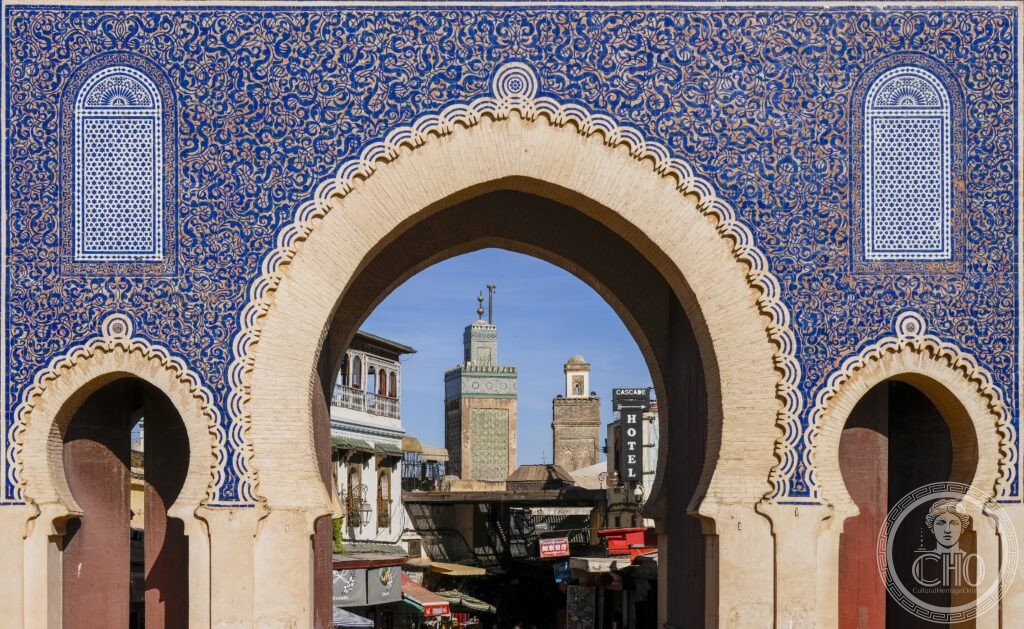
The entry to the medina is through the Bab Bou Jeloud (the “Blue Gate”; the most photographed gate in Morocco; built 1913 by the French Protectorate in the Moroccan-Andalusian style; the blue zelliges on the outer face face the Andalusian quarter; the green zelliges on the inner face face the al-Qarawiyyin; green is the colour of Islam; blue is the colour of Fès). From the gate, the Talaa Kebira (the main artery; one of the widest streets in the medina at approximately 3 metres; descending from the Bab Bou Jeloud toward the al-Qarawiyyin) leads to the Bou Inania Madrasa (on the left; entry approximately 20 MAD), the Attarine Madrasa (near the al-Qarawiyyin; entry approximately 20 MAD), the Chouara Tannery (in the north-east quarter; visible from the leather shop terraces; free access through the shops), the Moulay Idriss II shrine (the most sacred building in Fès; the tomb of Idris II, the founder’s son; non-Muslims may look into the entrance but cannot enter), and the Nejjarine Fountain and Fondouk (the most beautiful fountain in the medina; the cedar woodworking souk around it).
Practical information
- Navigating the medina: the most practically challenging of all UNESCO medinas. The Fès medina has 9,400 streets and is the most complex urban maze in the world: a first-time visitor without a guide or GPS will be lost within 10 minutes, which is at once the greatest challenge and the greatest pleasure of the place. Google Maps works reasonably well offline, so download the map before going in. For a first visit take a local guide, approximately EUR 30–50 for half a day; the official ones from the tourist office are licensed, wear badges, speak several languages and know the craft traditions in detail. One morning with a guide gives enough orientation to explore alone in the afternoon. The medina is busiest and most atmospheric early: craftsmen at work, the hammering from the copper workshops near Seffarine Square, the smell of fresh bread from the communal ovens. The Friday noon prayer empties the streets for a moment, then fills the alleys with recitation from hundreds of minarets at once.
- Getting there: Fès-Saïss Airport (FEZ; 15 km south of the medina; Ryanair from London Stansted, Brussels, Paris Beauvais, Rome Ciampino; Royal Air Maroc from Paris CDG, Amsterdam, Brussels, Madrid, and other European hubs; the airport bus (Line 16) runs to the city centre in 30 min (approximately 20 MAD); taxi approximately 100–120 MAD to the medina). From Marrakech by ONCF train (approximately 7–8h; change at Casablanca; or direct train daily). From Casablanca: 4h by ONCF train. From Tangier: 5–6h by train (direct). The medina is 10 min walk or taxi from Fès train station (Fès-Ville; in the modern Ville Nouvelle).
- The souks: the most complete surviving medieval craft market in the world. The Fès medina organises its craftsmen by trade quarter (an Islamic urban tradition that dates to at least the 10th century AD): the carpentry souk (Seffarine Square; copper and brass metalwork; the hammering is audible from 100 metres). The henna souk (the dried herbs, spices, and cosmetics market). The leather goods souk (adjacent to the tanneries). The textile souk (Kissaria; silk, wool, and cotton brocades). The ceramics workshops (outside the medina walls to the east; the famous blue Fès pottery). The functioning medieval city produces real goods for real Moroccan use, not primarily for tourism. The Fès potters, leather workers, and weavers sell nationally and internationally.
Getting there
Fès-Saïss Airport (15 km; Ryanair from several European cities). Train from Casablanca (4h), Marrakech (7–8h via Casablanca), Tangier (5–6h). GPS: 34.0653, -5.0017.
Nearby
- Meknes and Volubilis. 60 km west of Fès (1h by train or road). The Moroccan Versailles and the best-preserved Roman city in North Africa. Meknes is the imperial city of Sultan Moulay Ismail (1672–1727), the Moroccan Louis XIV, whose 55-year reign is the longest of any Moroccan sultan: he kept 3 European ambassadors permanently at his court, stabled 12,000 horses, held a harem estimated at 500 women, and ringed his capital with a defensive wall 40 km long. The Bab Mansour is the most magnificent city gate in Morocco; he began it in 1672 and his son finished it after his death, in 1732. Volubilis, the Roman city, lies 33 km north of Meknes, UNESCO WHS 1997: 32 hectares and the most complete Roman city in North Africa outside Libya. Its triumphal arch dates to 217 AD, and its mosaic floors are the most complete surviving Roman programme in the region, among them the fishing scene with its sea creatures, dolphins and Orpheus, beside the Capitol and the Basilica. Open daily, 9am–sunset, approximately 70 MAD.
- Ifrane and the Middle Atlas. 65 km south of Fès (1h by road). The “Morocco’s Switzerland” and the Barbary macaque forests. Ifrane is a mountain resort town the French Protectorate built in Swiss chalet style at 1,665 m altitude, with snow in winter and Morocco’s only ski resort nearby at Michlifen. The cedar forests of the Middle Atlas around Ifrane and Azrou are the last habitat in the world of the Barbary macaque, Macaca sylvanus: a tailless Old World monkey, the only wild primate in Africa north of the Sahara and the only wild monkey in Europe, since the Gibraltar colony descends from North African animals. The macaques are semi-habituated along the roadside at Azrou and can be photographed at close range. The forests themselves are the most spectacular in Morocco — some cedars are 1,000+ years old, and the floor is carpeted with undergrowth, unlike the scrubby landscape of the lowlands.
- Chefchaouen. 200 km north-west of Fès (3h by road or CTM bus). The most photographed medina in Morocco for colour. Chefchaouen, the Blue City, is famous worldwide for its blue-painted walls and stairs: a small Berber town in the Rif Mountains at 600 m altitude, with the massif visible from every part of the medina. Moulay Ali ben Rachid founded it in 1471 as a base for resisting Portuguese expansion. The blue is a relatively modern tradition of the 20th century, possibly introduced by the Jewish community that settled here in the 15th century after the expulsion from Spain, since blue traditionally stands for the sky and heaven in Jewish thought. The medina is small, 30 min to walk through, and heavily commercialised for Instagram tourism; the main monuments are the Jemaa, the main square, the Kasbah and the Spanish mosque on the hill above. The best photographs come early, before the day-trippers from Fès and Tetouan arrive.
Sources
- Wikipedia, Fes el-Bali. University of al-Qarawiyyin. Chouara Tannery, accessed June 2026.
- UNESCO, Medina of Fès, WHS reference 170, inscribed 1981.
- Richard Hamilton, The Last Storytellers: Tales from the Heart of Morocco, I.B. Tauris, 2011.
Find it on the map
See this place and what’s around it →📷 Become a Cultural Heritage Online photographer
Share your photos of places: they stay published under your name as the author. The more they're seen, the more you get noticed — and soon a contest will reward the most appreciated photos.
Log in or sign up free to add a photo