
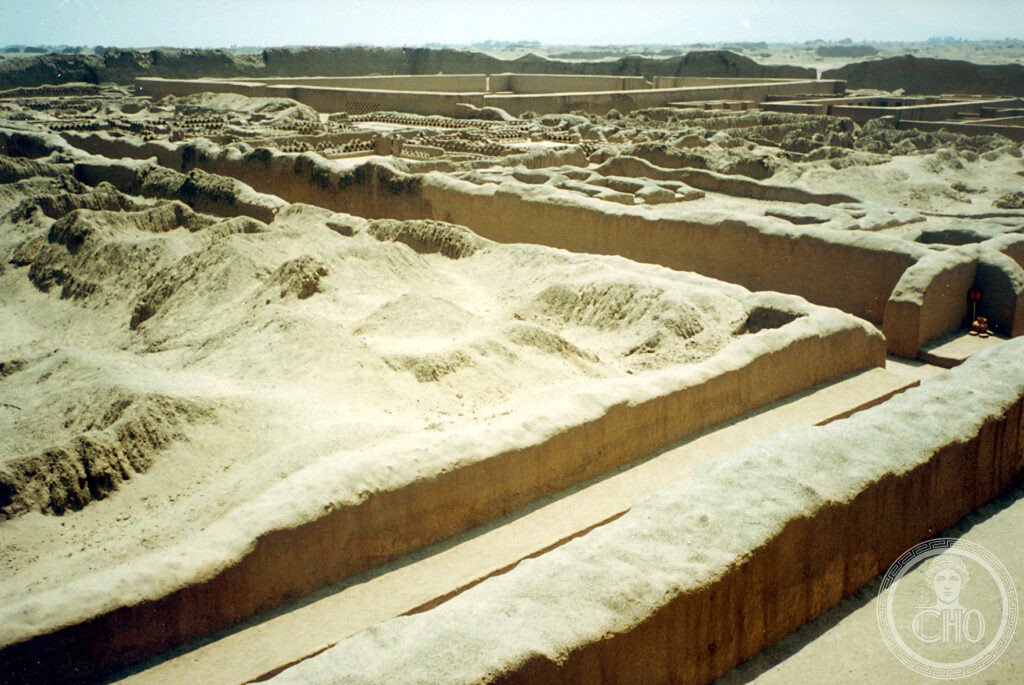
The largest pre-Columbian city in South America and the world’s largest adobe city. Chan Chan (Chimú: “Sun Sun”, a name of great antiquity for a place of great sun) was the capital of the Chimú Empire (c. 900–1470 AD), the most sophisticated pre-Inca civilisation of the Peruvian coast, covering approximately 20 km² and housing approximately 30,000 people at its height in a city of nine royal palace-mausolea (ciudadelas), each built by a different Chimú king and maintained as a royal court after his death, their mud-brick walls carved with an extraordinary vocabulary of maritime friezes.
At a glance
Chan Chan is 5 km west of Trujillo (population approximately 800,000), the third largest city in Peru and the regional capital of La Libertad, on the Pacific coastal desert immediately adjacent to the sea. The archaeological zone (UNESCO WHS 1986; on the World Heritage in Danger list since 1986 due to El Niño rainfall damage and urban encroachment) covers approximately 20 km² and contains the nine royal ciudadelas (the core of the ancient city) plus extensive non-elite residential and artisanal areas. The Ciudadela Tschudi (named for Johann Jakob von Tschudi, the 19th-century Swiss naturalist who described Chan Chan) is the only ciudadela currently open to visitors (it has been partially restored) and can be visited as a 2-hour circuit with the on-site archaeological museum.
Key facts
- The nine ciudadelas (royal palace-mausolea): the most distinctive feature of Chan Chan and the most unusual urban planning system in pre-Columbian America. Chimú royal ideology followed a principle of “split inheritance” (analogous to but predating the Inca system): when a Chimú king died, his heir received all the political power of the kingdom, but the dead king’s palace and his personal wealth (accumulated during his lifetime) remained with his royal panaca (the family group of descendants and courtiers) who maintained the palace as a functioning royal court with the dead king as a mummified oracle. This meant each king had to build a new palace from scratch, creating a new ciudadela for each reign. Nine ciudadelas have been identified (corresponding approximately to the nine kings listed in Chimú oral history at the time of the Spanish conquest, though the exact correspondence is debated). Each ciudadela is an enormous rectangular enclosure of adobe brick walls (up to 9 metres high, 3 metres thick at the base) measuring 200–600 metres on a side, containing within it: the burial platform of the king (a truncated pyramid-like mound where the king was interred with human sacrifices, textiles, metalwork, and ceramics), storerooms, administrative offices, a royal court (U-shaped audience courts called audiencias), a water reservoir (a sunken rectangular pool lined with adobe), and corridors decorated with the geometric friezes.
- The adobe friezes of Ciudadela Tschudi: the most immediately striking visual experience at Chan Chan. The corridor walls of the Ciudadela Tschudi are carved with repeating geometric and figurative friezes in the dry adobe (the carving was done when the adobe was still slightly damp, then dried hard in the coastal desert sun). The frieze vocabulary reflects the maritime economy of the Chimú coast: fish (the primary protein source, caught from the Pacific in reed-mat boats called caballitos de totora), pelicans (the primary fish-indicator bird of the Peruvian coast), sea otters, waves (in a step-fret pattern), and nets (the primary fishing technology). The friezes are arranged in horizontal bands that run the full length of the corridor walls, creating an effect like a continuous moving image. The scale of the decoration is extraordinary. Kilometres of frieze-decorated corridors within a single ciudadela.
- Chimú metalwork and textiles: the Chimú were the finest metalworkers and textile weavers in pre-Columbian South America (a reputation they maintained after the Inca conquest of 1470 AD, when the Inca transported Chimú craftsmen to Cusco to produce luxury goods for the Inca state). Chimú gold and silver work is characterised by the use of hammered sheet metal (not cast metal) shaped into elaborate vessels, ceremonial knives (tumis), earspools, and headdresses. The primary museum collection of Chimú metalwork is in the Larco Museum in Lima. Significant collections are also in the Museo de la Nación in Lima, the Brüning Museum in Lambayeque (50 km north of Trujillo), and the Chan Chan Site Museum.
- The World Heritage in Danger designation: Chan Chan has been on the UNESCO World Heritage in Danger list since 1986 (the year of its inscription, the only site to be simultaneously inscribed and listed as in danger) due to the vulnerability of adobe architecture to rainfall. The coastal desert of La Libertad normally receives less than 10 mm of rainfall per year, a climate in which adobe (sun-dried mud brick) lasts thousands of years without decay. However, the El Niño phenomenon (the periodic warming of the Pacific Ocean off the Peruvian coast) triggers exceptional rainfall years when 100–300 mm of rain can fall in a single season, which erodes and softens the adobe walls. The El Niño event of 1997–1998 caused severe damage to Chan Chan (and to many other coastal pre-Columbian sites in Peru). Subsequent El Niño events in 2016–2017 and 2023 have caused additional damage. Extensive conservation work (using traditional adobe repair techniques) has been ongoing since the 1980s.
- Heritage: UNESCO World Heritage Site (World Heritage in Danger), Chan Chan Archaeological Zone, inscribed 1986.
- GPS: 8.1012° S, 79.0752° W.
History
The Chimú Kingdom (Chimor, the “Kingdom of Chimú”) emerged on the north coast of Peru approximately 900 AD and expanded from its capital at Chan Chan to control the coastal strip from the Tumbes valley (near modern Ecuador) in the north to the Carabaillo valley (near Lima) in the south by approximately 1300 AD. A coastal empire of approximately 1,300 km in length, the largest political entity in South America before the Inca. The Chimú conquered the territories of earlier coastal cultures (the Moche/Mochica culture, 100–700 AD, had preceded the Chimú in the Trujillo area, building the massive adobe pyramids of the Huaca del Sol and Huaca de la Luna). The Inca conquered Chan Chan approximately 1470 AD under the Sapa Inca Tupac Yupanqui (son of Pachacuti, the Inca who built Machu Picchu). The Spanish arrived in 1532 and Pizarro founded Trujillo in 1534, naming it after his hometown in Extremadura, Spain. Chan Chan was used by the Spanish as a quarry for adobe bricks in the construction of colonial Trujillo. The huaqueros (tomb raiders) systematically looted the ciudadela burial platforms throughout the colonial period and into the 20th century, removing the majority of the metalwork and ceramics that had accompanied the Chimú kings in burial.
What you see
The Ciudadela Tschudi visit (the only ciudadela open to visitors) follows a marked circuit through the restored corridor sections of the ciudadela: enter the main gate (the Norte Gateway, approximately 4 metres wide, through the 9-metre wall). Walk through the first large audiencia court (the royal audience hall, U-shaped, with a low raised platform where the king sat to receive visitors and hear petitions; the U-shape is a Chimú architectural convention found throughout the Chimú domain from Chan Chan to smaller regional centres). The decorated corridors (the finest frieze sections are in the northern and western corridor sectors; the fish-and-net pattern and the pelican friezes are the most photographed). The Royal Water Reservoir (a large sunken garden/reservoir, 85 x 55 metres, where the groundwater table is close enough to the surface to maintain a permanent standing water level; the water was important both for practical use and for ceremonial purposes). The Storage Rooms (a large cluster of rectangular storerooms in the north-east corner of the ciudadela, used for storing tribute goods received from subject peoples). The Burial Platform (the mound where the king was buried, at the east end of the ciudadela; the burial platform has been extensively looted but its architectural form — a massive solid adobe mound with ramp access — is intact). The exit through the southern gateway.
Practical information
- Admission: combined ticket covering Ciudadela Tschudi, Chan Chan Site Museum, Huaca Esmeralda (a Chimú temple 2 km south of Chan Chan), and Huaca Arco Iris/La Dragón (a Chimú temple 4 km south) approximately 15 PEN (approximately €3.70; one of the best-value archaeological sites in Peru). The ticket is valid for 2 days. Individual sites cannot be purchased separately. The combined ticket is available at all four sites. The Ciudadela Tschudi is open 9am–4:30pm. Guides are available in Spanish and English at the entrance (approximately 30 PEN additional for a 1.5-hour guided tour, which adds considerable value).
- Getting there: Chan Chan is 5 km west of Trujillo city centre. By taxi from Trujillo centre approximately 15–20 PEN (15 min). By minibus (colectivo, marked “Huanchaco” or “Chan Chan”) from the Trujillo city bus hub, approximately 2 PEN (20 min). The coastal road (Av. Mansiche → Av. Víctor Larco) runs directly past the Chan Chan entrance gate. Trujillo has its own international airport (TRU, Capitán FAP Carlos Martínez de Pinillos Airport) with direct flights from Lima (1h 10 min, several daily with LATAM, Avianca, and Sky Airline) and one-stop connections from Bogotá, Quito, and other South American cities.
- The Trujillo circuit: Chan Chan (the primary site, 2h) + Huaca de la Luna (7 km south of Chan Chan, 3 km from Trujillo; the most spectacular Moche pyramid site in Peru, with extraordinary painted murals of the Moche warrior-deity “Decapitator” and the Moche sacrifice ceremony; the site museum is excellent; allow 2h) + Huanchaco (3 km north-west of Chan Chan on the coast; the most atmospheric traditional fishing village on the north Peruvian coast, with the last practising builders and users of the caballito de totora reed-mat surf boats, which have been built and used on this coast for approximately 3,000 years; excellent seafood ceviche).
Getting there
Trujillo Airport (TRU): direct flights from Lima (1h 10min daily). Taxi from Trujillo city centre (5 km, 15 min). Colectivo bus from Trujillo centre (20 min, 2 PEN). GPS: -8.1012, -79.0752.
Nearby
- Huaca de la Luna (Moche). 7 km south of Chan Chan (15 min by taxi). The most important Moche archaeological site in Peru and one of the most visually stunning pre-Columbian sites in South America. The Huaca de la Luna (Moon Pyramid) is a massive adobe pyramid built in stages from approximately 100 to 600 AD by the Moche civilisation (the culture that preceded the Chimú on the north Peruvian coast). The pyramid’s facade was painted in vivid polychrome (red, yellow, white, black) with enormous images of the “Decapitator” deity (the warrior-deity who sacrifices captive warriors, holding a severed head in one hand and a knife in the other) and with narrative scenes of the Moche sacrifice ceremony. The paint has survived in extraordinary condition on the sheltered facade sections (protected by later construction phases that buried the earlier painted facades). The site museum and guided tour explain the Moche sacrificial ritual depicted in the murals (confirmed by the discovery in 2002 of the skeletal remains of approximately 70 sacrificial victims in front of the pyramid, with Moche Period radiocarbon dating).
- Señor de Sipán Royal Tombs, Lambayeque. 50 km north of Trujillo (45 min by car). The most important archaeological discovery in the Americas in the 20th century. The Royal Tombs of Sipán (discovered 1987 by Peruvian archaeologist Walter Alva after catching a huaquero attempting to sell looted gold) are intact Moche royal burials of approximately 290 AD (the “Lord of Sipán”) and approximately 50 AD (the “Old Lord of Sipán”), both found with the complete funerary offerings in situ: gold pectorals, gold earspools, copper masks, textiles, ceramic vessels, and the skeletons of human retainers sacrificed to accompany the lord in death. The Museo Tumbas Reales de Sipán in Lambayeque (2002, designed by Peter Pfeiffer as an inverted pyramid, a deliberate architectural echo of the truncated pyramid tombs themselves) houses the complete collection with exceptional curation. It is the single best archaeological museum in Peru.
- Huanchaco. 12 km north-west of Trujillo (20 min by taxi). The most authentic traditional fishing village on the Peruvian coast. The caballito de totora (the single-reed surfboard-shaped fishing raft, approximately 3 metres long, paddled by kneeling surfers using a split-cane paddle) has been used at Huanchaco continuously for at least 3,000 years (Moche ceramics depict the identical boat). The last fishermen who still build and use the caballitos in the traditional manner work from the Huanchaco beach at dawn (the reed boats are dried in the sun each day leaning against the seawall — they must be constantly dried to avoid waterlogging and replaced approximately every 3 months). Excellent ceviche restaurants overlook the beach.
Sources
- Wikipedia, Chan Chan. Chimu people. Ciudadela Tschudi, accessed June 2026.
- UNESCO, Chan Chan Archaeological Zone, WHS reference 366, inscribed 1986 (World Heritage in Danger).
- Michael E. Moseley and Kent C. Day (eds.), Chan Chan: Andean Desert City, University of New Mexico Press, 1982.
- John H. Rowe, “The Kingdom of Chimor”, Acta Americana 6(1–2), 1948.
Find it on the map
See this place and what’s around it →📷 Become a Cultural Heritage Online photographer
Share your photos of places: they stay published under your name as the author. The more they're seen, the more you get noticed — and soon a contest will reward the most appreciated photos.
Log in or sign up free to add a photo