
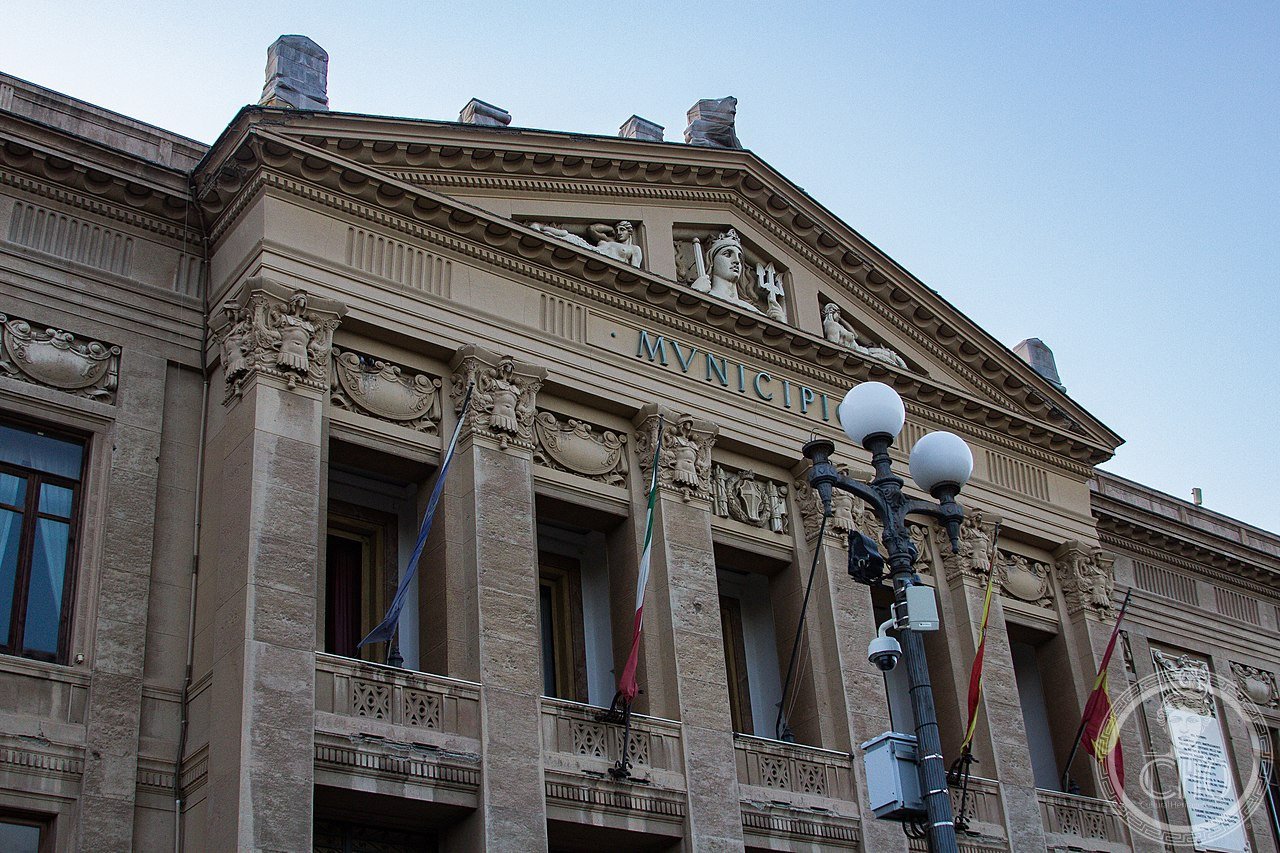
Messina’s city hall rose from the ruins of 1908 in sober neoclassical stone, the work of the Palermo architect Antonio Zanca.
At a glance
Palazzo Zanca is the town hall of Messina, built between 1914 and 1924 to replace the municipal building destroyed by the 1908 earthquake. Designed by the Palermo architect Antonio Zanca, it is a monumental neoclassical block and one of the anchors of the rebuilt city centre.
Key facts
- Built: 1914–1924
- Architect: Antonio Zanca, of Palermo
- Style: Neoclassical
- Context: Reconstruction of Messina after the 1908 earthquake
- Current use: Town hall of Messina
- Coordinates: 38.1939, 15.5558 — Google Maps
History
The earthquake of 1908 destroyed Messina’s town hall along with the rest of the city. Reconstruction of the new Palazzo Zanca began in December 1914 under the direction of Antonio Zanca and was completed in 1924.
The building takes its name from its architect and remains the seat of the city government, its council and executive.
What you see
The facade is a measured neoclassical composition in pale stone, with a giant order and a strong central accent — civic solidity rather than ornament, fitting a city rebuilding its institutions.
Inside, the ceremonial Salone delle Bandiere is the principal room; among the works kept here is a sixteenth-century Last Supper by Alonso Rodriguez.
Practical information
- Working town hall; the ceremonial halls are open on civic occasions and guided visits.
- The facade faces the seafront and is freely visible.
- Central, near the port and the cathedral.
Getting there
Palazzo Zanca faces Piazza Unione Europea on the Messina waterfront, in the city centre near the port and the cathedral.
Nearby
- Galleria Vittorio Emanuele III
- Cathedral of Messina, Piazza Duomo
- Mu.Me. – Regional Museum of Messina
Sources
- Wikipedia, “Palazzo Zanca”
- Comune di Messina
- Studies on the reconstruction of Messina
Find it on the map
See this place and what’s around it →📷 Become a Cultural Heritage Online photographer
Share your photos of places: they stay published under your name as the author. The more they're seen, the more you get noticed — and soon a contest will reward the most appreciated photos.
Log in or sign up free to add a photoIs this page about you?
This page is read by travellers and heritage enthusiasts who find it on Google. Tell us how you are connected to this place and we will take it from there.