
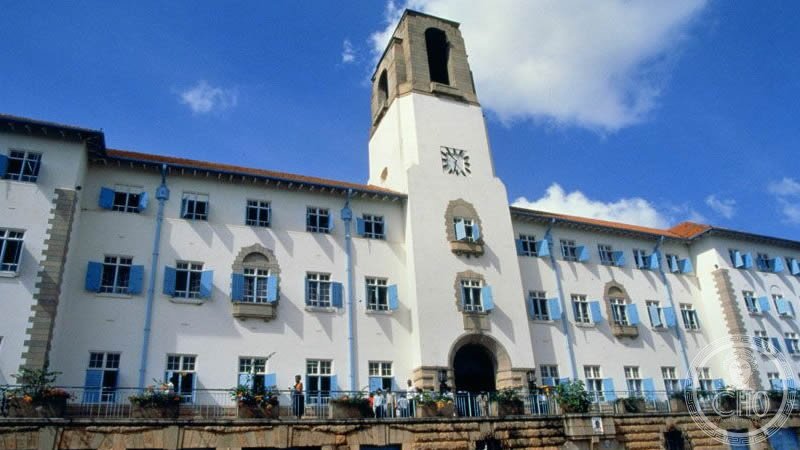
The Baroque clock tower of Makerere University has presided over East Africa’s oldest and most prestigious university since 1941, educating presidents, Nobel laureates, and a generation of African leaders on a hilltop campus in Kampala.
At a glance
- Type
- University building — Main Hall and Administration
- Period
- 1937–1950 (campus development); Main Hall 1941
- Style
- British Colonial Modernism with Baroque clock tower
- Location
- Makerere Hill, Kampala, Uganda
- Coordinates
- 0.3352 N, 32.5680 E
- Architect
- British colonial public works department architects
Overview
Makerere University Main Hall stands at the symbolic heart of what has long been called the “Harvard of Africa.” Perched on Makerere Hill in Kampala, the building anchors a campus of red-brick colonial structures built between the 1930s and 1950s that together form the finest collection of British colonial institutional architecture in East Africa. Founded in 1922 as a technical school, Makerere became a university college in 1949, affiliated with the University of London, and gained full university status in 1970. Today over 35,000 students pursue degrees here across fourteen colleges, carrying forward a tradition of excellence that has shaped the leadership of an entire continent.
History
Makerere’s origins lie in a modest technical school established by the British colonial government in 1922, offering trade and clerical training to a small intake of East African students. Through the 1930s the institution steadily expanded, and the construction of permanent brick buildings on the hilltop — including the Main Hall in 1941 — signaled ambitions beyond mere vocational training. Affiliation with the University of London in 1949 brought academic prestige and drew students from across British East and Central Africa. The university flourished through the 1950s and 1960s, becoming the intellectual engine of African independence movements. Alumni include Ugandan President Yoweri Museveni, Kenyan Nobel Peace Prize laureate Wangari Maathai, Tanzanian founding president Julius Nyerere, and scores of African cabinet ministers and Supreme Court justices. The campus suffered devastating losses under Idi Amin’s dictatorship (1971–1979), when faculty members were killed, imprisoned, or fled into exile and the academic library was looted. Recovery through the 1980s and 1990s was slow but steady, and Makerere reclaimed its continental standing by the 2000s.
Architecture and Design
The Main Hall exemplifies the restrained but dignified approach of British colonial institutional architecture in tropical Africa. Built of locally fired red brick with lime-washed rendering on the clock tower drum, the building adapts European Baroque compositional principles — symmetry, a dominant central tower, rhythmic window bays — to a hilltop setting that commands views across Kampala. The clock tower, the building’s defining element, rises above a colonnaded entrance portico and has served as the visual symbol of Makerere in photographs, stamps, and official imagery for over eighty years. Surrounding buildings on campus follow a coherent palette of dark brick, terracotta tiles, and white render that creates a remarkably harmonious ensemble despite being built piecemeal over two decades. The hilltop siting, likely chosen for drainage and ventilation in the equatorial climate, gives the campus a commanding presence above the surrounding city.
Cultural significance
Makerere University occupies a place in African cultural memory analogous to Oxford or the Sorbonne in the European imagination — a place where an intellectual tradition was forged and where generations of leaders formed lifelong bonds. For the first three decades of African independence, a Makerere degree was the premier credential for public service across the entire East African region. The campus has been the setting for student protests, political debates, and artistic movements that shaped Uganda and its neighbours. Writers including Ngugi wa Thiong’o and Okot p’Bitek taught or studied here, making Makerere a centre of the East African literary renaissance of the 1960s. The Main Hall, as the ceremonial and administrative heart of the campus, has witnessed every graduation, state visit, and moment of crisis in the university’s century-long history.
Visiting today
Makerere University’s hilltop campus is open to visitors and is easily reached from central Kampala. The Main Hall and surrounding colonial buildings can be viewed from the campus grounds; the university welcomes respectful visitors who wish to walk the historic pathways between the brick buildings. The Makerere Art Gallery, housed on campus, displays works by Uganda’s leading artists and is free to enter. The university’s main library contains historical archives relating to East African colonial and post-colonial history. Campus food courts offer affordable local meals. Visitors should be aware that academic buildings may be restricted during examinations and official events.
Getting there
Makerere Hill is approximately four kilometres northwest of Kampala city centre. Boda-boda (motorcycle taxi) riders know the campus well and offer the fastest point-to-point service from anywhere in the city. Matatu minibuses running along Bombo Road pass the campus gates and are the cheapest option. Taxi cabs (shared saloon cars) can be flagged on Bombo Road. Visitors arriving from Entebbe International Airport (about 40 kilometres south) should take the Entebbe Expressway into the city and arrange onward transport from the Old Taxi Park. No parking fee is charged for campus visitors arriving by private vehicle at the main gate on University Road.
Sources and resources
Find it on the map
See this place and what’s around it →📷 Become a Cultural Heritage Online photographer
Share your photos of places: they stay published under your name as the author. The more they're seen, the more you get noticed — and soon a contest will reward the most appreciated photos.
Log in or sign up free to add a photoIs this page about you?
This page is read by travellers and heritage enthusiasts who find it on Google. Tell us how you are connected to this place and we will take it from there.