
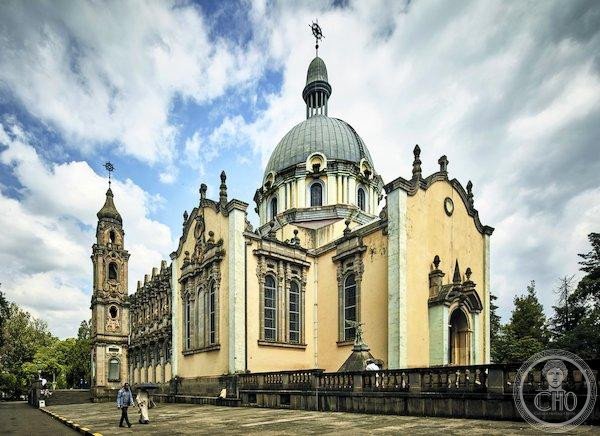
Rising above Addis Ababa with gilded domes and elaborate stained-glass windows, Holy Trinity Cathedral is the most important Ethiopian Orthodox church in the country after the ancient Cathedral of Saint Mary of Zion in Axum. Emperor Haile Selassie I commissioned it in 1933 as a monument of national pride and religious devotion, and construction continued through the Italian occupation, completing in 1944 — the year Ethiopia reclaimed full sovereignty. The building fuses Ethiopian ecclesiastical tradition with Byzantine grandeur and hints of colonial European influence, its richly ornamented facade standing in deliberate contrast to the austerity of the Fascist-era structures built during occupation. Inside, luminous biblical scenes and episodes from Ethiopian history glow in stained glass panels created by Hungarian artist László Horváth. The cathedral serves simultaneously as a house of worship, a mausoleum for the imperial family, a war memorial, and a pilgrimage destination — making it one of Africa's most layered and emotionally resonant ecclesiastical spaces.
At a glance
- Type
- Ethiopian Orthodox cathedral
- Period
- 1933–1944
- Style
- Ethiopian ecclesiastical with Byzantine and European influences
- Location
- Kirkos Sub-city, Addis Ababa, Ethiopia
- Coordinates
- 9.0308 N, 38.7666 E
- Architect
- Ethiopian imperial craftsmen (architect unrecorded)
Overview
Holy Trinity Cathedral occupies a prominent hilltop site in Addis Ababa, its copper-clad domes and carved stone towers visible from much of the city. Emperor Haile Selassie I laid the foundation stone in 1933, intending the building as the spiritual counterpart to his political modernization program. Construction was interrupted — but not stopped — by the Italian occupation of 1936–1941; much of the interior finishing work, including the extraordinary stained-glass cycle, was completed after liberation. The cathedral belongs to the Ethiopian Orthodox Tewahedo Church, one of the oldest Christian denominations in the world, tracing its origins to the 4th century. It is formally known as Kidist Selassie (Holy Trinity) and ranks as the second holiest site in Ethiopia after Axum. The compound includes the main cathedral, a smaller chapel, the imperial mausoleum, memorial obelisks to the patriots who died resisting Italian rule, and the graves of several foreigners who served Ethiopia — among them Sylvia Pankhurst, the British suffragette and Ethiopia advocate who died in Addis Ababa in 1960.
History
The decision to build the cathedral emerged from Haile Selassie's dual agenda: deepening the state's identification with Ethiopian Orthodoxy and projecting imperial grandeur on an international scale. Construction began in 1933, a full three years before Mussolini's invasion. During the occupation (1936–1941) the half-built structure survived largely intact, and the completion of the interior — including the László Horváth windows — took place in the years immediately following liberation, culminating in the formal consecration in 1944. The building thereafter became the dynastic church of the House of Solomon. When Haile Selassie was deposed and killed by the Derg junta in 1975 his body was buried beneath a palace floor in an act of deliberate humiliation; it was only in 2000 that his remains were ceremonially interred in the cathedral mausoleum alongside Empress Menen Asfaw. The memory of the patriots — tens of thousands of Ethiopians killed during the occupation — is honored by memorials in the grounds and by an annual commemorative service.
Architecture and Design
The cathedral blends Ethiopian ecclesiastical form with Byzantine volumetrics and elements absorbed from colonial-era European church design circulating in East Africa in the 1930s. The exterior presents a symmetrical composition of carved stone, arched windows, and multiple domes finished in copper that have aged to a warm green patina. The main portal is framed by figural sculpture mixing Orthodox iconographic convention with the monumental realism favored in state architecture of the period. The most celebrated interior feature is the stained-glass cycle by László Horváth: large narrative panels depicting scenes from the Old and New Testaments alongside episodes from Ethiopian history — the conversion of the Eunuch, the Queen of Sheba, the Battle of Adwa. The floor is polished stone; the sanctuary is screened by an elaborately embroidered curtain in the Orthodox tradition. Lighting enters through the colored glass and through clerestory windows, bathing the interior in shifting colored light throughout the day.
Cultural significance
Holy Trinity Cathedral carries an extraordinary density of national meaning. It is simultaneously a functioning cathedral, a dynastic mausoleum, a war memorial, and a symbol of Ethiopia's centuries-long sovereignty. For the global Rastafari movement, which regards Haile Selassie as divine, the cathedral is a pilgrimage site of the highest order; Rastafari from Jamaica, the UK, and North America travel to Addis Ababa specifically to pray at the emperor's tomb. The cathedral also commemorates Ethiopia's victory at the Battle of Adwa (1896), when Ethiopian forces inflicted a decisive defeat on the Italian colonial army — the only African nation to do so in the era of European expansion. The presence of Sylvia Pankhurst's grave connects the site to a broader international story of anti-fascist solidarity and resistance to occupation.
Visiting today
Holy Trinity Cathedral is open to non-Orthodox visitors, though modest dress — shoulders and knees covered — is required and shoes must be removed at the entrance to the sanctuary. The mausoleum of Haile Selassie and Empress Menen is accessible and clearly signed. A small museum in the compound displays imperial regalia, vestments, and photographs. The cathedral is an active place of worship; Sunday morning services beginning around 6:00 am draw large congregations and offer a remarkable experience for early-rising visitors. Photography is generally permitted in the grounds and exterior; flash photography inside the sanctuary should be avoided. An entrance fee applies for tourists. Guides are available at the gate.
Getting there
Holy Trinity Cathedral is located in the Kirkos Sub-city of Addis Ababa, roughly 2 km east of Meskel Square, the city's main ceremonial plaza. The Addis Ababa Light Rail Transit (LRT) serves the city center; the nearest stop is Mexico Square (about 1 km walk). Taxis and minibuses (shared taxis) are the most practical option for visitors; tuk-tuks (bajaj) are also widely available and inexpensive for short distances within the city. Ride-hailing apps including Ride and ZayRide operate in Addis Ababa. The cathedral is a well-known landmark and taxi drivers will know it by name (also called Kidist Selassie). Allow extra time on Sunday mornings when traffic around the cathedral is heavy.
Sources and resources
Find it on the map
See this place and what’s around it →📷 Become a Cultural Heritage Online photographer
Share your photos of places: they stay published under your name as the author. The more they're seen, the more you get noticed — and soon a contest will reward the most appreciated photos.
Log in or sign up free to add a photoIs this page about you?
This page is read by travellers and heritage enthusiasts who find it on Google. Tell us how you are connected to this place and we will take it from there.