

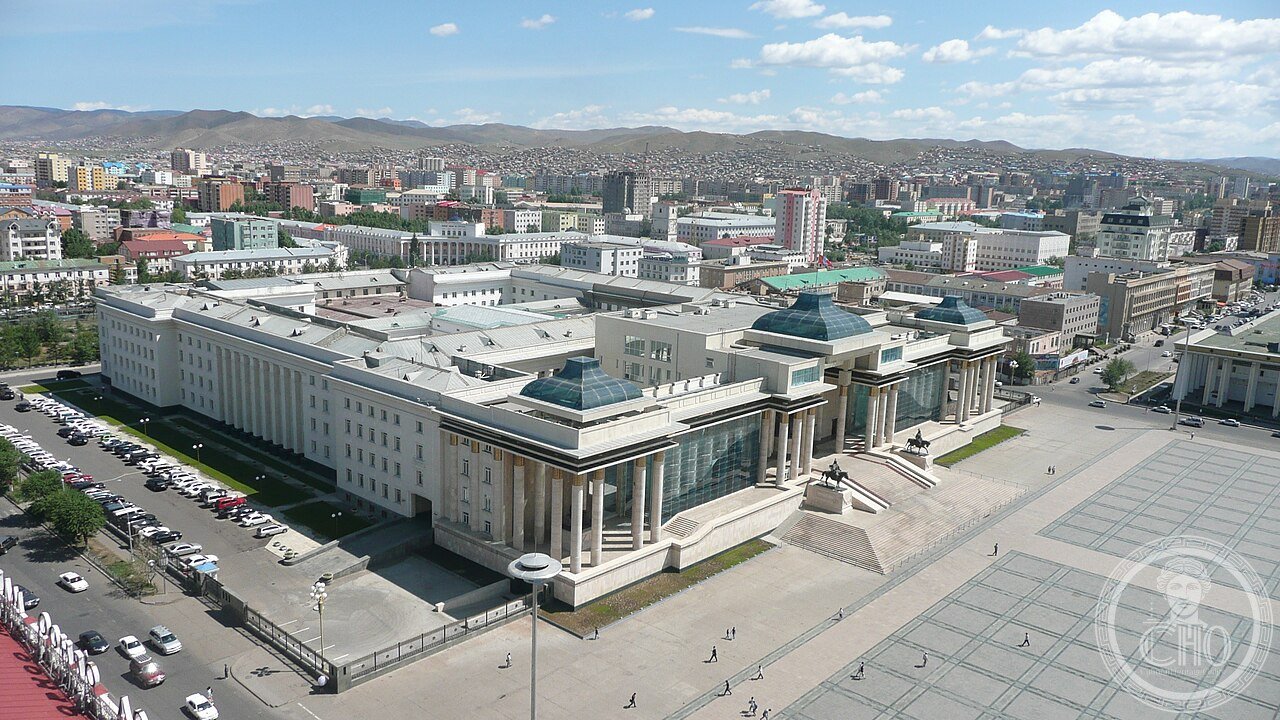
The Government Palace of Mongolia anchors Sukhbaatar Square in the heart of Ulaanbaatar, its 140-metre colonnade of massive columns forming one of the most imposing Stalinist classical facades in Asia. Built in 1951 to house the State Great Khural (parliament) and government ministries, the building encapsulates the contradictions of twentieth-century Mongolian history: erected as a monument to Soviet fraternal socialism, it now frames a portico containing colossal bronze statues of Chinggis Khaan and his greatest successors. The square before it, where thousands gather for the summer Naadam festival, witnessed the peaceful democratic revolution of 1990 when protesters forced an end to seven decades of communist rule. Today the building stands at the intersection of Mongolia’s imperial past and democratic present, its Soviet-era architecture reinterpreted as a backdrop for the nation’s deepest cultural symbols.
At a glance
- Type
- Government palace and parliament building
- Period
- 1951
- Style
- Soviet Classicism (Stalinist)
- Location
- Chinggis Khaan Square, Ulaanbaatar, Mongolia
- Coordinates
- 47.9066 N, 106.9221 E
- Architect(s)
- B. Chimed
Overview
The Government Palace houses the State Great Khural, Mongolia’s unicameral parliament, along with the offices of the President and the Cabinet. It fronts Chinggis Khaan Square (formerly Sukhbaatar Square), a ceremonial space large enough to accommodate the mass gatherings of the Naadam festival each July. The building’s symmetrical colonnade, monumental proportions, and imposing granite facade make it the undisputed architectural centrepiece of Mongolia’s capital, visited by virtually every traveller who passes through Ulaanbaatar.
History
The palace was completed in 1951 during the height of Soviet influence over the Mongolian People’s Republic. Its construction reflected the broader Soviet programme of providing fraternal socialist states with monumental civic architecture that would project ideological seriousness and permanence. The square was named after Damdin Sukhbaatar, hero of the 1921 Mongolian Revolution, whose equestrian statue stood at its centre for decades. In 1990, the square became the focus of Mongolia’s democratic revolution, with mass protests demanding the end of one-party rule. In 2006, the enormous seated statue of Chinggis Khaan was installed in the palace’s central portico, and in 2013 the square itself was renamed in his honour.
Architecture and Design
The palace exemplifies Stalinist High Classicism as exported to Soviet client states: a symmetrical facade of extraordinary horizontal length, faced in light stone, with a full colonnade of square pilasters and columns running the length of the main elevation. The central projecting portico is the building’s most dramatic element, designed to frame large ceremonial statuary. Flanking bronze equestrian figures of Mongolian historical heroes stand at either end of the main facade. The 2006 addition of the Chinggis Khaan statue group in the portico represents a deliberate post-Soviet reinterpretation of the building’s symbolism, overlaying Soviet architecture with pre-communist Mongolian imperial identity.
Cultural significance
Few buildings in Asia carry the layered historical weight of the Government Palace. It is simultaneously a monument to Soviet-era state-building, a witness to peaceful democratic transition, and the architectural backdrop for Mongolia’s most important national celebrations. The juxtaposition of Stalinist architecture with Chinggis Khaan’s statue is a uniquely Mongolian statement: a nation that absorbed Soviet modernity without abandoning its own imperial identity. The Naadam festival opening ceremonies held in the square each July draw tens of thousands and are broadcast nationally.
Visiting today
The exterior and square are freely accessible at all times and are the starting point for any exploration of central Ulaanbaatar. The building’s interior is not open to the general public as it remains an active seat of government. The Chinggis Khaan statue in the portico may be viewed and photographed from the square. The square is most atmospheric during Naadam (11-13 July) and during national holidays, when ceremonial guards are deployed and public gatherings fill the space.
Getting there
Chinggis Khaan Square is in central Ulaanbaatar on Peace Avenue (Enkhtaivany Orgon Choloo), within walking distance of most central hotels and the main tourist accommodation area. City buses stop on Peace Avenue directly adjacent to the square. Chinggis Khaan International Airport is approximately 18 kilometres south of the city centre; taxis and airport buses connect the airport to the city in 30 to 45 minutes depending on traffic.
Sources and resources
Do you know more?
On this page we have published what we were able to verify. If you know Government Palace (State Great Khural), Ulaanbaatar first-hand — you work there, have studied it, or remember how it used to be — and can add a detail, a date, a story or an old photograph, write to Sofia, who looks after these pages. Photographs of the place are welcome too: you can send them with the form at the bottom of this page.
Write to Sofia
or send a message on WhatsApp
Please start your message with the title of this page, so it reaches the right file. Every contribution is checked against independent sources before it goes on the page, and we always say where a piece of information came from.
Find it on the map
See this place and what’s around it →📷 Become a Cultural Heritage Online photographer
Share your photos of places: they stay published under your name as the author. The more they're seen, the more you get noticed — and soon a contest will reward the most appreciated photos.
Log in or sign up free to add a photoIs this page about you?
This page is read by travellers and heritage enthusiasts who find it on Google. Tell us how you are connected to this place and we will take it from there.