
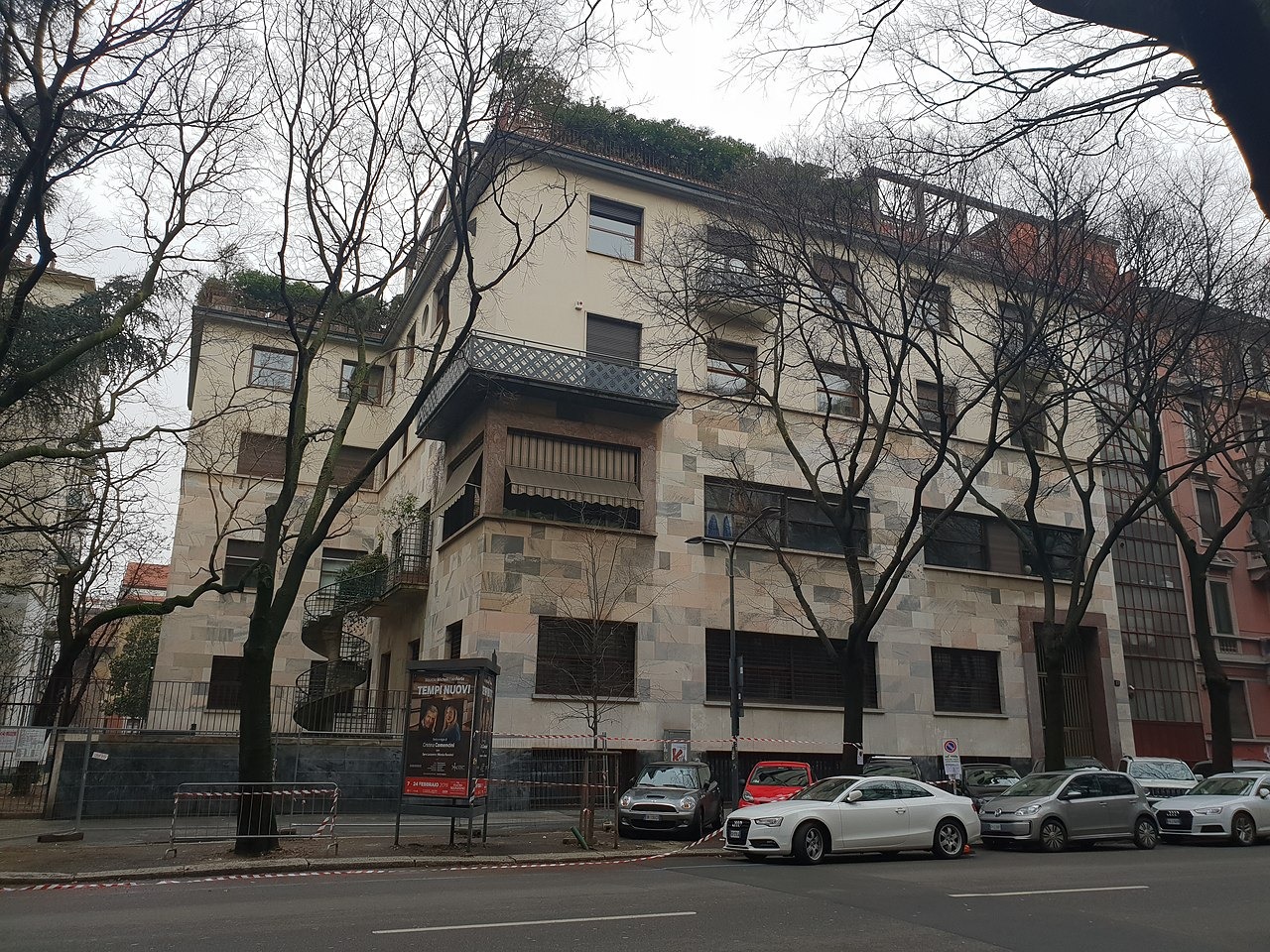
Casa Corbellini Wassermann is a residential house in Milan designed by architect Piero Portaluppi, constructed between 1934 and 1936.
Portaluppi was a prolific Milanese architect who graduated from the Politecnico in 1910 and went on to design over 100 buildings throughout his career. His early commissions included industrial and hydroelectric projects for major electrical companies; by the interwar period, his practice expanded to encompass residential and civic commissions that shaped Milan’s urban fabric. The Casa Corbellini Wassermann represents his domestic architectural practice during the 1930s, a period of intensive building activity in the city.
About Piero Portaluppi
Born in Milan in 1888, Portaluppi trained under Enrico Agostino Griffini and Carlo Calzecchi at the Politecnico. Before establishing himself as an architect, he worked as a caricaturist for satirical publications. Following the First World War, during which he served in military engineering roles, Portaluppi resumed his professional practice and became one of Milan’s most active architects of the twentieth century, working until his death in 1967.
Details
- Architect: Piero Portaluppi
- Location: Milan, Lombardy, Italy
- Date: 1934–1936
- Building type: Residential house
Explore more: 193 heritage places in Milano
Frequently asked questions
Who designed Casa Corbellini Wassermann?
Piero Portaluppi, a Milan-based architect who graduated from the Politecnico in 1910 and designed over 100 buildings throughout his career.
When was the house built?
Construction took place between 1934 and 1936 during the interwar period of Italian architectural activity.
Where is Casa Corbellini Wassermann located?
The house is located in Milan, Lombardy, in northern Italy.
Sources
- S1 — Molinari, Luca, and Sebastiano Brandolini. Piero Portaluppi: Linea cifrata. Skira, 2003. ISBN 978-88-8491-678-5.
- S2 — Gramigna, Giuliana, and Sergio Mazza. Milano. Un secolo di architettura milanese dal Cordusio alla Bicocca. Hoepli, 2001. ISBN 978-88-203-2913-6.
Spotted an error? Write to editorial@culturalheritageonline.com and we correct it the same day.


