
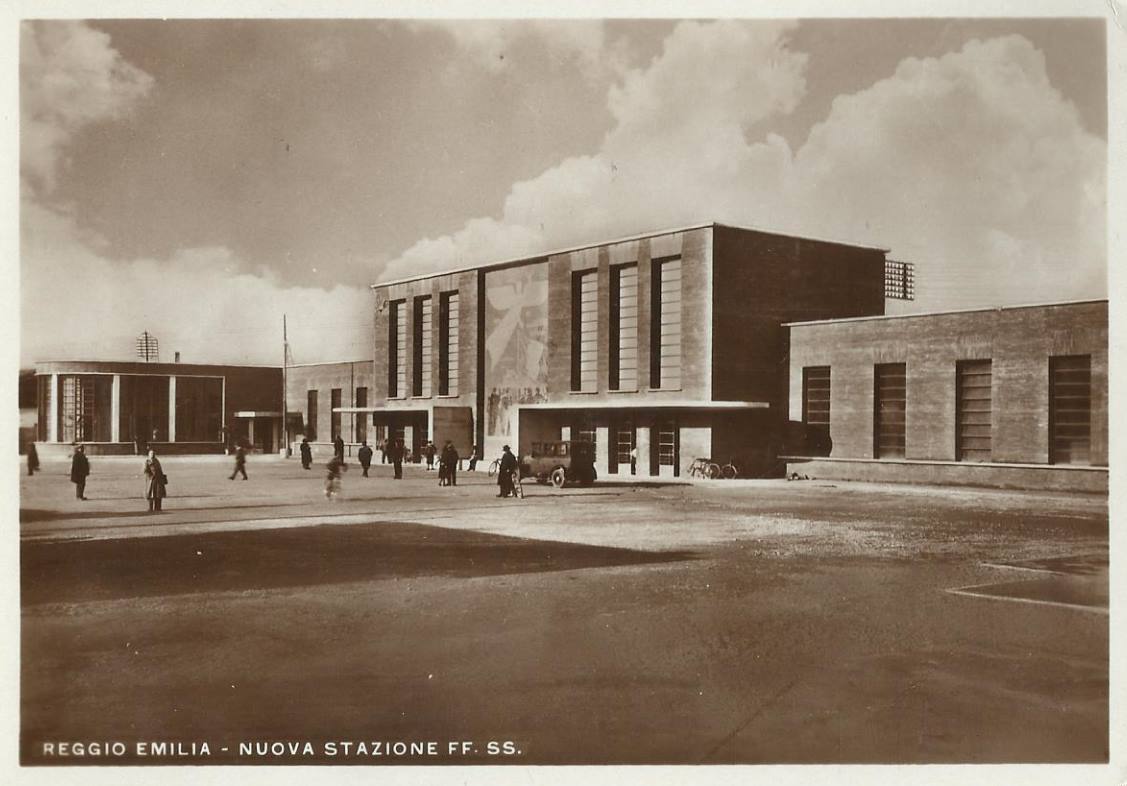
The Reggio Emilia Railway Station was designed by Italian architect Angiolo Mazzoni. Built during the interwar period, it formed part of a comprehensive national program of public works undertaken by the Italian state.
Mazzoni served as chief architect for the Ministry of Communications and the State Railways, positions that enabled him to shape the modernization of Italy’s railway infrastructure. As a prolific designer, he produced hundreds of public buildings, post offices, and train stations across the country during the 1920s and 1930s. The Reggio Emilia station reflects the architectural principles and urban ambitions of this transformative era in Italian infrastructure development.
About Angiolo Mazzoni
Angiolo Mazzoni (1894–1979) was an Italian architect and engineer born in Bologna. After studying at the Academy of Fine Arts in Bologna and practicing under Marcello Piacentini, he joined the Ministry of Communications in 1924, where he rose to prominence as a designer of major public works. His extensive career during the interwar period left a significant mark on Italy’s institutional and transport architecture.
Details
- Architect: Angiolo Mazzoni
- Location: Reggio Emilia, Emilia Romagna, Italy
- Period: Interwar (1920s–1930s)
- Building type: Railway station
- Context: National program of modernization and public works
Explore more: 9 heritage places in Reggio Emilia
Frequently asked questions
Who designed the Reggio Emilia Railway Station?
The station was designed by Angiolo Mazzoni, an Italian architect and engineer who served as chief architect for the Ministry of Communications and the State Railways during the interwar period.
When was the station built?
The station was constructed during the 1920s and 1930s as part of a comprehensive national program of public works and railway modernization in Italy.
What was Mazzoni’s role in Italian architecture?
Mazzoni designed hundreds of public buildings, post offices, and train stations across Italy during the interwar period, playing a central role in the modernization of the nation’s infrastructure and institutional architecture.
Sources
- S1 — Ciucci, Giorgio. Gli architetti e il fascismo: architettura e città 1922-1944. Einaudi, 2002. ISBN 978-88-06-16310-5.
- S2 — Nicoloso, Paolo. Mussolini architetto: Propaganda e paesaggio urbano nell'Italia fascista. Einaudi, 2008. ISBN 978-88-06-19086-6.
Spotted an error? Write to editorial@culturalheritageonline.com and we correct it the same day.


