
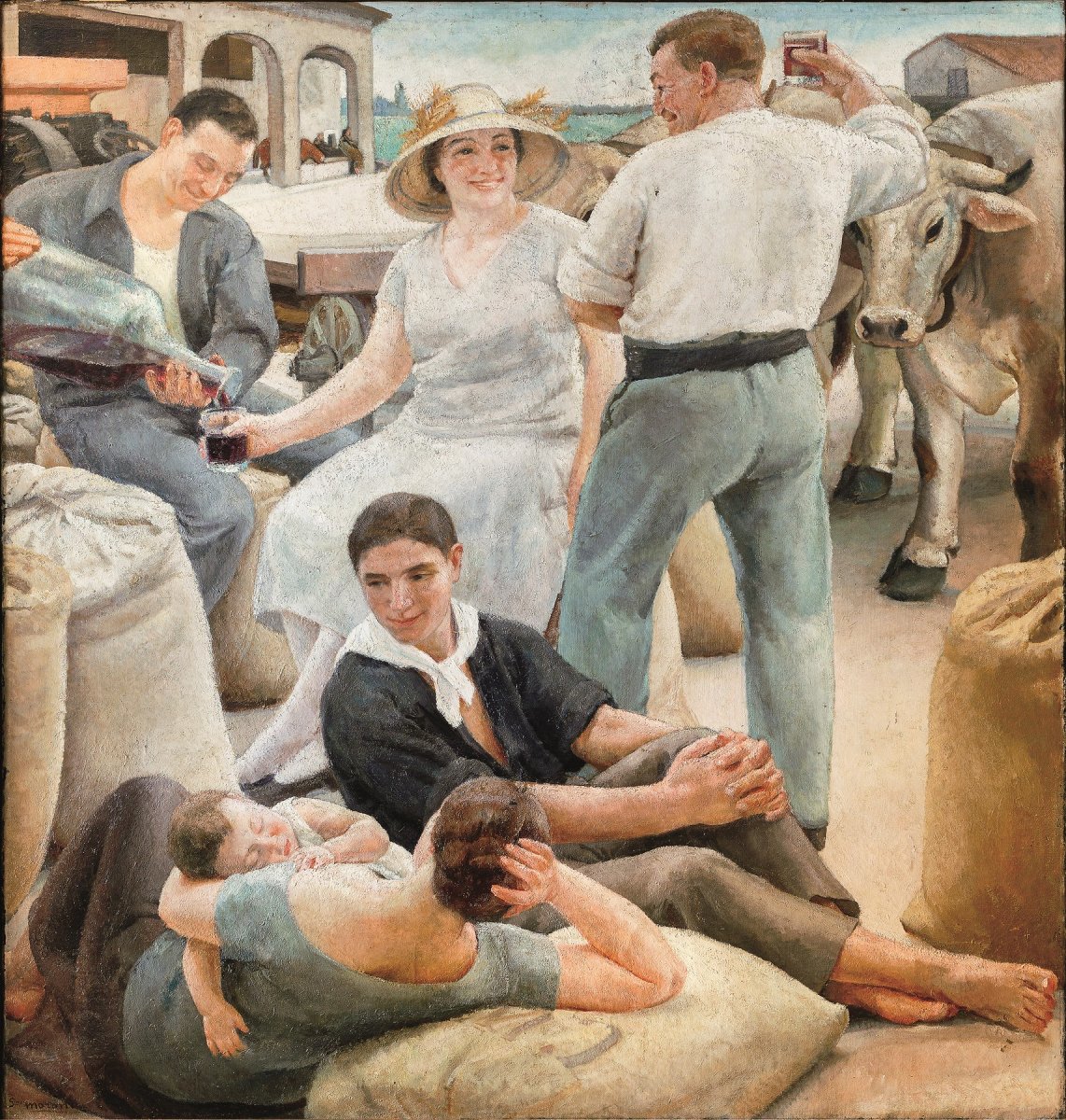
Nuova vita feconda is a painting by Giuseppe Moroni created in 1931. Moroni was an Italian painter born in Cremona in 1888 and based in Rome from the early twentieth century onward.
Moroni received formal training across Italy’s principal art institutions. After studying ornamental arts in his native Cremona, he moved to Milan as a teenager to pursue advanced studies, then won the Fanny Ferrari competition to attend the Accademia di Brera. In 1912, having won the Oggioni Prize, he relocated to Rome to study at the Scuola Superiore di Belle Arti under Giulio Aristide Sartorio and Giulio Bargellini. Following military service, Moroni taught applied decoration at Rome’s Regia Scuola Superiore di Architettura before dedicating himself fully to painting.
About Giuseppe Moroni
Moroni’s career spanned the late nineteenth and mid-twentieth centuries, a period of significant artistic ferment in Italy. His training under established academic masters positioned him within the broader currents of early twentieth-century Italian painting. He maintained a studio practice in the countryside, dividing his time between Rome and Pieveottoville to sustain his artistic work.
Details
- Artist: Giuseppe Moroni
- Year: 1931
- Title: Nuova vita feconda (New Fertile Life)
- Period: Italian interwar era
- Artist’s lifespan: 1888–1959
Frequently asked questions
Who was Giuseppe Moroni?
An Italian painter born in Cremona in 1888 and trained at the Accademia di Brera and Rome’s Scuola Superiore di Belle Arti, Moroni worked in Rome from the early 1910s onward and taught at the city’s principal architecture school before pursuing full-time artistic practice.
When was this work created?
Nuova vita feconda dates to 1931, during Italy’s interwar period when Moroni was active as an established painter.
What was Moroni’s artistic training?
Moroni studied ornamental arts in Cremona, attended evening courses at Milan’s applied-arts school, won competitions that funded advanced study at the Accademia di Brera and Rome’s national academy, and worked under prominent academic instructors including Cesare Tallone and Giulio Aristide Sartorio.
Sources
- S1 — Pontiggia, Elena. Il Novecento Italiano. Abscondita, 2003. ISBN 978-88-8416-048-5.
- S2 — Ciucci, Giorgio. Gli architetti e il fascismo: architettura e città 1922-1944. Einaudi, 2002. ISBN 978-88-06-16310-5.
Spotted an error? Write to editorial@culturalheritageonline.com and we correct it the same day.


