
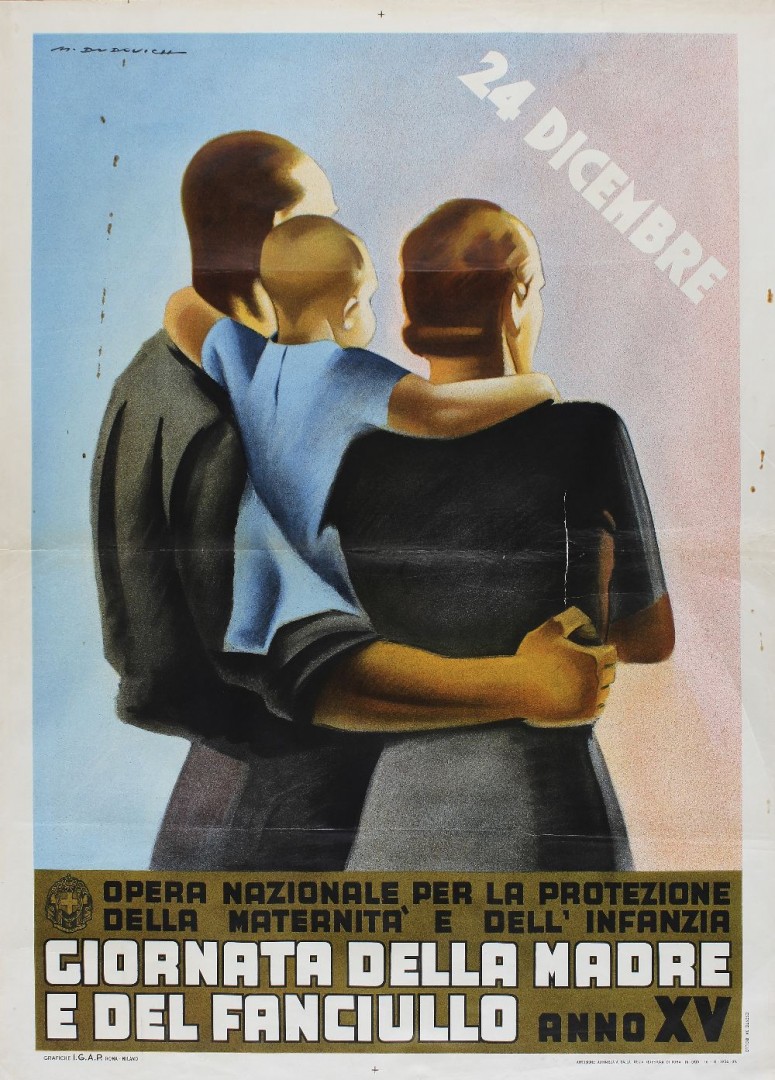
This advertising poster was designed by Marcello Dudovich in 1937. Dudovich was one of the leading figures in Italian poster design, working alongside contemporaries such as Leonetto Cappiello, Adolfo Hohenstein, and Leopoldo Metlicovitz to establish the language of modern Italian commercial art.
Born in Trieste in 1878, Dudovich trained in lithography and illustration before relocating to Milan in 1897, where he began his career in advertisement design. Throughout his career spanning several decades, he established himself as a master of the advertising poster, combining commercial purpose with sophisticated graphic composition.
About Marcello Dudovich
Dudovich was born to an Italian mother and Dalmatian father in Trieste, where he received his early training at the Royal School. His entry into professional design came through his father’s connections with established illustrators. After moving to Milan, he became instrumental in shaping the visual language of Italian advertising during a transformative period in graphic design history.
Details
- Creator: Marcello Dudovich
- Year: 1937
- Object type: Advertising poster (Italian manifesto)
- Medium: Lithographic poster design
- Career period: Active from late 19th century through mid-20th century
On video
Frequently asked questions
Who was Marcello Dudovich?
Marcello Dudovich (1878–1962) was an Italian painter, illustrator, and poster designer born in Trieste. He is recognized as one of the progenitors of Italian poster design, working alongside figures such as Leonetto Cappiello and Leopoldo Metlicovitz to pioneer the modern advertising poster.
What made Dudovich significant in poster design?
Dudovich helped establish Italian poster design as a distinct artistic practice by combining commercial advertising with sophisticated graphic composition and lithographic technique. His work spanned from the late 19th century through the mid-20th century, influencing generations of designers.
Where did Dudovich work?
After his early training in Trieste, Dudovich relocated to Milan in 1897, where he worked as a lithographer and advertisement designer, becoming a central figure in Italy’s commercial art scene for several decades.
Sources
- S1 — Menegazzi, Luigi. Il manifesto italiano: 1882-1925. Electa, 1995. ISBN 978-88-435-5134-7.
- S2 — De Fusco, Renato. Storia del design. Laterza, 2002. ISBN 978-88-420-6623-1.
Spotted an error? Write to editorial@culturalheritageonline.com and we correct it the same day.


