
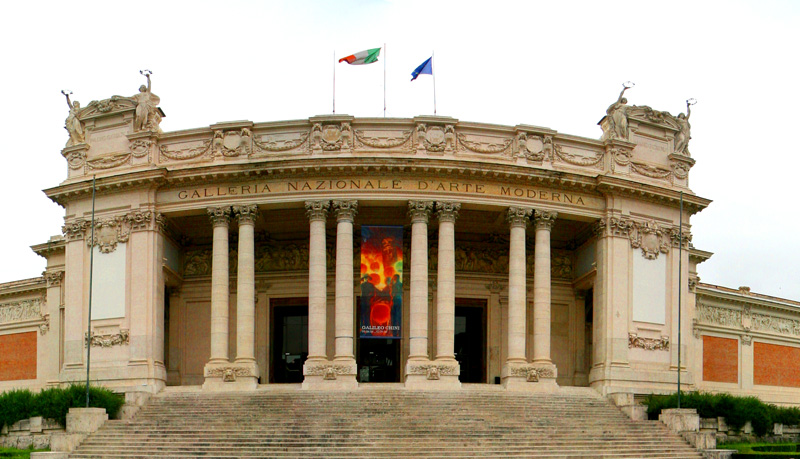
Five major galleries of modern and contemporary art across Italy represent the country’s exceptional artistic patrimony and world-class collections. Italy receives millions of international visitors annually to its museums and galleries dedicated to modern art, which showcase leading artistic movements from the nineteenth century to the present day.
Galleria Nazionale d’Arte Moderna e Contemporanea, Rome
Founded in 1883, the National Gallery of Modern and Contemporary Art in Rome holds the broadest collection of modern and contemporary art in Italy. The gallery houses approximately 20,000 works—paintings, drawings, sculptures and installations—documenting major artistic currents from the nineteenth century onwards. It is Italy’s only national museum dedicated entirely to modern art.
The gallery’s original location, the Palace of Expositions on Via Nazionale, soon proved insufficient. The 1911 International Exposition of Rome provided the opportunity to construct a permanent home at Valle Giulia, designed by Cesare Bazzani. Major exhibitions presented include Picasso (1953), Mondrian (1956), Pollock (1958) and Burri (1959), shaped by superintendent Palma Bucarelli and art historians Giulio Carlo Argan and Cesare Brandi. In October 2016, a new arrangement opened based on the concept ‘Time is out of joint’, suspending chronological reading. The collection includes works by Canova, Hayez, Fattori, Medardo Rosso, Courbet, Rodin, Degas, Van Gogh, Monet, Duchamp, Pollock, Burri, Fontana and Arnaldo Pomodoro.
Galleria Civica d’Arte Moderna e Contemporanea, Turin
Founded around 1891–95 and located at Via Magenta 31, Turin’s civic gallery (GAM) holds over 45,000 works spanning paintings, sculptures, installations, photographs and drawings. Turin was the first Italian city to establish a public modern art collection, beginning with the Museo Civico in 1863. The current building, designed by Carlo Bassi and Goffredo Boschetti, opened in 1959 after the original Corso Siccardi location was destroyed in World War II bombing.
Initially organized chronologically, the collection was reorganized thematically in 2009 (Veduta, Genere, Infanzia and Specularità) and again in 2013 for the 150th anniversary with new paths: Infinito, Velocità, Etica and Natura. The gallery is recognised for its projects, conferences and collaborations with major international museums.
MAMBo—Museo d’Arte Moderna di Bologna
Located at Via Don Minzoni 12 in Bologna’s cultural district, MAMBo was founded in 1926 with Villa delle Rose as its first home, donated by Contessa Nerina Armandi Avogli. A new building opened in 2007, hosting exhibitions, musical events, screenings and artist meetings alongside the permanent collection. The upper floors preserve over 3,500 works of modern and contemporary art from the postwar period onwards, exploring Italian realism, conceptual art, arte povera and subsequent movements. Temporary exhibitions occupy the lower floors. The collection includes works by Francesco Hayez, Salvatore Garau, Arnaldo Pomodoro and Alfredo Savini, with a notable focus on Giorgio Morandi.
Galleria Internazionale d’Arte Moderna, Venice
Housed in Palazzo Pesaro in the Santa Croce district, this gallery opened in 1902 following Felicita Bevilacqua La Masa’s donation of the palazzo to the city for modern art. The seventeenth-century palace is a masterpiece of Venetian Baroque civil architecture. The collection, begun with Alberto Giovanelli’s donation in 1897, encompasses European modern and contemporary movements including works by Rodin, Bonnard, Burri, Afro, Fontana, Munch, Ensor, Klee, Kandinsky, Martini and Medardo Rosso. Notable pieces include Klimt’s Giuditta II, Bonnard’s Nude at the Mirror, Chagall’s The Rabbi, and Rodin sculptures including The Thinker and The Burghers of Calais.
Galleria d’Arte Moderna, Milan
Located in the Villa Reale at Via Palestro 16, Milan’s modern art gallery (GAM) holds the most significant Lombard collection of nineteenth-century works. The building, Villa Belgiojoso, is a Neoclassical masterpiece designed by Austrian architect Leopoldo Pollack and once served as Napoleon Bonaparte’s Milanese residence. Converted in 1921 to house Milan’s modern art collections, it draws international recognition for works from three major collections: the Nineteenth Century Collection of sculptor Pompeo Marchesi, the Grassi Collection of Carlo Grassi and the Vismara Collection of Giuseppe Vismara. Artists represented include Hayez, Segantini, Canova, Cézanne, Van Gogh, Manet, Balla, Gauguin, Picasso, Modigliani and Boccioni.
Frequently asked questions
When did the National Gallery in Rome open?
The Galleria Nazionale d’Arte Moderna e Contemporanea opened in 1883 and is Italy’s only national museum dedicated entirely to modern art.
How many artworks does Turin’s civic gallery hold?
GAM Turin holds over 45,000 works spanning paintings, sculptures, installations, photographs and drawings by major Italian and international artists.
Which palace houses Venice’s modern art gallery?
The Galleria Internazionale d’Arte Moderna is housed in Palazzo Pesaro, a seventeenth-century masterpiece of Venetian Baroque architecture in the Santa Croce district.
Sources
- S1 — Solima, Ludovico. Management museale: Teoria e pratica per la gestione del museo. Carocci, 2018. ISBN 978-88-430-9366-3.
- S2 — Pontiggia, Elena. Il Novecento Italiano. Abscondita, 2003. ISBN 978-88-8416-048-5.
Spotted an error? Write to editorial@culturalheritageonline.com and we correct it the same day.


