
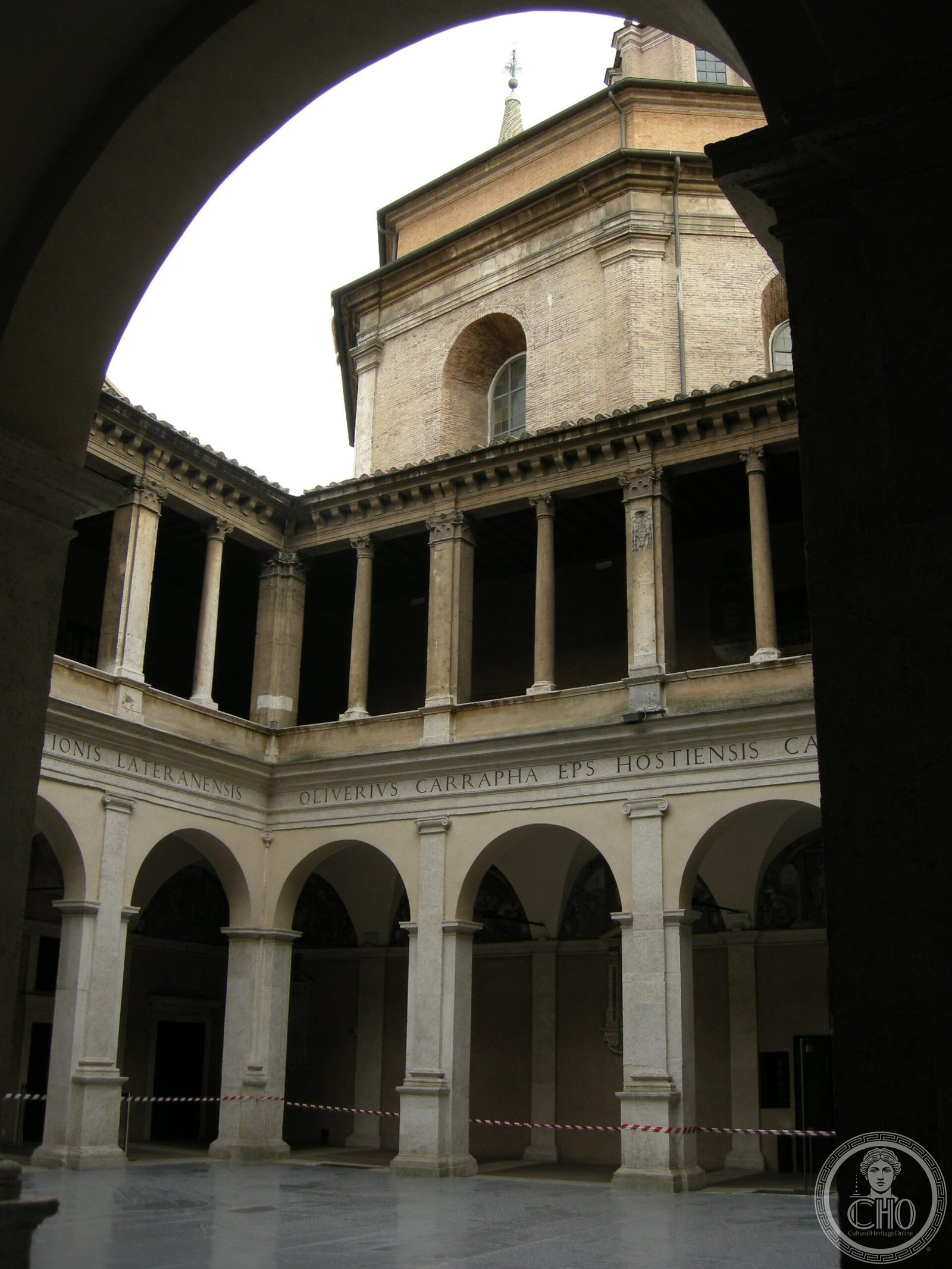
Donato Bramante’s Renaissance masterpiece, built for Cardinal Oliviero Carafa, demonstrates architectural restraint and classical proportion through its ingenious modular design and Vitruvian geometry.
At a glance
One of Bramante’s earliest Roman commissions after his Milanese period, this cloister embodies Renaissance ideals of mathematical harmony. A square plan encompasses a central void surrounded by 16 pillars with rib-vaulted arches, paired with an adjacent refectory. Two superimposed orders of pilasters create rhythmic, classically inspired elevations.
History
Commissioned by Cardinal Oliviero Carafa around 1500, the cloister represents Bramante’s transition to Roman architectural practice. Built between 1500 and 1504, it signals his departure from the ornamental language of his Milanese works toward a more refined, antique-inspired vocabulary. The project established principles that would influence his subsequent Roman designs and those of his contemporaries.
What you see
The ground level features Ionic pilasters supporting a continuous entablature with round arches on pilaster strips—a vocabulary drawn directly from classical Roman sources. Above, a pseudo-Corinthian order of pilasters alternates with free-standing columns of matching proportions, creating sophisticated visual variety without ornamental excess.
The portico’s rib-vaulted arches rise from 16 pillars arranged in a 4×4 grid, establishing the module that governs the entire composition. Lunettes on the back wall are frescoed with Stories of the Life of the Virgin, enriched by episodes connected to the church’s history and its celebrated miraculous image.
Cultural significance
The cloister exemplifies Renaissance engagement with Vitruvian principles of numerical proportion and classical order—concepts shared by Leon Battista Alberti and Sebastiano Serlio. Its restrained aesthetic marks a decisive break from Lombard-inspired decoration, establishing a new standard for Roman Renaissance architecture. Today it hosts temporary art exhibitions, bridging historical preservation with contemporary practice.
Key facts
- Address: Arco della Pace, 5, 00186 Roma
- Coordinates: 41.899765, 12.471448
- Website: https://www.chiostrodelbramante.it/
- Phone: 06 6880 9035
- Architect: Donato Bramante
- Patron: Cardinal Oliviero Carafa
- Date: 1500–1504
Practical information
The cloister functions as a cultural venue. Current hours and admission details are available on the official website or by telephone.
Getting there
Located in Rome’s historic center at Arco della Pace, 5, near the church of Santa Maria della Pace. Check transport links and accessibility details on the official website before your visit.
Sources & resources
Find it on the map
See this place and what’s around it →Historical events at this place (4)
📷 Become a Cultural Heritage Online photographer
Share your photos of places: they stay published under your name as the author. The more they're seen, the more you get noticed — and soon a contest will reward the most appreciated photos.
Log in or sign up free to add a photoIs this page about you?
This page is read by travellers and heritage enthusiasts who find it on Google. Tell us how you are connected to this place and we will take it from there.