
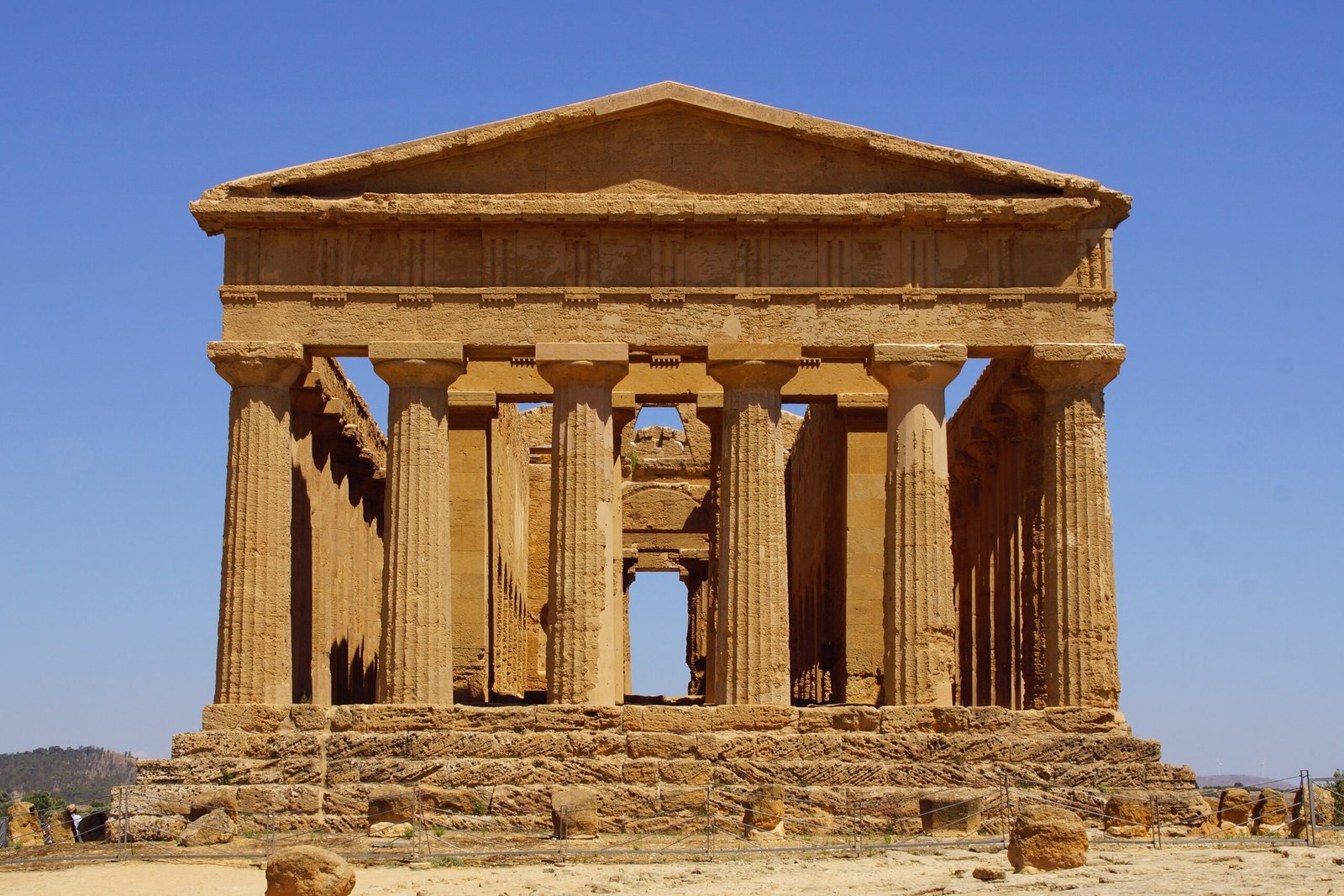
Valle dei Templi
One of the largest archaeological parks in the Mediterranean — 1,300 hectares of Doric temples, late-antique churches and ancient water gardens strung along a sandstone ridge above the Sicilian coast.
At a glance
The Valle dei Templi at Agrigento is the archaeological park of ancient Akragas, a Greek colony founded around 580 BC on the southern coast of Sicily. The site preserves one of the largest concentrations of Doric temples outside Greece, strung along a sandstone ridge above the modern city. It was inscribed on the UNESCO World Heritage List in 1997 and is managed by the Parco Archeologico e Paesaggistico Valle dei Templi.
Key facts
- Location: Agrigento, Sicilia
- Coordinates: 37.2913° N, 13.5890° E
- UNESCO inscription: 1997, criteria i, ii, iii, iv
- Site area: approximately 1,300 hectares — one of the largest archaeological parks in the Mediterranean
- Period: mainly 6th–5th century BC (Greek), with Roman, late-antique and medieval phases
- Original city: Akragas, founded c. 580 BC by colonists from Gela
History
Akragas reached its peak in the fifth century BC under the tyrant Theron, whose victory at Himera in 480 BC over the Carthaginians is said by Diodorus Siculus to have financed much of the temple-building programme. The poet Pindar called it “the most beautiful city of mortals”. In 406 BC the Carthaginians sacked Akragas; the city revived under Timoleon in the fourth century and was incorporated into the Roman province of Sicilia after 210 BC.
Several temples were converted to Christian use in late antiquity — the so-called Tempio della Concordia became a basilica around AD 597 and owes its survival to that conversion. Systematic archaeological investigation began in the eighteenth century and continues today under the Parco and its scientific partners.
What you see
The Agrigento temples are built in the Doric order from a soft local sandstone whose porous surface was originally coated with a fine stucco to imitate marble. They sit on a long limestone ridge — the so-called Collina dei Templi — that closes the southern edge of the ancient city. The largest, the Tempio di Zeus Olimpico, was a colossal pseudo-peripteral structure whose half-engaged columns were articulated by giant telamons, male figures over seven metres tall; one reconstructed telamon lies in the archaeological zone.
Highlights along the ridge include the Tempio della Concordia (c. 440–430 BC), the best-preserved Doric temple in the Mediterranean; the Tempio di Hera Lacinia (Giunone) at the east end (c. 450 BC); the Tempio di Eracle, with eight standing columns of the oldest temple on site; the Tempio dei Dioscuri, four columns rebuilt in the nineteenth century; and the Giardino della Kolymbethra, an ancient hydraulic basin now a citrus garden managed by FAI.
Practical information
- Tickets: park admission required; combined ticket with the Museo Archeologico Regionale “Pietro Griffo” recommended.
- Two access gates: ingresso Tempio di Giunone (east) and ingresso Porta V / Tempio di Eracle (west).
- Best season: spring and autumn — the ridge is exposed; bring water and a sun hat.
- Evening openings: summer evening visits allow sunset and after-dark walks.
- Time needed: half a day for the main ridge; a full day to add the Kolymbethra and the Pietro Griffo museum.
Getting there
Agrigento Centrale station has direct trains from Palermo (about 2h). From the station, TUA city bus lines 1, 2 and 3 reach the park entrances in about 15 minutes. By car, the SS189 connects Palermo to Agrigento; ample parking is available at both gates. GPS: 37.2913, 13.5890 — open in Google Maps.
Nearby
- Scala dei Turchi — white marl cliff on the coast, 15 km west.
- Eraclea Minoa — Greek city with a sandstone theatre above the sea, 35 km west.
- Villa Romana del Casale, Piazza Armerina — UNESCO Roman mosaics, 90 km north-east.
- Selinunte — second great Doric park of western Sicily, 110 km west.
Sources
- Parco Archeologico e Paesaggistico Valle dei Templi — sito ufficiale.
- UNESCO World Heritage Centre — Archaeological Area of Agrigento.
- Regione Siciliana, Assessorato dei Beni Culturali e dell’Identità Siciliana.
- Treccani, Enciclopedia Italiana — voce “Agrigento”.