
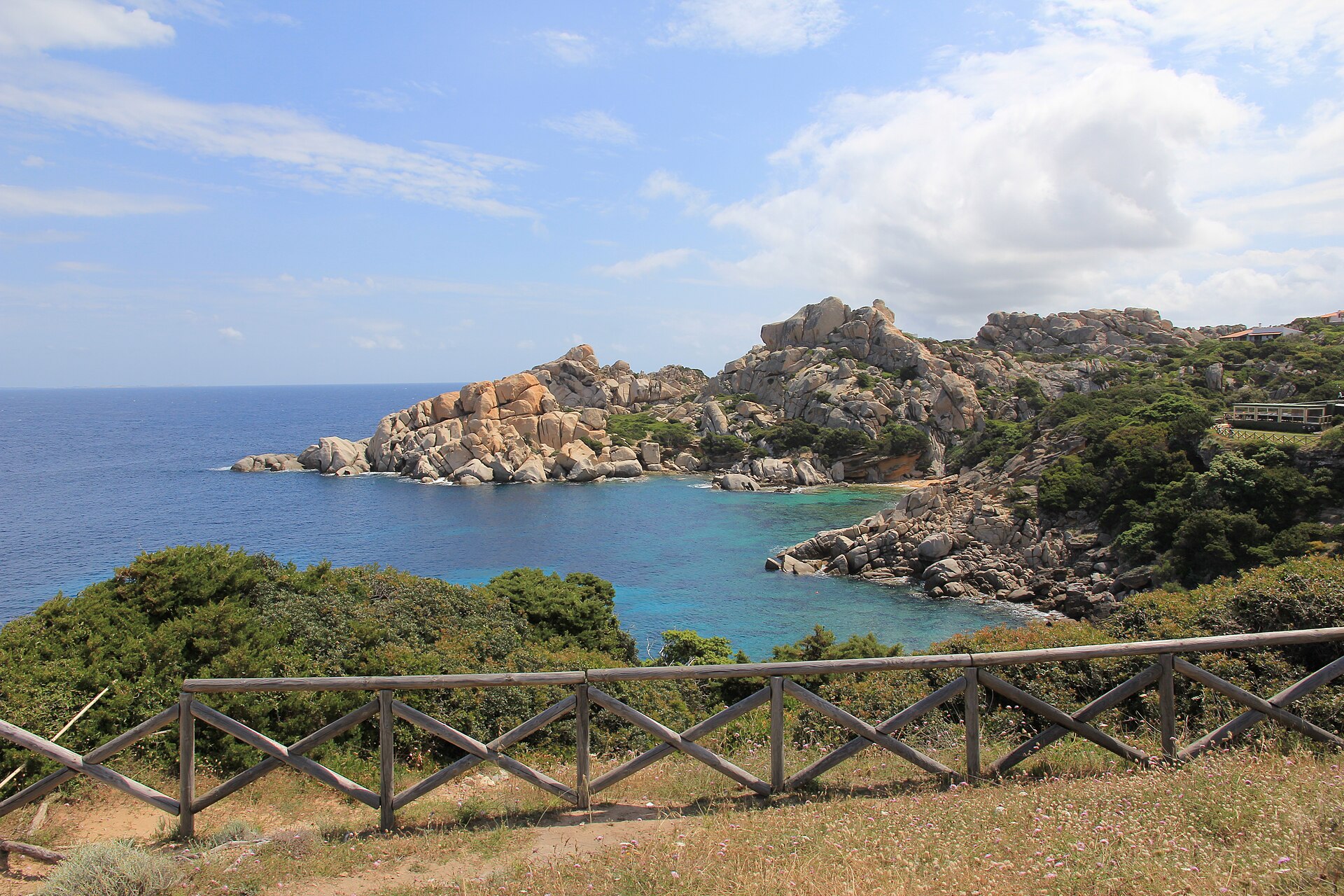
Capo Testa is a dramatic granite headland at the northernmost tip of Sardinia, projecting into the Strait of Bonifacio opposite Corsica, near the town of Santa Teresa Gallura. Renowned for its sculpted wind-eroded granite formations — some of the most spectacular in the Mediterranean — the headland also preserves the ruins of ancient Roman granite quarries that supplied stone for buildings across the Empire, including columns shipped to Rome and Carthage. Today Capo Testa is a protected natural area combining geological, archaeological and scenic heritage of international significance.
At a glance
- Type
- Natural headland; ancient quarry site
- Period
- Roman quarrying activity from the 1st century BCE; protected natural area since the late 20th century
- Style
- Granite coastal landscape
- Location
- Santa Teresa Gallura, Sassari, Sardinia, Italy (41.2436° N, 9.1442° E)
Overview
Capo Testa juts into the turquoise waters of the Strait of Bonifacio, the narrow channel separating Sardinia from Corsica, at one of the most geologically striking points along Italy’s coastline. The headland is connected to the mainland by a narrow sandy isthmus flanked by two bays — Valle della Luna to the west and Rena di Ponente to the east — that together create a natural amphitheatre of granite, sea and sky. The combination of accessible archaeology, extraordinary rock formations and transparent coastal waters has made Capo Testa a destination of note for heritage travellers, geologists and naturalists alike.
History
The granite of Capo Testa was identified and exploited by Roman quarry workers (lapicidini) from at least the 1st century BCE, drawn by the exceptional quality of the blue-grey Sardinian granite for monumental building. Columns, lintels and decorative elements were roughed out on site and loaded onto ships for transport across the Mediterranean — the Roman Pantheon’s grey granite columns are cited among the products of Sardinian quarries of this period, though the precise origin of each shipment remains debated by archaeologists. The site was likely abandoned as a quarry when the Western Roman Empire contracted in the 5th century CE. During the medieval period the headland served as a navigational landmark and refuge for sailors crossing the treacherous Bonifacio strait.
What you see
Walking the headland, visitors encounter enormous rounded granite boulders weathered by millennia of wind and sea spray into organic, almost anthropomorphic forms — the Valle della Luna valley takes its name from the lunar quality of this landscape at dusk. Visible cuts, drill marks and abandoned rough-hewn column drums remain in the rock face, constituting an open-air archaeological record of Roman industrial activity. A lighthouse built in the 19th century crowns the highest point of the promontory, offering panoramic views toward Corsica some 12 km to the north. Mediterranean maquis — rockrose, myrtle, rosemary and juniper — covers the slopes between the granite outcrops.
Cultural significance
Capo Testa is significant both as a geological spectacle and as a working industrial heritage site of the Roman world, where the physical process of empire-building — the extraction and long-distance transport of architectural stone — can be read directly in the rock. The headland forms part of Sardinia’s broader heritage landscape, which encompasses Nuragic civilisation, Phoenician and Carthaginian settlement, and Roman provincial culture, making the island one of the richest and least-crowded archaeological territories in the Mediterranean.
Practical information
- Address
- Capo Testa, 07028 Santa Teresa Gallura SS, Sardinia, Italy
- Hours
- Open access year-round; summer months busiest
- Admission
- Free; parking fees may apply in summer
Getting there
The nearest airport is Olbia Costa Smeralda (OLB), approximately 65 km from Santa Teresa Gallura. ARST buses connect Olbia with Santa Teresa Gallura; from the town, Capo Testa is 5 km by road, accessible by local taxi or bicycle in summer. Ferries from Bonifacio (Corsica) and Genoa arrive at Santa Teresa Gallura port, making the headland directly reachable by sea. A rental car provides the most flexibility for exploring the Gallura coast.
Sources & resources
See the place
Find it on the map
See this place and what’s around it →📷 Become a Cultural Heritage Online photographer
Share your photos of places: they stay published under your name as the author. The more they're seen, the more you get noticed — and soon a contest will reward the most appreciated photos.
Log in or sign up free to add a photo