
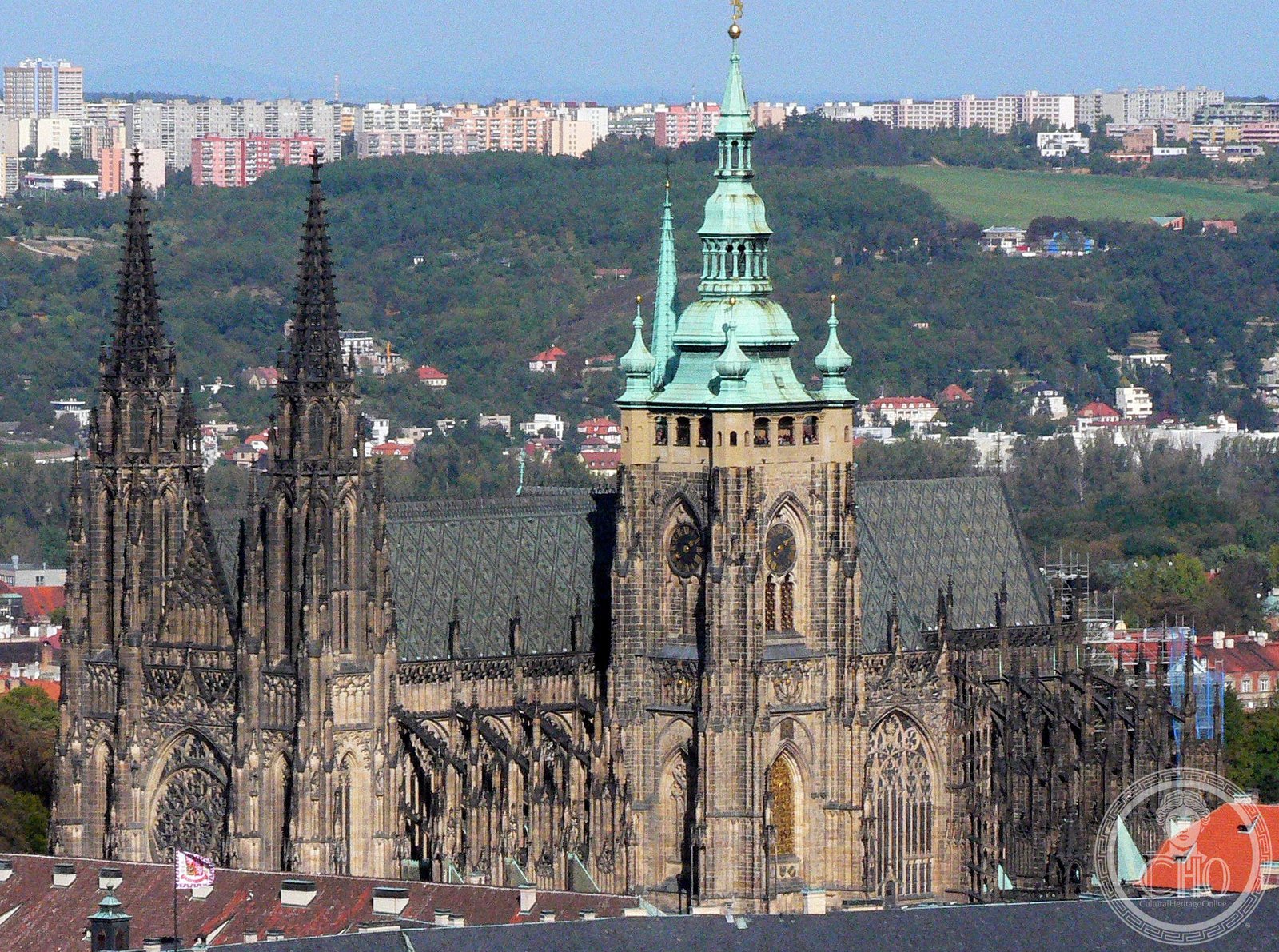
The Metropolitan Cathedral of Saints Vitus, Wenceslaus and Adalbert — universally known as St. Vitus Cathedral — is the seat of the Archbishop of Prague and the spiritual heart of the Czech nation. Begun in 1344 on the site of earlier Romanesque rotundas within Prague Castle, the Gothic cathedral was not fully completed until 1929, making it a nearly six-century building project. It houses the Bohemian Crown Jewels, the tomb of the patron saint Wenceslaus, and the remains of several Holy Roman Emperors.
At a glance
- Type
- Catholic metropolitan cathedral
- Period
- Construction began 1344; completed 1929
- Style
- Gothic; Neo-Gothic completion
- Location
- Prague Castle (Pražský hrad), Hradčany, Prague, Czech Republic
- Coordinates
- 50.0909° N, 14.3983° E
Overview
St. Vitus Cathedral is the largest and most important church in the Czech Republic, serving as the seat of the Archbishop of Prague and as the burial place of Czech kings, Holy Roman Emperors and saints. It stands within the grounds of Prague Castle on Hradčany hill, overlooking the Vltava river and the city below. The cathedral is the spiritual and symbolic centre of Czech statehood, and its silhouette defines the Prague skyline.
History
The site was first consecrated as a Romanesque rotunda dedicated to Saint Vitus around 929 CE by Prince Wenceslaus I of Bohemia, later canonised as the patron saint of the Czechs. In 1060 Bishop Šebíř replaced the rotunda with a larger Romanesque basilica. Construction of the present Gothic cathedral began in 1344 under King John of Bohemia and his son Charles IV, with the French architect Matthias of Arras as first master builder; after his death in 1352, the Swabian master Peter Parler took over and worked on it until his own death in 1399. Work then halted for centuries due to the Hussite Wars, religious conflict and lack of funds, and the cathedral was only finally completed — including its west façade and twin towers — in 1929, on the occasion of the millennial anniversary of Saint Wenceslaus’s martyrdom.
What you see
The cathedral’s interior is 124 metres long and 60 metres wide, with a nave vault soaring to 33 metres. The St. Wenceslaus Chapel, completed in 1367 by Peter Parler, is lined with semi-precious stones and 14th-century fresco cycles depicting the saint’s life. The ambulatory contains the Royal Mausoleum and the tomb of St. John of Nepomuk in ornate Baroque silver. The twenty-eight stained glass windows include a celebrated Art Nouveau window designed by Alfons Mucha in 1931. The Crown Chamber above the Chapel of St. Wenceslaus holds the Bohemian Crown Jewels, accessible only on rare public occasions.
Cultural significance
St. Vitus Cathedral is a UNESCO World Heritage Site as part of the Historic Centre of Prague, recognised for its outstanding Gothic and Neo-Gothic architecture and its role in Central European history. It is the repository of Czech royal and national memory: coronations were held here, kings are buried here, and the Crown Jewels of Bohemia are safeguarded within its walls. For Czechs it represents the continuity of statehood from the Přemyslid dynasty to the present republic.
Practical information
- Address
- III. nádvoří 48/2, 119 08 Praha 1, Czech Republic (within Prague Castle)
- Access
- Part of Prague Castle circuit; combined tickets available at castle gates
Getting there
Take Metro Line A (green) to Malostranská station, then walk uphill through Malá Strana and Nerudova Street to the castle gates (about 15 minutes). Alternatively, Tram 22 stops at Pražský hrad, a short walk from the Second Courtyard entrance. Taxis and rideshare services can drop passengers at Hradčanské náměstí directly in front of the main gate.
Sources & resources
See the place
Find it on the map
See this place and what’s around it →📷 Become a Cultural Heritage Online photographer
Share your photos of places: they stay published under your name as the author. The more they're seen, the more you get noticed — and soon a contest will reward the most appreciated photos.
Log in or sign up free to add a photo