
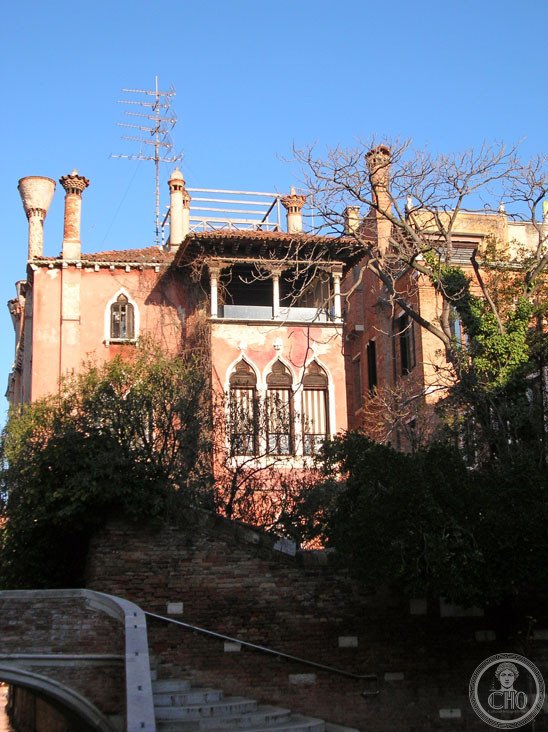
Palazzo Dario (Ca’ Dario)
Palazzo Dario, popularly known as Ca’ Dario, is a late-15th-century palace on the Grand Canal in the sestiere of Dorsoduro, Venice. Built for the Venetian diplomat Giovanni Dario around 1487 and attributed to Pietro Lombardo, it is celebrated for its polychrome marble facade inlaid with roundels of coloured stone — a rare fusion of Venetian Gothic structure with early Renaissance surface decoration. The palace is also widely known for a persistent legend linking it to a long series of misfortunes and deaths among its successive owners.
At a glance
- Type
- Venetian Gothic-Renaissance palace
- Period
- Constructed c. 1487; facade attributed to Pietro Lombardo
- Style
- Venetian Gothic with early Renaissance decorative elements
- Location
- Dorsoduro, Grand Canal, Venice, Italy
- Coordinates
- 45.4650° N, 12.1827° E
- Current use
- Private residence; not open to the public
Overview
Palazzo Dario sits on a narrow stretch of the Grand Canal between Palazzo Barbaro Wolkoff and the Rio delle Torreselle, its compact three-storey facade conspicuous for its tilt caused by subsidence — a common condition in Venice, here more pronounced than in most palaces. The building changed hands many times after the Dario family and attracted a remarkable concentration of tragedy among its owners, inspiring its Italian epithet Ca’ dala testa storta (the house with the crooked head). Despite its small footprint, it is considered one of the most photographed facades on the Grand Canal.
History
Giovanni Dario, secretary of the Venetian Senate and a key diplomat in negotiations with the Ottoman court, commissioned the palace as a residence for his family after years of service to the Republic. The facade is attributed to Pietro Lombardo, who was simultaneously working on the Basilica di Santa Maria dei Miracoli, and displays the same taste for coloured marble inlay characteristic of his workshop. After Giovanni Dario’s death the palace passed through successive noble and wealthy owners, and in the 19th and 20th centuries it attracted the interest of John Ruskin, who described it in The Stones of Venice, and later the composer Henri de Régnier, the art patron Filippo Grimani, and the rock musician Woody Lane.
What you see
The facade is the palace’s primary artistic document: three tiers of round-arched windows are framed by panels of verde antico, porphyry, and Istrian stone roundels set into white marble, producing a polychrome effect unique on the Grand Canal. The slight forward lean of the building is visible from a boat on the canal. The interior, rarely accessible, retains elements from multiple periods of ownership but is considered secondary to the iconic exterior. The palace is best observed from a vaporetto passing stop Santa Maria del Giglio or from the Ponte dell’Accademia.
Cultural significance
Ca’ Dario represents a pivotal moment in Venetian architectural history, when the city’s Gothic tradition began absorbing the Renaissance decorative vocabulary arriving from Lombardy and Tuscany. John Ruskin’s extensive analysis in The Stones of Venice (1851–1853) established it as a touchstone of Venetian Gothic scholarship. The palace’s cursed reputation, though anecdotal, has made it a persistent subject of popular cultural interest and a case study in how mythology attaches itself to historic buildings.
Practical information
- Address
- Calle Ca’ Dario 352/A, Dorsoduro, 30123 Venice, Italy
- Access
- Private residence; exterior viewable from the Grand Canal or nearby calli
- Best viewpoint
- From a vaporetto on the Grand Canal or from Fondamenta Venier dai Leoni opposite
Getting there
Take vaporetto Line 1 or Line 2 to the Salute stop on the Grand Canal; from there walk west along the fondamenta past the Peggy Guggenheim Collection. Alternatively, alight at Accademia and walk south through Dorsoduro. The palace is a short walk from both stops and is visible from the canal itself.
Sources & resources
See the place
Find it on the map
See this place and what’s around it →📷 Become a Cultural Heritage Online photographer
Share your photos of places: they stay published under your name as the author. The more they're seen, the more you get noticed — and soon a contest will reward the most appreciated photos.
Log in or sign up free to add a photoIs this page about you?
This page is read by travellers and heritage enthusiasts who find it on Google. Tell us how you are connected to this place and we will take it from there.