
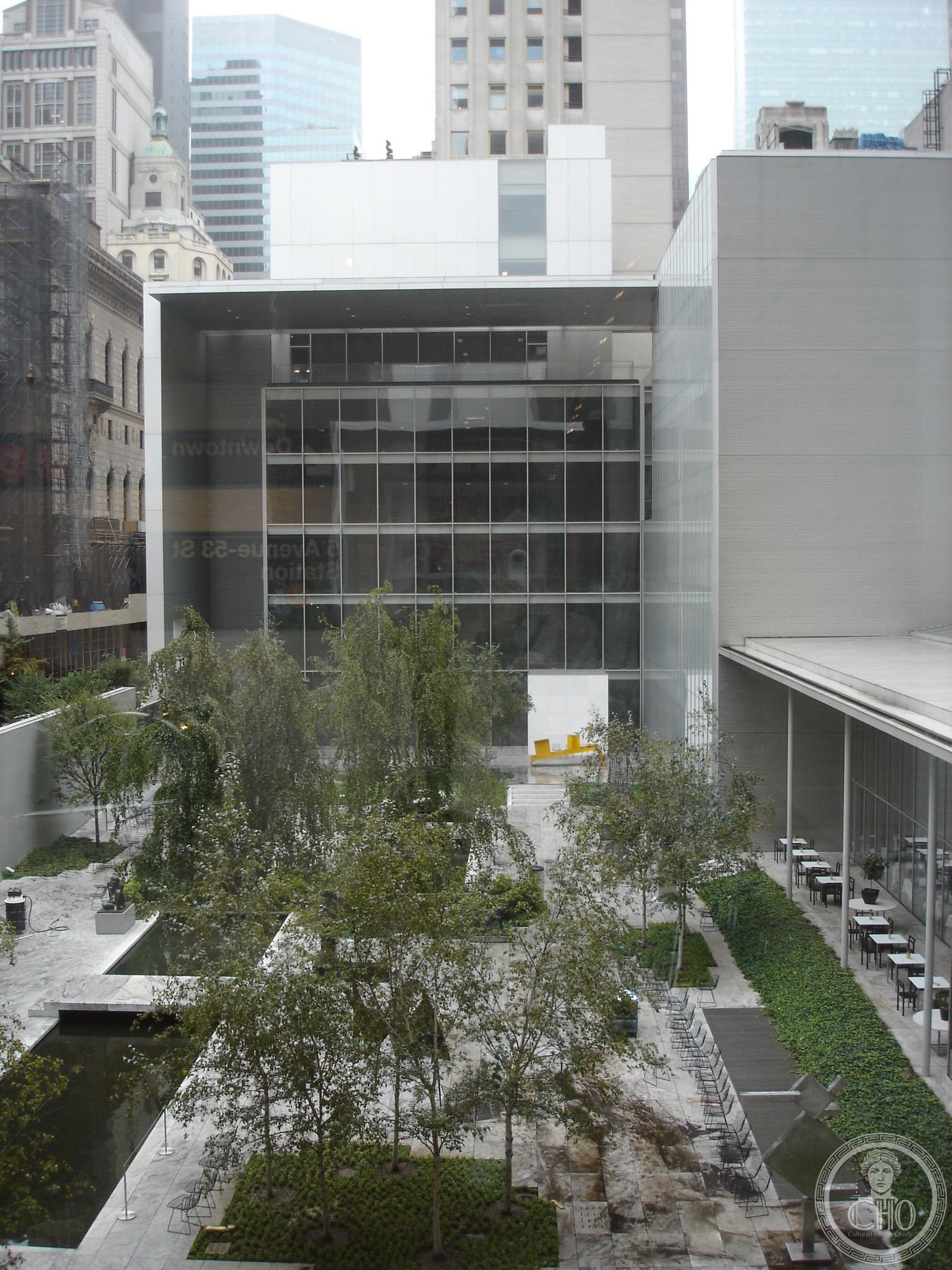
The Museum of Modern Art (MoMA) in Midtown Manhattan, New York City, is one of the world’s most influential modern and contemporary art museums. Founded in 1929 by Abby Aldrich Rockefeller, Lillie P. Bliss, and Mary Quinn Sullivan, it holds a collection of more than 200,000 works spanning painting, sculpture, drawing, photography, film, design, and architecture, including canonical pieces such as Vincent van Gogh’s The Starry Night and Pablo Picasso’s Les Demoiselles d’Avignon.
At a glance
- Type
- Museum of modern and contemporary art
- Period
- Founded 1929; current building designed by Yoshio Taniguchi, opened 2004; expanded 2019
- Style
- Modernist; International Style architecture
- Location
- 11 West 53rd Street, Midtown Manhattan, New York City, NY 10019, USA
- Coordinates
- 40.7614° N, 73.9776° W
Overview
MoMA’s collection traces the development of modern art from the late 19th century to the present, encompassing movements from Post-Impressionism and Cubism to Abstract Expressionism, Pop Art, and global contemporary practice. The museum pioneered the institutional treatment of photography, film, and industrial design as art forms, establishing departments for each as early as the 1930s. Today it operates alongside MoMA PS1 in Long Island City, Queens, its contemporary art affiliate and one of the largest centres for experimental art in the United States.
History
MoMA opened on 7 November 1929, just weeks after the Wall Street Crash, in rented rooms in the Heckscher Building on Fifth Avenue. Alfred H. Barr Jr., its founding director, shaped its encyclopaedic approach to modern art and defined the canonical progression from Post-Impressionism to abstraction that influenced museums worldwide. The institution moved to its current West 53rd Street site in 1939, underwent major renovations in 1984 (Cesar Pelli addition) and again in 2004 (Yoshio Taniguchi redesign), and completed a further expansion in 2019 that added approximately 30 percent more gallery space.
What you see
Permanent collection highlights include Van Gogh’s The Starry Night (1889), Picasso’s Les Demoiselles d’Avignon (1907), Salvador Dalí’s The Persistence of Memory (1931), and Jackson Pollock’s One: Number 31, 1950. The design collection features landmark objects from the Bauhaus and mid-century modernism, including the Bell-47D1 helicopter and a cantilevered Thonet chair. The film archive, one of the largest in the world, screens daily programmes in two on-site theatres. Temporary exhibitions regularly re-examine the museum’s own collection from new critical perspectives.
Cultural significance
MoMA’s curatorial decisions have consistently shaped global taste: its early championing of European modernism helped establish New York as the centre of the art world after 1945, and its acquisitions continue to set market benchmarks. The museum’s free online collection database, covering more than 90,000 objects, has become a standard scholarly reference for modern art research worldwide.
Practical information
- Address
- 11 West 53rd Street, New York, NY 10019, USA
- Hours
- Open daily (hours vary by season); check moma.org for current schedule
- Admission
- Paid; members and NYC residents under 16 free; check moma.org for current prices
- Website
- moma.org
Getting there
Take the E or M subway line to Fifth Avenue/53rd Street, or the B/D/F/M to 47–50th Streets–Rockefeller Center. The museum is a 5-minute walk from both stations. Multiple bus lines serve the 53rd Street corridor. Midtown parking is available but expensive; public transit is recommended.
Sources & resources
See the place
Find it on the map
See this place and what’s around it →📷 Become a Cultural Heritage Online photographer
Share your photos of places: they stay published under your name as the author. The more they're seen, the more you get noticed — and soon a contest will reward the most appreciated photos.
Log in or sign up free to add a photo