
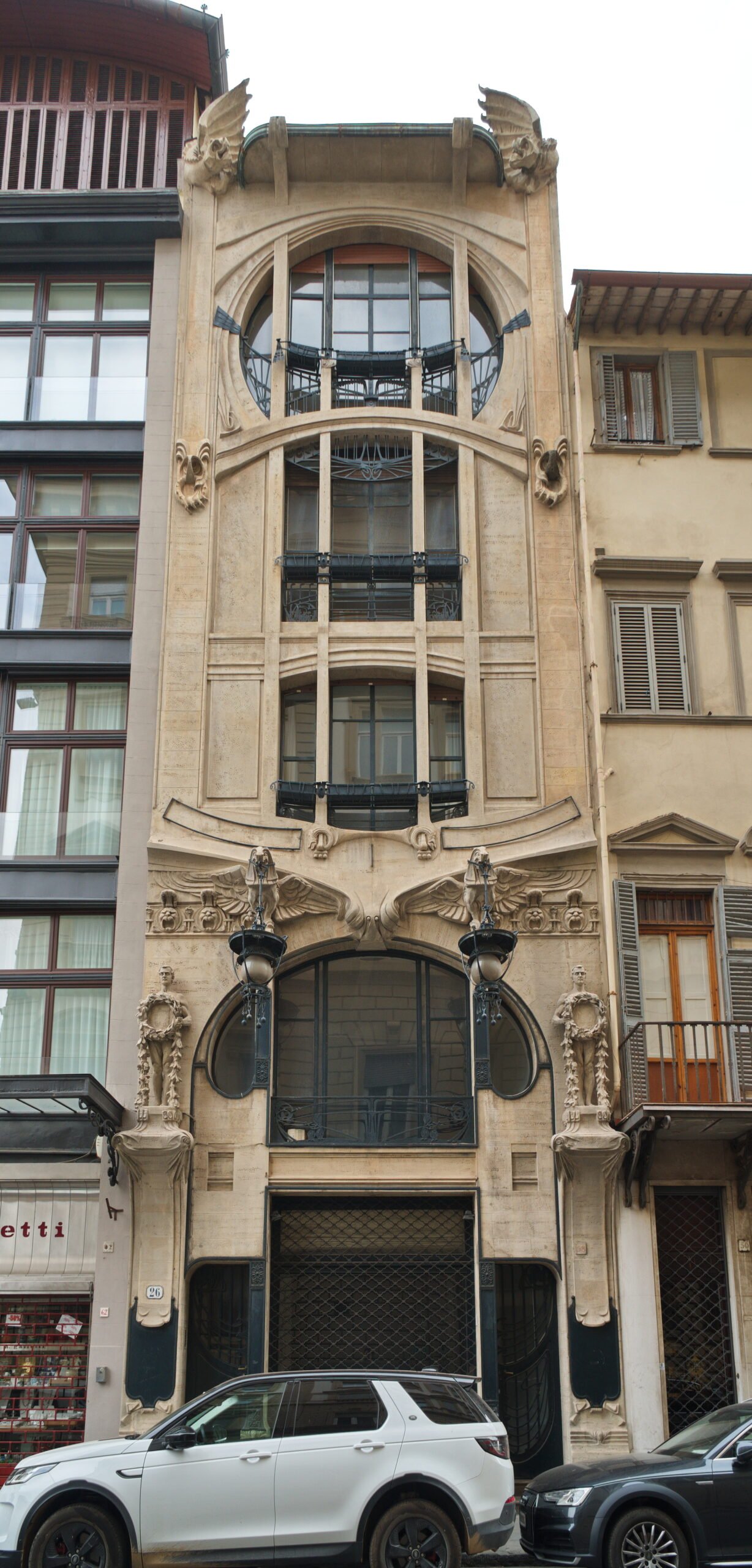
Giovanni Michelazzi’s most ambitious urban statement: a tall, narrow Liberty facade erupting with sculpted flora on a Renaissance street beside the Arno.
At a glance
Casa-Galleria Vichi stands at Borgo Ognissanti 26 in Florence, built c. 1910–1911 by architect Giovanni Michelazzi. Widely considered his masterpiece and one of Florence’s most celebrated Liberty buildings, it asserts an emphatically organic language on a street more accustomed to stone rustication and classical proportion. The tall, narrow facade is encrusted with carved stone reliefs and wrought-iron work in floral and vegetal motifs, making it one of the most striking Art Nouveau survivals in Tuscany.
Key facts
- Architect: Giovanni Michelazzi (Rome, 1879 – Fiesole, 1920)
- Built: c. 1910–1911
- Address: Borgo Ognissanti 26, Florence, Tuscany
- Style: Liberty (Italian Art Nouveau)
- Status: Privately owned; facade viewable from the street
- Significance: Michelazzi’s Liberty masterpiece — the peak of his architectural output
- Setting: Situated on Borgo Ognissanti at the corner facing the Arno river
History
Giovanni Michelazzi graduated in architecture from Florence in 1901 and spent the following decade producing a series of Liberty villas and villini in the city’s residential outskirts. By 1910 his formal vocabulary had matured: fluid lines, surfaces in constant motion, ornament that seemed to grow rather than be applied. Casa-Galleria Vichi, commissioned for a central Florentine address on Borgo Ognissanti, gave him his first major urban canvas and his most demanding brief.
Construction began in 1910 and the building was completed in 1911, the same year Michelazzi finished Villino Broggi-Caraceni on Via Scipione Ammirato — a remarkably productive moment in a career that would last less than two decades. Scholarly sources, including Luca Quattrocchi’s monograph Giovanni Michelazzi 1879–1920 (Franco Cosimo Panini, 1993), identify Casa-Galleria Vichi as his masterpiece, distinguished by its tall, narrow profile inserted into the dense historic fabric of the Oltrarno district.
Florence is overwhelmingly a Renaissance city. The Liberty movement, which flourished across northern Italy between roughly 1895 and 1915, left only a handful of traces here: a few villini in the suburbs, the occasional shop front, and this building. In Turin or Milan, an Art Nouveau facade competes with others; at Borgo Ognissanti 26 it competes with Brunelleschi and Alberti, and its survival into the twenty-first century is itself remarkable. Many of Michelazzi’s works were demolished during the anti-Liberty backlash of the 1950s and 1960s, when architectural taste swung violently against the style. Casa-Galleria Vichi endured, protected in part by its urban visibility and in part by scholarly interest that intensified from the 1960s onward.
Michelazzi died in Fiesole on the night of 21–22 August 1920, aged forty-one. He left behind a concentrated body of work in Florence that constitutes the most coherent Liberty legacy of any Tuscan architect. Casa-Galleria Vichi is the centrepiece of that legacy: the building that brought his exuberant ornamental instinct into the heart of the city.
What you see
The facade rises from a narrow street frontage in a vertical composition that reads almost as a tower. Stone carving covers the surface in dense, interlocking floral reliefs — petals, stems, and leaves spread across window surrounds and between floors with a disciplined restlessness. Wrought-iron work, characteristically Michelazzi in its weight and presence, frames the openings and spills down in decorative flourishes that soften the building’s hard limestone edges. The proportions are emphatically vertical, which allowed Michelazzi to achieve maximum ornamental impact on a site constrained by the medieval street grid.
Inside, the building functioned as both residence and gallery — the “Galleria” of its name — a combination typical of early-twentieth-century Florence, where ground-floor commercial spaces underpinned domestic investment. The facade facing the Arno gives the building a second, equally theatrical presence: seen from the river bank or the bridges, it reads as a polychrome interruption in the grey-stone rhythm of the Lungarno. Looking up at the carved stone at close range, the hand of a craftsman trained in the tradition of Viennese Sezession is unmistakeable — Michelazzi absorbed the publications of the Wagnerschule and translated them into a distinctly Florentine material language.
Practical information
- Access: Privately owned residential building; interior not open to the public
- Viewing: The facade is fully visible from the street and best appreciated on foot from across Borgo Ognissanti
- Nearest public transit: Bus lines C3 and 6 stop at Piazza Ognissanti (2-minute walk); Santa Maria Novella train station is 10 minutes on foot
- Recommended time: 10–15 minutes to view the exterior; combine with a walk along the Lungarno
Getting there
Casa-Galleria Vichi is at Borgo Ognissanti 26, in the Oltrarno quarter between Santa Maria Novella and the Arno. From Piazza Santa Maria Novella, follow Via della Vigna Nuova east and turn right onto Borgo Ognissanti; the building is on the left within two blocks. From the Ponte Vespucci or Ponte alla Carraia, it is visible from the riverbank. By bus: lines C3 and 6 serve Piazza Ognissanti directly. Street parking is limited in this central zone; the Santa Maria Novella area car parks are the nearest option.
Nearby
- Villino Broggi-Caraceni — Michelazzi’s contemporary Liberty villino (1910–11), Via Scipione Ammirato 99
- Villino Ravazzini — One of Michelazzi’s earlier Liberty works (1906–07), Via Scipione Ammirato 101
- Chiesa di Ognissanti — Botticelli’s church, 200 metres west along Borgo Ognissanti
- Ponte Vespucci and Ponte alla Carraia — both within walking distance, offering views back toward the building from the Arno
Sources
- Luca Quattrocchi, Giovanni Michelazzi 1879–1920, Franco Cosimo Panini, Modena, 1993 — primary scholarly monograph on the architect
- Carlo Cresti, Firenze 1896–1915: La Stagione del Liberty, Uniedit, Florence, 1978 — contextual study of Florentine Art Nouveau
- Rossanna Bossaglia, Liberty in Italia, Il Saggiatore, Milan, 1968 — national survey including Michelazzi’s Florentine works
- G. K. Koenig, “Note su Giovanni Michelazzi,” Ingegneri Architetti 6–7 (1961) — early scholarly reassessment of the architect’s significance
- Wikimedia Commons, File: Giovanni Michelazzi, Casa-Galleria Vichi, Florence, c. 1910–1911.jpg — photo by Armin Kleiner, CC BY-SA 4.0
Find it on the map
See this place and what’s around it →Record researched and written by Carla Szathvary for Cultural Heritage Online, 2026.

📷 Become a Cultural Heritage Online photographer
Share your photos of places: they stay published under your name as the author. The more they're seen, the more you get noticed — and soon a contest will reward the most appreciated photos.
Log in or sign up free to add a photoIs this page about you?
This page is read by travellers and heritage enthusiasts who find it on Google. Tell us how you are connected to this place and we will take it from there.