
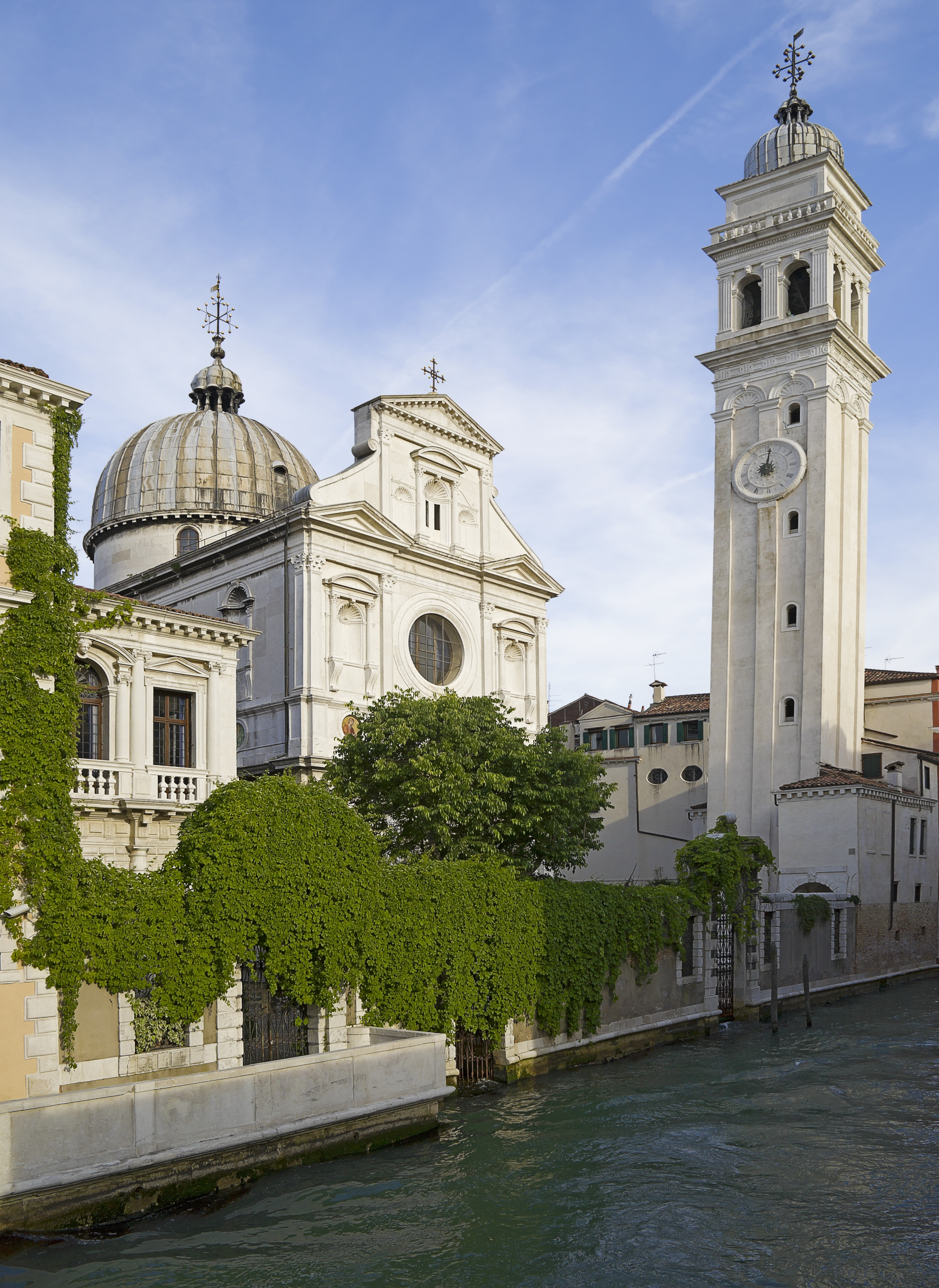
Church of San Giorgio dei Greci
The church of San Giorgio dei Greci is the principal Greek Orthodox church in Venice, built between 1539 and 1561 to serve the city’s large community of Greek immigrants and refugees. Together with the adjacent Scuola di San Nicolò and the Istituto Ellenico, it forms a remarkable enclave of Byzantine-rite Christianity in the heart of the Latin West, and houses a collection of Byzantine and post-Byzantine icons of outstanding quality.
At a glance
- Type
- Greek Orthodox church
- Period
- Construction 1539–1561; campanile completed 1603
- Style
- Venetian Renaissance with Byzantine liturgical interior
- Location
- Fondamenta dei Greci, Castello, Venice, Italy
- Coordinates
- 45.4354° N, 12.3426° E
Overview
San Giorgio dei Greci stands in the Castello sestiere as a testament to Venice’s long history as a refuge for Greeks fleeing Ottoman expansion, particularly after the fall of Constantinople in 1453. The church is the oldest Greek Orthodox church in Italy still in regular liturgical use and remains an active place of worship for Venice’s Orthodox community. It is also home to the Museum of Byzantine and Post-Byzantine Art (Museo dell’Istituto Ellenico), one of the finest collections of its kind in Western Europe.
History
The Greek community in Venice grew rapidly after the fall of Constantinople in 1453, and by the early 16th century numbered several thousand. In 1498 the community received permission from the Venetian Senate to build their own church. Construction of the current building began in 1539 under the architect Sante Lombardo, and the church was consecrated in 1561. The famous leaning campanile was added in 1603 and already showed its characteristic tilt early on. The adjacent Scuola di San Nicolò, built in 1678, houses the community’s confraternity and the museum.
What you see
The church interior is entirely Orthodox in character, with a gilded iconostasis separating the nave from the sanctuary — a feature rare among Venetian churches. The iconostasis, dating from the 17th century, is decorated with icons in the Byzantine tradition. The aisled basilica plan is topped by a dome, and the walls display a rich programme of icons and devotional paintings spanning the 16th to 18th centuries. Adjacent to the church, the museum holds portable icons, illuminated manuscripts, vestments, and liturgical objects collected by the Greek community over five centuries.
Cultural significance
San Giorgio dei Greci is an irreplaceable document of the Greek diaspora in Renaissance Venice and of the artistic tradition of the post-Byzantine icon painters known as the Madonneri, who worked in Venice and blended Orthodox iconographic conventions with Western Renaissance technique. The church and its museum preserve a cultural identity that survived centuries of displacement and remain a living bridge between Eastern and Western Christian heritage.
Practical information
- Address
- Fondamenta dei Greci 3412, 30122 Venezia VE, Italy
- Museum hours
- Check the Istituto Ellenico di Studi Bizantini e Postbizantini website for current opening hours
- Admission
- The church may be visited when not in liturgical use; museum has a small admission fee
Getting there
Take Vaporetto line 1 or 2 to the San Zaccaria stop; from there walk east along the Riva degli Schiavoni for about 5 minutes and turn into the Fondamenta dei Greci. The church is also within a 10-minute walk from the Arsenale vaporetto stop (line 4.1/4.2). Venice is pedestrian only; no car access.