

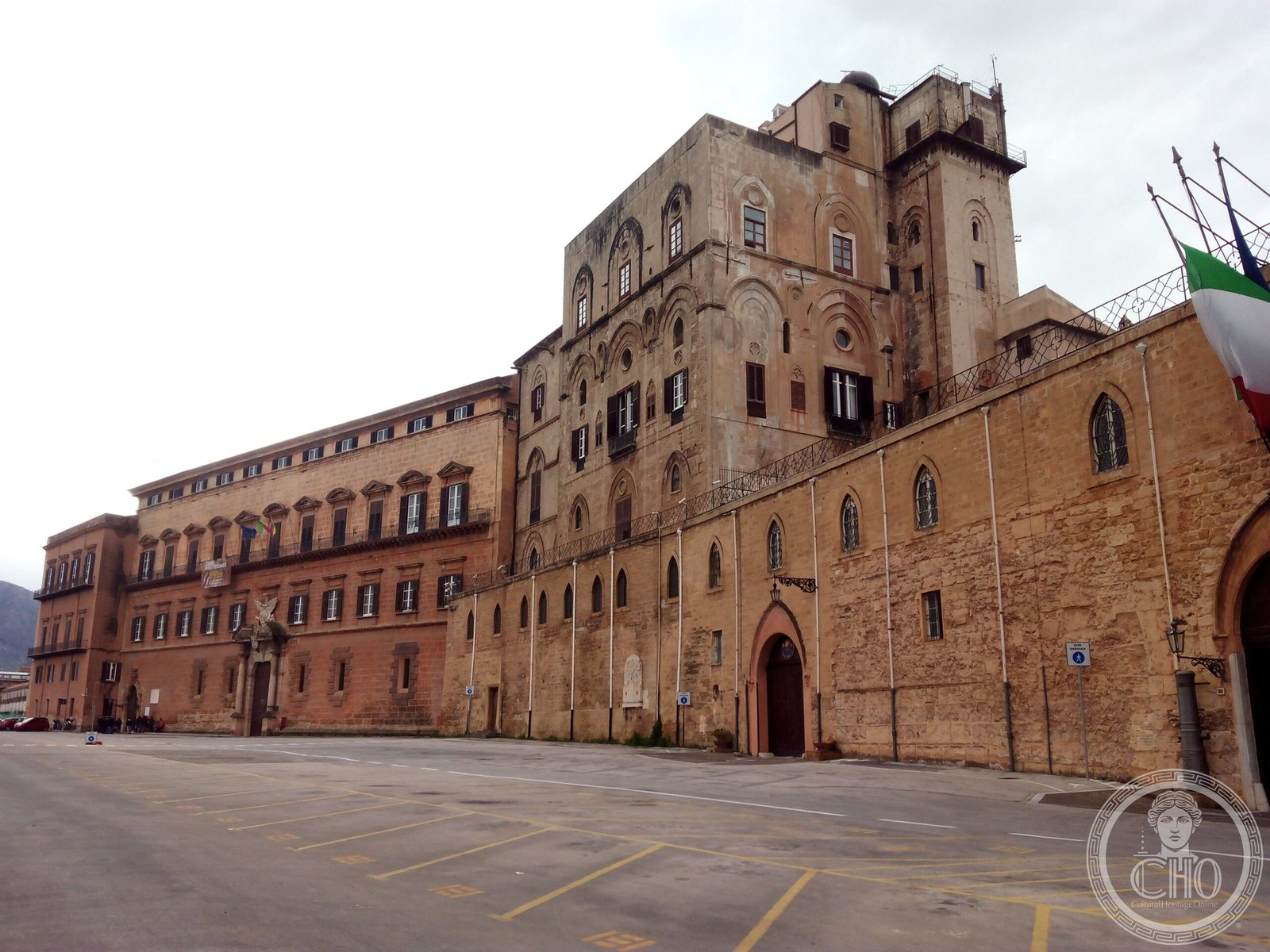
The Palermo Astronomical Observatory (Osservatorio Astronomico di Palermo “Giuseppe S. Vaiana”) is one of the oldest astronomical institutions in Italy, founded in 1790 on the hill of the Norman Palace in central Palermo. It is named in honour of Giuseppe S. Vaiana, the Italian astrophysicist who directed it in the late 20th century, and today forms part of the National Institute for Astrophysics (INAF). The observatory is celebrated in the history of science for Giusepppe Piazzi’s discovery of Ceres — the first known asteroid — on 1 January 1801.
At a glance
- Type
- Astronomical observatory and scientific institute
- Period
- Founded 1790; current building completed 1792
- Style
- Neoclassical observatory architecture
- Location
- Monte Pellegrino hill above the Norman Palace, Palermo, Sicily, Italy
Overview
The Palermo Astronomical Observatory occupies a prominent hilltop position above the historic Norman Palace (Palazzo dei Normanni) in the heart of Palermo, offering an elevated vantage point that was ideal for optical astronomical observation in the pre-electric era. Founded under King Ferdinand III of Sicily, it became one of the foremost observatories in Europe during the 19th century, particularly under the directorship of Giuseppe Piazzi (1787–1817). Today INAF–Osservatorio Astronomico di Palermo “Giuseppe S. Vaiana” continues active research in solar physics, stellar astrophysics and X-ray astronomy, maintaining both research and public outreach functions.
History
The observatory was established in 1790 at the behest of the Bourbon court of the Kingdom of Sicily, with the astronomer Giuseppe Piazzi appointed its first director. On 1 January 1801 Piazzi made his most famous observation from the Palermo dome: the discovery of Ceres, initially classified as a new planet and later recognised as the first of the asteroid belt’s minor planets — a discovery that fundamentally changed understanding of the solar system. Piazzi also produced the Palermo Catalogue of 7,646 stars (1814), a landmark work of positional astronomy. In the 20th century the observatory expanded its research to X-ray astrophysics under Giuseppe Salvatore Vaiana, after whom it is now named, and it was integrated into INAF (the Italian National Institute for Astrophysics) in 2002.
What you see
The observatory complex includes a neoclassical main building with a characteristic cylindrical dome housing the historic Ramsden altazimuth circle used by Piazzi, several ancillary domes with refractors and spectrographs added in the 19th and early 20th centuries, and a small museum that preserves original instruments and historical archives. The tower of the main telescope dome rises above the Norman Palace hill, visible from much of the lower city. The surrounding garden offers views over Palermo’s rooftops to the sea. A library holds one of the most important collections of astronomical manuscripts and printed works in southern Italy.
Cultural significance
The Palermo Astronomical Observatory holds a unique place in the history of science as the site of the discovery of Ceres, the largest object in the asteroid belt, a discovery that opened the era of minor-planet astronomy and prompted the redefinition of the solar system’s structure. Its combination of scientific heritage, neoclassical architecture and commanding position above one of Sicily’s most historically layered urban sites makes it an outstanding landmark of European scientific culture.
Practical information
- Address
- Piazza del Parlamento 1 (Norman Palace hill), 90134 Palermo PA, Italy
- Coordinates
- 38.1120° N, 13.3534° E
- Website
- www.astropa.inaf.it
- Visits
- Public visits and school programmes available; check the official INAF website for guided tour schedules and booking
Getting there
The Norman Palace (Palazzo dei Normanni) hill is in the western historic centre of Palermo, approximately 1.5 km from Palermo Centrale railway station. City bus routes (AMG Palermo) stop at Piazza del Parlamento and Via Vittorio Emanuele. On foot, walk west along Corso Vittorio Emanuele from the historic centre. By car, limited access to the ZTL historic centre applies; use peripheral car parks and continue on foot or by bus.
Sources & resources
Find it on the map
See this place and what’s around it →📷 Become a Cultural Heritage Online photographer
Share your photos of places: they stay published under your name as the author. The more they're seen, the more you get noticed — and soon a contest will reward the most appreciated photos.
Log in or sign up free to add a photoIs this page about you?
This page is read by travellers and heritage enthusiasts who find it on Google. Tell us how you are connected to this place and we will take it from there.