
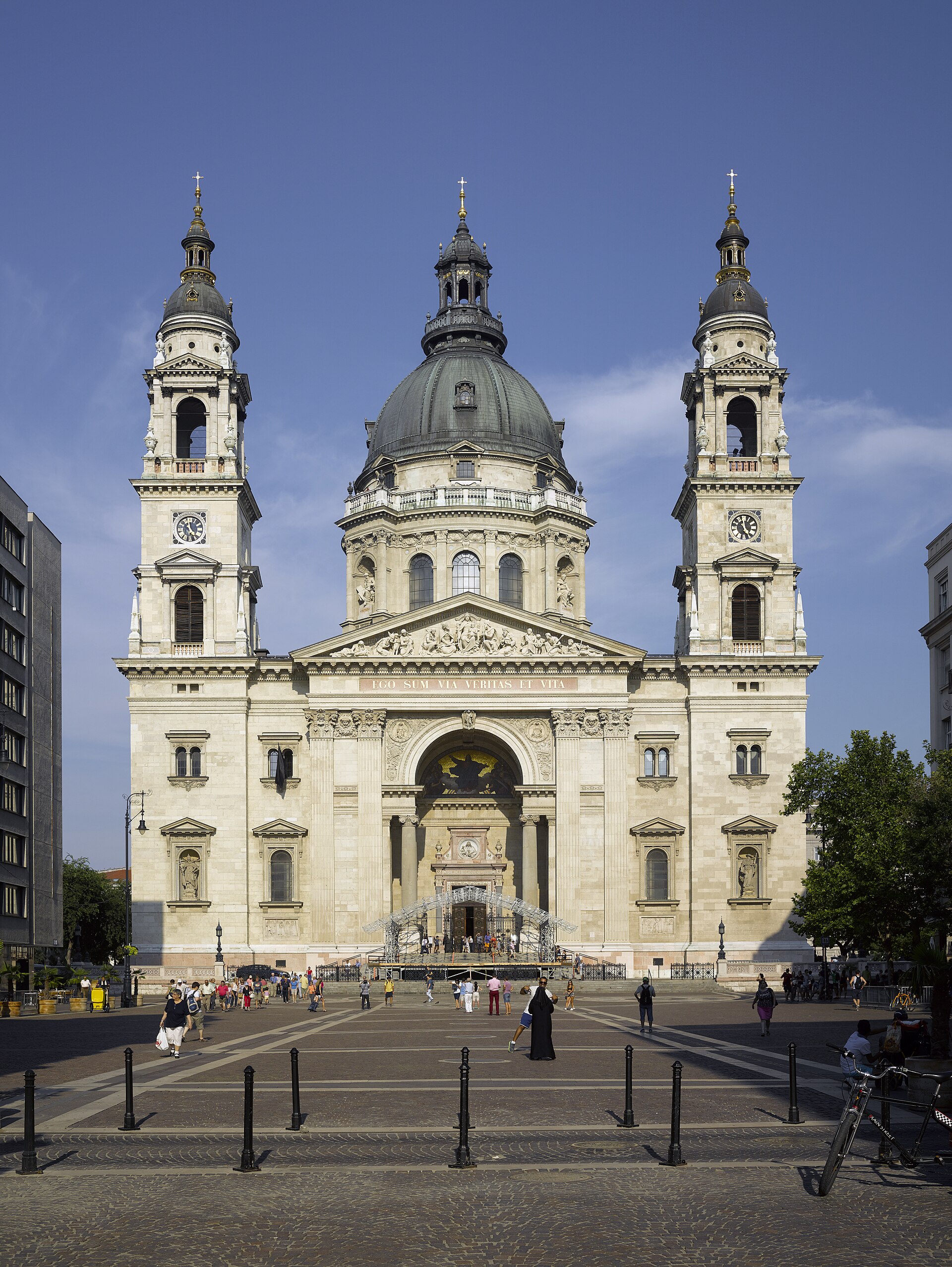
St. Stephen’s Basilica is a Roman Catholic basilica in the heart of Budapest, Hungary, named in honour of Stephen I, the first King of Hungary and the country’s founding patron saint, whose mummified right hand — the Holy Dexter — is preserved in a reliquary within the church. The largest church in Budapest and one of the tallest buildings in the city at 96 metres, matching the height of the Hungarian Parliament to underscore constitutional equality, the basilica was built between 1851 and 1905 in a Neoclassical and Renaissance Revival style to designs by three successive architects.
At a glance
- Type
- Roman Catholic minor basilica; Budapest’s largest church
- Period
- Construction 1851–1905; consecrated 1905
- Style
- Neoclassical / Renaissance Revival
- Location
- Szent István tér 1, District V (Lipótváros), Budapest, Hungary
- Coordinates
- 47.5008° N, 19.0540° E
Overview
St. Stephen’s Basilica dominates the Lipótváros (Leopold Town) quarter of inner Budapest and serves as the seat of the Archbishop of Esztergom-Budapest. Its 96-metre height was deliberately set to equal that of the Hungarian Parliament Building across the Danube, a symbolic statement that the church and state stand as equals in the Hungarian constitutional order. The basilica attracts approximately one million visitors annually, making it one of the most visited religious buildings in Hungary.
History
Construction began in 1851 under the direction of architect József Hild, who adopted a Neoclassical plan with a central dome. After Hild’s death in 1867, Miklós Ybl took over and substantially revised the design toward a Renaissance Revival aesthetic, adding the twin bell towers. A dramatic setback occurred in 1868 when the partially built dome collapsed, requiring demolition and reconstruction of the drum and vault. Following Ybl’s death in 1891, József Kauser completed the project; the basilica was finally consecrated by Emperor Franz Joseph I on 9 November 1905, fifty-four years after the foundation stone was laid.
What you see
The facade presents a colonnaded portico beneath twin towers crowned with onion-shaped cupolas; the central dome rises 96 metres and can be climbed for panoramic views over both Buda and Pest. Inside, the nave is decorated with coloured marble, mosaics, and gilded ornament; the main apse contains a large mosaic of St. Stephen presenting his crown to the Virgin Mary. The most venerated object is the Holy Dexter, the mummified right hand of King Stephen I, displayed in a jewelled reliquary in the dedicated Holy Right Chapel and carried in procession through the city each 20 August, Hungary’s national day.
Cultural significance
As the home of the Holy Dexter — Hungary’s most sacred relic — St. Stephen’s Basilica occupies a unique position at the intersection of religious devotion and national identity. The deliberate height equivalence with Parliament encodes a constitutional philosophy into urban form, a gesture that has made the building a recurring reference in discussions of the relationship between church and state in modern Hungarian history. The basilica’s central location and architectural grandeur have also established it as the de facto symbol of Catholic Budapest in international cultural memory.
Practical information
- Address
- Szent István tér 1, Budapest 1051, Hungary
- Opening hours
- Open daily; dome access seasonal — check official website for current hours
- Admission
- Church entry free (donation requested); dome and treasury fee — check official website
- Website
- bazilika.biz
Getting there
The basilica is a 5-minute walk from Deák Ferenc tér, served by Metro lines M1, M2, and M3 — the major interchange of Budapest’s subway network. From Bajcsy-Zsilinszky út (Metro M3) the walk takes under 3 minutes. Tram line 2 stops at the Danube embankment, roughly 10 minutes on foot. The square in front of the basilica is a pedestrian zone.
Sources & resources
- Wikipedia — St. Stephen’s Basilica: en.wikipedia.org/wiki/St._Stephen%27s_Basilica
- Official website: bazilika.biz
- Cultural Heritage Online: culturalheritageonline.com
See the place
Find it on the map
See this place and what’s around it →📷 Become a Cultural Heritage Online photographer
Share your photos of places: they stay published under your name as the author. The more they're seen, the more you get noticed — and soon a contest will reward the most appreciated photos.
Log in or sign up free to add a photoIs this page about you?
This page is read by travellers and heritage enthusiasts who find it on Google. Tell us how you are connected to this place and we will take it from there.