

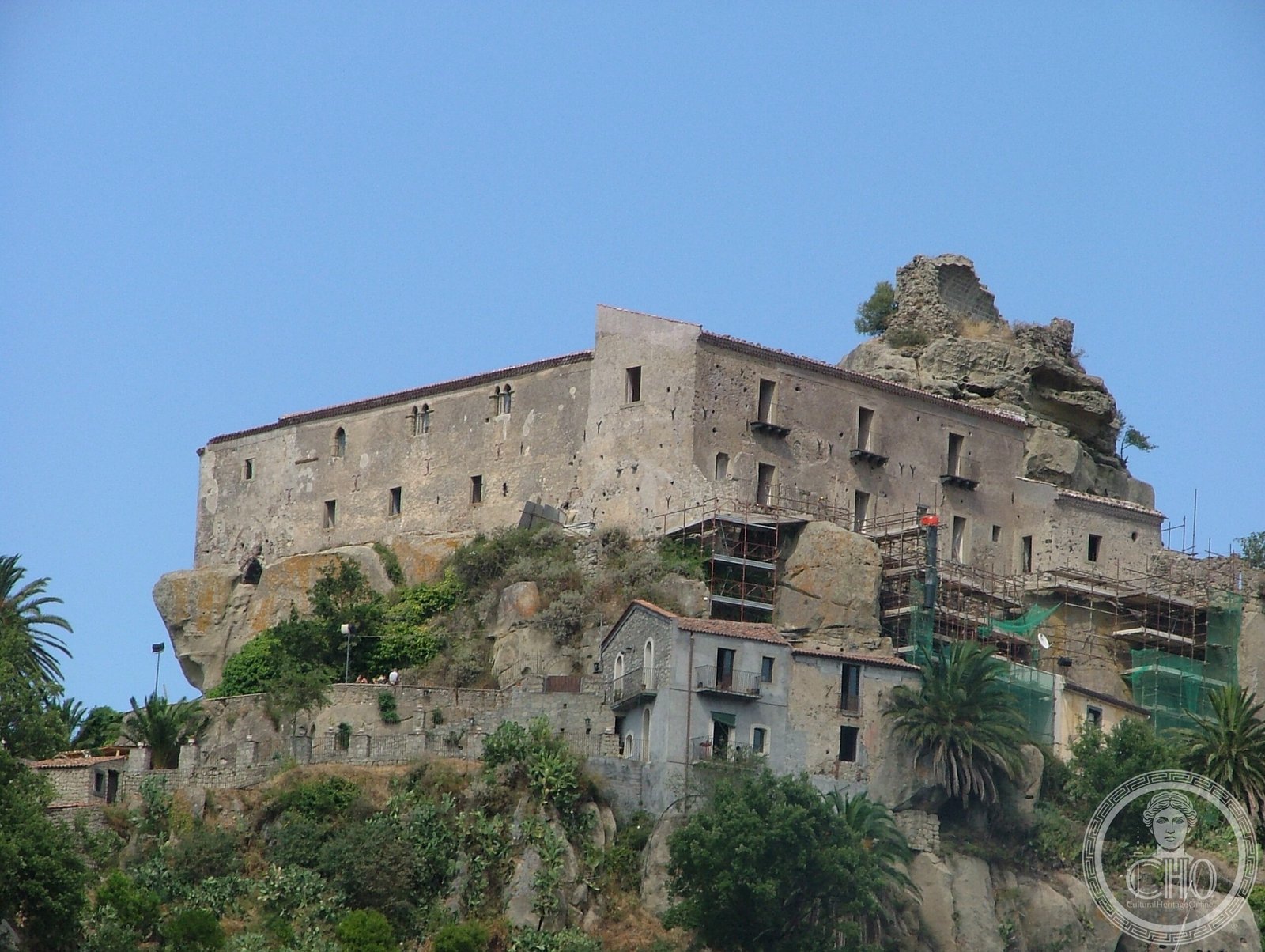
The castle that gave Castiglione di Sicilia its name, on the Alcantara valley under Etna: a Norman-Swabian core with underground passages to the Castelluccio and prison cells a metre high.
At a glance
- Type
- Castle
- Where
- Castiglione di Sicilia, Province of Catania, Sicily, Italy
- Coordinates
- 37.8839569° N, 15.1187277° E
- Core
- Probably Norman-Swabian, from the paired windows of the west side
- Town’s arms
- A castle and two couchant lions
Overview
The castle stands at Castiglione di Sicilia, in the Province of Catania, in the Alcantara valley on the northern side of Etna. Its role in the life of the town was important enough that the town takes its name from it.
Castiglione is called Quastallum by Edrisi in the twelfth century, Castillo in a diploma of Roger II and Castillio in one of Pope Eugene III. The present name means «great castle»: to the medieval Latin castellum was added the augmentative suffix -ione, giving Castellione, which the Aragonese and then the Spanish pronounced Casteglione. It was soon read instead as Castello del Leone, the castle of the lion, to give the town a mark of royalty — and it is from that reading that the arms come: a castle and two couchant lions.
History
There is no certain notice of the castle’s origin, but the two paired windows on the west side suggest that the main core was most probably built in the Norman-Swabian period.
In the Middle Ages the castle was linked to the stronghold of the Castelluccio and to an outpost identifiable with the church of San Pietro, connected to them by underground passages that are said to have reached as far as the Cannizzo. Together they formed a true architectural and defensive complex, and an old sixteenth-century coat of arms of the town, with three towers, shows how much it mattered.
What you see
The quarters of the castle had different uses. There was the noble part reserved to the castellan; the stables, haylofts and byres, and the lodgings of the servants and of those who kept the place up.
There were the prisons, whose cramped cells — called dammusi, no more than two metres long and barely a metre high — held political opponents and hardened criminals; the cisterns for rainwater, used in a siege to hide victuals and valuables; and the round stone shot, ready to be thrown at attackers.
In the highest part is a wide room called the Solecchia, commonly held to have been the mint where coins were struck, though it may have been the place where the feudal lord sheltered from the sun with almost the whole of his vast fief in view.
Practical information
- Address: Via Edoardo Pantano 46, 95012 Castiglione di Sicilia (CT), Sicily.
- Castiglione is one of the towns of the Alcantara valley, under the northern slope of Etna.
Sources
- Cultural Heritage Online historical archive — original Italian entry (beniculturalionline.it), transposed and corrected 2026.
Find it on the map
See this place and what’s around it →📷 Become a Cultural Heritage Online photographer
Share your photos of places: they stay published under your name as the author. The more they're seen, the more you get noticed — and soon a contest will reward the most appreciated photos.
Log in or sign up free to add a photo