
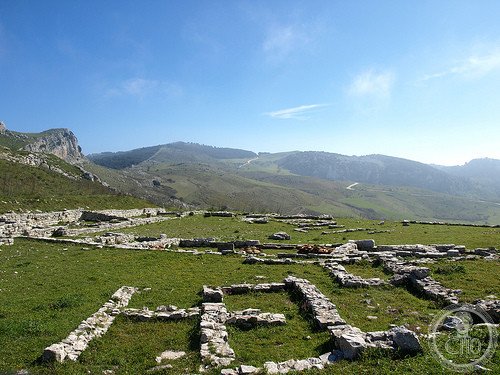
Monte Adranone is a mountain rising 900 metres above sea level in the comune of Sambuca di Sicilia, Province of Agrigento, western Sicily. On its summit and slopes lie the remains of an ancient city inhabited by indigenous Sicanian and later Greek populations between the sixth and third centuries BC. The site is recognised as an archaeological zone of regional importance for its evidence of pre-Greek indigenous culture and of subsequent Hellenisation in the Sicanian interior.
At a glance
- Type
- Ancient indigenous and Greek hilltop settlement — archaeological zone
- Period
- Inhabited c. 6th–3rd century BC; destroyed and abandoned after the First Punic War
- Style
- Sicanian indigenous architecture; Hellenistic urban elements
- Location
- Sambuca di Sicilia, Province of Agrigento, Sicily, Italy
- Coordinates
- 37.6814° N, 13.1393° E
Overview
Monte Adranone represents one of the best-preserved examples of a pre-Greek Sicanian settlement that was progressively influenced by — and eventually assimilated into — Greek colonial culture during the archaic and classical periods. The site’s elevated position, commanding views over the Belice valley and towards the sea, explains its strategic importance across centuries of occupation. Archaeological work, carried out by the Soprintendenza di Agrigento, has yielded finds now displayed in the regional museum at Agrigento.
History
The mountain’s occupation begins in the sixth century BC, when indigenous Sicanian communities built the earliest structures on the summit. Contact with Greek colonies — particularly the nearby city of Selinus (Selinunte) — brought Hellenistic architectural and material culture to the site during the fifth century BC, reflected in ashlar masonry, ceramic imports, and votive deposits of Greek type. The city was violently destroyed in the late third century BC, most probably during the Roman campaigns of the First Punic War (264–241 BC), and never rebuilt. The abrupt abandonment preserved stratigraphic contexts of exceptional archaeological integrity.
What you see
Excavations have uncovered a necropolis, residential quarters with identifiable room functions, a sanctuary area with votive deposit pits, and stretches of the city wall. The necropolis is particularly informative, with chamber tombs yielding grave goods that document the transition from indigenous Sicanian burial customs to Hellenistic practice over successive generations. The remote hilltop setting means visitor numbers are low and the site retains an undisturbed quality; finds are housed at the Regional Archaeological Museum “Pietro Griffo” in Agrigento.
Cultural significance
Monte Adranone is important precisely because it is not a Greek colonial foundation but an indigenous Sicanian community that engaged with and adapted Greek culture on its own terms. This makes it a counterpoint to the better-known coastal Greek sites of Sicily and a key reference for understanding the island’s complex pre-Roman ethnic and cultural geography.
Practical information
- Address
- Contrada Monte Adranone, Sambuca di Sicilia, 92017 Agrigento AG
- Hours
- Check official website or contact Parco Archeologico di Agrigento
- Admission
- Check official website for current access and ticket information
Getting there
Sambuca di Sicilia is reached by road from Agrigento via the SS188 (approximately 50 km). There is no direct railway service to Sambuca; the nearest stations are Agrigento Centrale and Sciacca (seasonal services). The nearest major airports are Palermo Falcone-Borsellino (PMO), about 90 km north, and Trapani Birgi (TPS), approximately 80 km north-west. A local road leads from Sambuca towards the Monte Adranone archaeological site; access conditions should be confirmed before visiting.
Sources & resources
Find it on the map
See this place and what’s around it →📷 Become a Cultural Heritage Online photographer
Share your photos of places: they stay published under your name as the author. The more they're seen, the more you get noticed — and soon a contest will reward the most appreciated photos.
Log in or sign up free to add a photo