
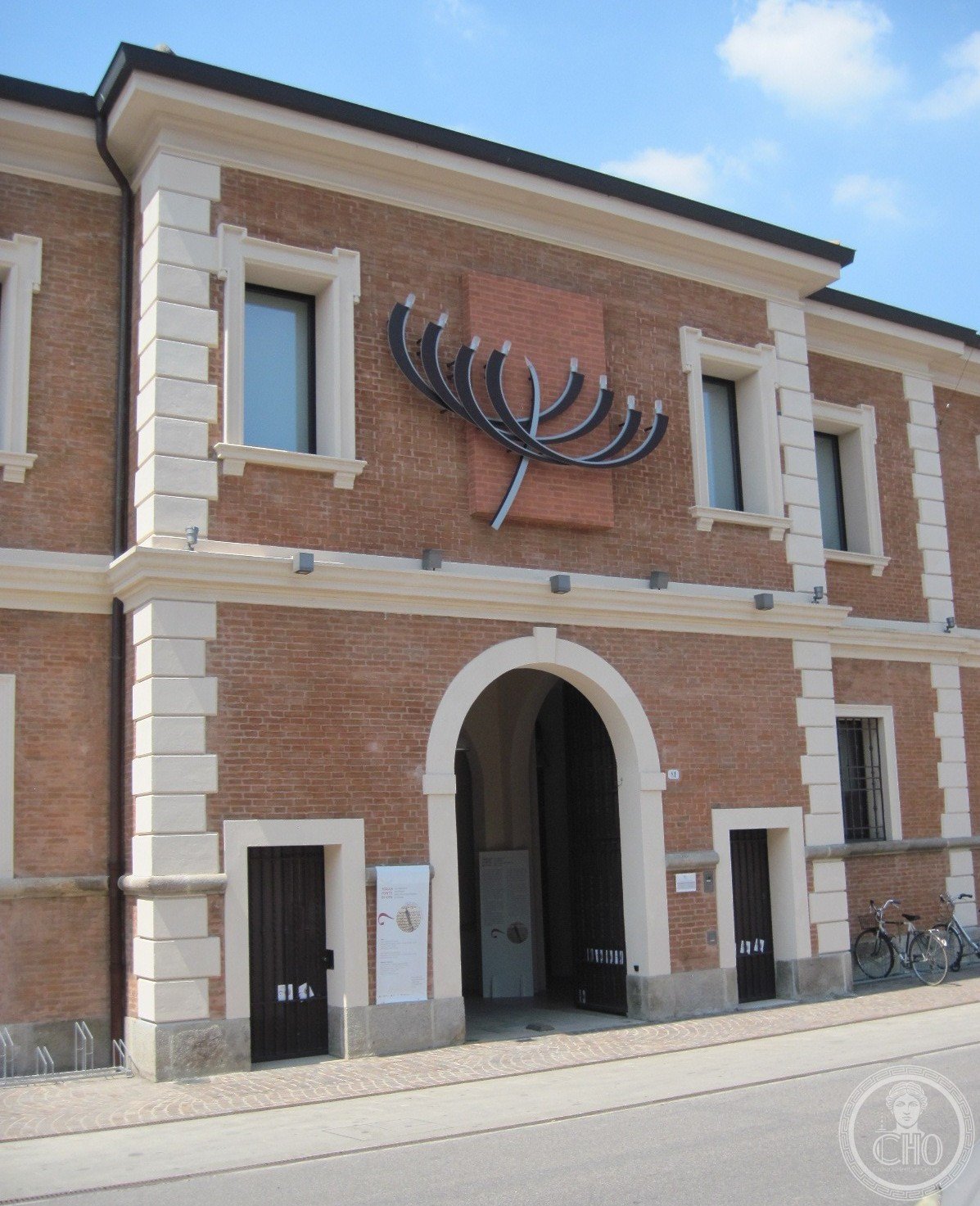
The National Museum of Italian Judaism and the Shoah — known by its Italian acronym MEIS — is the only Italian national museum dedicated to the history, culture, and memory of Italy’s Jewish communities and to the Holocaust on Italian soil. Located in Ferrara, within the partially restored former Jewish prison quarter, MEIS opened in its definitive form in 2017 and uses thematic, chronologically ordered exhibitions to trace two thousand years of Jewish presence in Italy, from the Roman Empire to the present day.
At a glance
- Type
- National museum of history and memory
- Period
- Former prison complex; museum inaugurated 2017, ongoing expansion
- Style
- Adaptive reuse of 19th-century prison buildings; contemporary museum design
- Location
- Via Piangipane 81, 44121 Ferrara, Emilia-Romagna, Italy
Overview
MEIS occupies a historic prison complex on Via Piangipane in Ferrara, a city with one of Italy’s oldest and most significant Jewish communities — a community that shaped the Este court culture of the Renaissance and survived into the modern era. The museum presents the story of Italian Jews not as a marginal footnote but as an integral thread of Italian civilisation, covering religious life, intellectual contribution, persecution, and renewal across two millennia. Its permanent and temporary exhibitions draw on documents, objects, art, and testimony to speak to both specialist and general audiences.
History
Ferrara’s Jewish community dates to at least the 13th century and flourished under the patronage of the Este dynasty, which offered relative tolerance at a time of widespread European persecution. The city’s former ghetto, established in 1627 and dissolved after Unification in 1859, left a dense legacy in the urban fabric. The MEIS project was established by Italian parliamentary law in 2003 and took shape gradually in a converted 19th-century prison, with the first sections opening in 2017 and further gallery spaces inaugurated in subsequent years. The museum is a national institution under the Italian Ministry of Culture.
What you see
The museum’s permanent exhibition is structured chronologically, beginning with the Jewish arrival in Rome in antiquity and moving through medieval life, the Renaissance ghetto experience, Emancipation, Fascism, and the Shoah, before addressing post-war reconstruction and the contemporary Italian Jewish community. Gallery spaces balance documentary material — manuscripts, photographs, archival records — with reconstructed environments and contemporary artistic responses. The architecture itself, with its repurposed prison cells and courtyards, layers historical meaning onto every room. Temporary exhibitions address themes of memory, identity, and intercultural dialogue.
Cultural significance
MEIS is the central institution for the preservation and communication of Italian Jewish heritage at a national level, making it an essential destination for anyone engaging seriously with Italian history, the history of religious minorities, or the memory of the Holocaust. Ferrara itself was inscribed on the UNESCO World Heritage List in 1995 as a Renaissance city of exceptional urban integrity, adding further significance to the museum’s setting. The institution actively collaborates with schools, universities, and international Jewish memory networks.
Practical information
- Address
- Via Piangipane 81, 44121 Ferrara FE
- Coordinates
- 44.8352° N, 11.6132° E
- Hours
- Check the official website for current opening times and temporary exhibition schedules
- Admission
- Ticketed; reduced rates for students, under-18, and groups. Check official website for current pricing.
- Website
- meisweb.it
Getting there
Ferrara is on the Bologna–Venice railway line, with frequent direct trains from Bologna (25 minutes) and Padova. From Ferrara railway station, the museum is reachable on foot in approximately 20 minutes or by bus. By car, Ferrara is served by the A13 motorway. The museum has no dedicated parking but the city centre has several public car parks nearby.
Sources & resources
- MEIS official website
- Wikipedia — National Museum of Italian Judaism and the Shoah
- Cultural Heritage Online — Emilia-Romagna
See the place
Find it on the map
See this place and what’s around it →📷 Become a Cultural Heritage Online photographer
Share your photos of places: they stay published under your name as the author. The more they're seen, the more you get noticed — and soon a contest will reward the most appreciated photos.
Log in or sign up free to add a photoIs this page about you?
This page is read by travellers and heritage enthusiasts who find it on Google. Tell us how you are connected to this place and we will take it from there.