
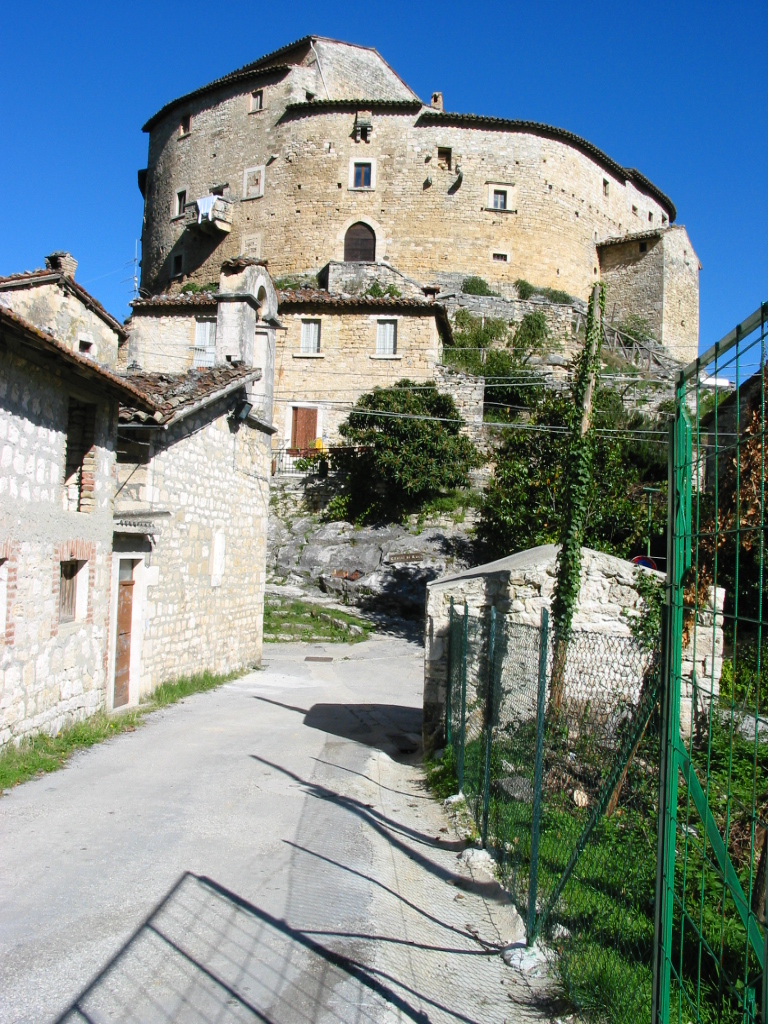
Castel di Luco is a medieval fortress perched on an isolated volcanic plug above the Tronto river valley near Acquasanta Terme in the province of Ascoli Piceno, on the border between Abruzzo and the Marche. Built on a distinctive basalt monolith that rises dramatically from the valley floor, the castle commands panoramic views of the surrounding Apennine terrain and served for centuries as a strategic stronghold controlling the ancient route between the Adriatic coast and the interior mountains. Its striking natural pedestal, combined with well-preserved medieval masonry, makes Castel di Luco one of the most scenically memorable fortifications in central Italy.
At a glance
- Type
- Medieval hilltop castle on volcanic plug
- Period
- 11th–13th century; later modifications
- Style
- Romanesque military architecture
- Location
- Acquasanta Terme, Ascoli Piceno, Abruzzo/Marche border, Italy
- Coordinates
- 42.7782° N, 13.4252° E
Overview
Castel di Luco rises from a basalt volcanic plug above the Tronto river, a geological oddity that made the site both naturally defensible and visually spectacular. The castle occupies virtually the entire summit of the rock, its walls following the irregular outline of the plug itself. The valley below was a key corridor connecting the Adriatic with the trans-Apennine interior, and whoever held Castel di Luco exercised significant control over medieval trade and military movements.
History
The site’s defensive advantages were recognised in antiquity, but the castle as it stands dates primarily from the eleventh and twelfth centuries, when local lords fortified the rock to assert control over the Tronto valley. The structure passed through the hands of various feudal dynasties across the medieval period, and was contested during the struggles between the papacy and the Holy Roman Empire that periodically convulsed central Italy. Partial restorations have been undertaken in modern times to consolidate the surviving masonry.
What you see
Approaching from Acquasanta Terme, the basalt plug appears as an almost vertical dark column topped by the compact profile of the castle walls and tower. The ascent to the summit reveals thick curtain walls built directly onto the rock face, with minimal external ornament typical of military Romanesque construction. From the top, the view encompasses the deep Tronto gorge, the thermal springs at Acquasanta, and successive ridges of the central Apennines stretching toward Gran Sasso.
Cultural significance
Castel di Luco is valued both as a military heritage site and as an outstanding example of Italian landscape architecture in its broadest sense — a human construction so integrated with its geological setting that the two appear inseparable. The castle has drawn travellers since the Grand Tour era and continues to attract photographers, hikers, and heritage enthusiasts exploring the lesser-known Apennine interior.
Practical information
The castle is located near Acquasanta Terme, in the municipality of Ascoli Piceno. Access involves a footpath from the valley road. Check with the local comune or tourist office in Acquasanta Terme for current visiting conditions and any seasonal restrictions on access to the summit.
Getting there
Acquasanta Terme is served by the SS4 Via Salaria, the ancient Roman road connecting Rome with the Adriatic coast. From Ascoli Piceno (approximately 23 km), take the SS4 south toward Arquata del Tronto and follow signs for Acquasanta Terme. Public transport options are limited; a car or bicycle is recommended for visiting the Tronto valley.
Sources & resources
See the place
Find it on the map
See this place and what’s around it →📷 Become a Cultural Heritage Online photographer
Share your photos of places: they stay published under your name as the author. The more they're seen, the more you get noticed — and soon a contest will reward the most appreciated photos.
Log in or sign up free to add a photo