
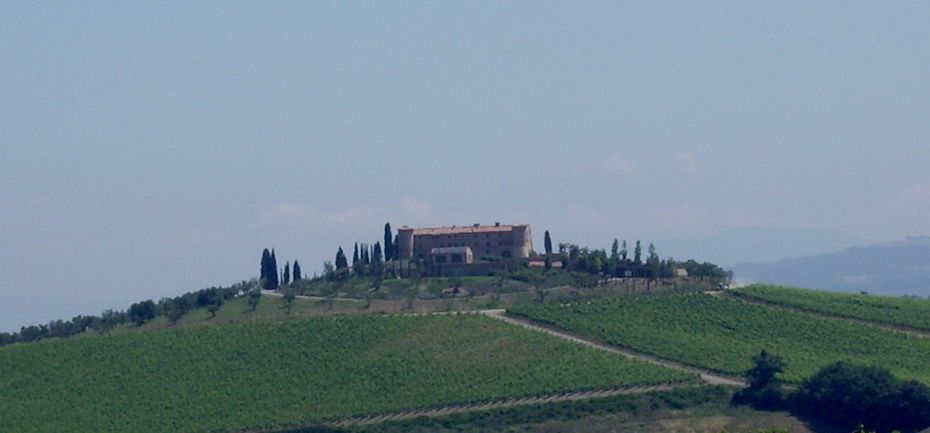
Colle Massari Castle
A fortified medieval castle transformed into a convent, then into a distinctive farm, Colle Massari stands on a hilltop near Cinigiano with corner towers and a seventeenth-century chapel.
At a glance
Colle Massari Castle rises on the crest of a hill southeast of Poggi del Sasso in Grosseto province. The complex comprises three stone buildings arranged around a central quadrangular courtyard, entered through an arched gateway in the curtain wall. Four corner towers—two well preserved, two altered—once served defensive and sighting functions. Today it operates as a working farm and winery.
History
Built as a castle in medieval times, Colle Massari was originally controlled by the abbey of San Galgano near Siena, which simultaneously held the nearby castle of Sabatina. The structure later became a convent, developing around an ancient parish church dedicated to Sant’Ippolito in Martura that remained active through the fourteenth century.
In the late seventeenth century, the Patrizi marquises acquired the property and undertook substantial renovation. They transformed the religious complex into a fortified farm, reshaping its character to serve agricultural purposes while retaining its defensive architecture. The chapel of Santa Marta was constructed during this period, replacing the vanished parish church.
What you see
The castle presents the appearance of a fortified rural structure, its present form largely defined by seventeenth-century restoration work. Three connected buildings enclose a quadrangular courtyard accessed via a characteristic arched doorway. A curtain wall closes the courtyard’s fourth side where no buildings stand.
Four corner towers punctuate the complex. Two remain substantially intact; the others show significant alteration. The southeastern tower collapsed during the nineteenth century following a landslide, leaving only traces of its foundations. The chapel of Santa Marta, a seventeenth-century addition, functions as the noble chapel within the castle walls.
Cultural significance
Colle Massari exemplifies the adaptive reuse common in rural Tuscany, where medieval defensive structures evolved into agricultural and monastic centers. Its progression from abbey possession through convent use to fortified farm reflects broader patterns of land control and resource management in medieval and early modern Toscana. The survival of corner towers and courtyard layout preserves the spatial logic of medieval fortification adapted to peaceful rural life.
Key facts
- Address: Localita, 58044 Cinigiano (Grosseto)
- Coordinates: 42.88764258600391, 11.328497529029846
- Phone: 0564 990496
- Website: https://www.collemassariwines.it
Practical information
Colle Massari Castle currently operates as a private farm and winery. Visit details and access policies are available through the official website and phone number listed above.
Getting there
The castle sits on a hilltop southeast of the hamlet Poggi del Sasso in the municipality of Cinigiano, in Grosseto province, southern Toscana. GPS coordinates and the winery website provide navigation details. Contact the property directly for visiting arrangements.
Sources & resources
Find it on the map
📷 Diventa un fotografo di Cultural Heritage Online
Condividi le tue foto dei luoghi: restano pubblicate con la tua firma come autore. Più vengono viste, più ti fai conoscere — e presto un concorso premierà le foto più apprezzate.
Accedi o registrati gratis per aggiungere una foto